




- Google Fitbit Air Spotted on Flipkart at Rs 13,999 Ahead of India Launch: All Details
- Alia Bhatt Looks Stunning In Love & War First-Look Poster
- Natural farming doubles turmeric output in Gujarat trial, finds study
- Apple Rumoured to Launch Three Devices Soon: MacBook Pro and More
- India’s LPG Customer Base Falls By 6.2 Million As Supply Disruptions Hit Imports
- Nani Reacts To The Paradise Trolls: Learnt From The Flaws
- 'Made in UP' BrahMos missiles giving Pakistan sleepless nights: HM Amit Shah
- “Make in India” Turns 12: Vaishnaw Says Smartphone Manufacturing Booms
Prime Minister Represents the Nation, Chief Minister the State, Farmer the Entire World: DK Shivakumar
In Short
He was speaking after inaugurating the Vijay Karnataka Super Star Farmer Awards ceremony at Ravindra Kalakshetra in Bengaluru. Shivakumar urged farmers not to lose confidence and praised their resilience in difficult circumstances.
Share :
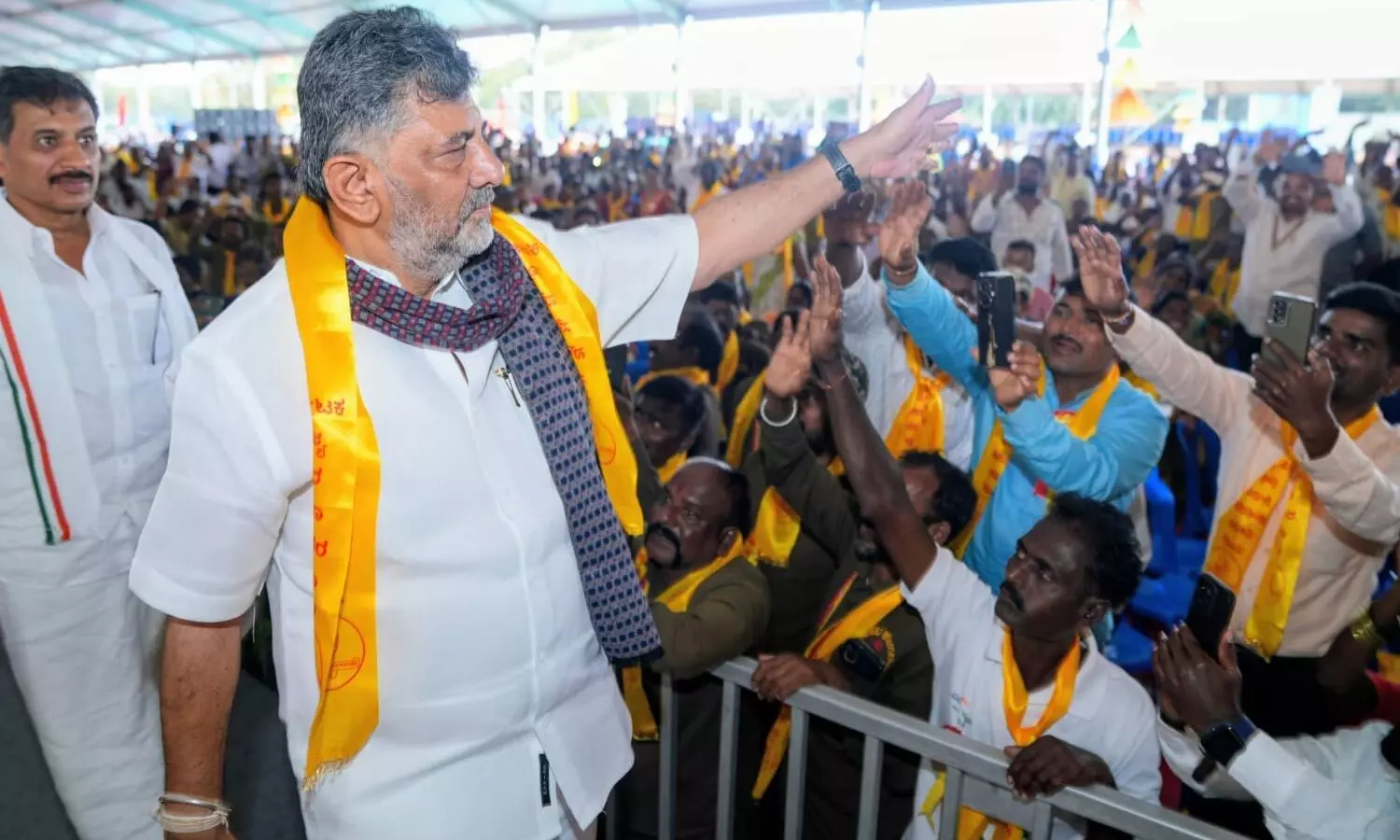
Prime Minister Represents the Nation, Chief Minister the State, Farmer the Entire World: DK Shivakumar
Bengaluru: Chief Minister DK Shivakumar said farmers should be given a distinct designation before their names, just as doctors, teachers and engineers are identified by professional titles, stressing that farmers represent the entire world.
“The Prime Minister is the representative of the country, the Chief Minister represents the State, an MLA represents his constituency, while a farmer represents the entire world. Just as doctors, teachers and engineers are given professional designations such as DR, TR and ER, we are considering introducing a designation before the names of farmers,” Shivakumar said.
He was speaking after inaugurating the Vijay Karnataka Super Star Farmer Awards ceremony at Ravindra Kalakshetra in Bengaluru. Shivakumar urged farmers not to lose confidence and praised their resilience in difficult circumstances. He said that despite water shortages in Kolar and Chikkaballapur, not a single farmer in those districts had lost hope. He also cited farmers in Hoskote who cultivate flowers and vegetables on small plots, grape growers in Vijayapura and Bagalkot, and farmers in Kanakapura, Ramanagara and Channapatna who have built their livelihoods through sericulture. “There is no one greater than the food provider. Karma is the farmer’s religion, hard work is the farmer’s strength and food is his offering. What is given to the soil returns as a crop, and what is given to the farmer returns as a livelihood. We must all work together to strengthen the lives of farmers,” he said.
He said society depended on four essential pillars — workers for employment, teachers for the future of children, farmers to provide food and the collective contribution of all sections of society. “A soldier protects the country’s borders, while a farmer protects the lives of people. A person who preserves the land, applies fertiliser, sows and harvests is a true farmer. Merely wearing a green shawl does not make someone a farmer,” Shivakumar said. He said agriculture was a continuous way of life and praised the precision and knowledge of farmers. “Farmers who work with the plough do not need measuring instruments. Their furrows are as precise as those drawn by engineers. Women too carry out transplantation with great precision,” he said.
Shivakumar said Karnataka was facing a severe drought, with around 200 taluks affected. He recalled that he had not been able to offer the traditional tribute to the Cauvery River due to the prevailing situation and said the court had also directed the release of Cauvery water. “Farmers in Mandya have understood the situation and have remained patient. I have told them to cultivate crops after assessing the water availability. Farmers in Andhra Pradesh and Telangana are also saying that they do not have enough water even for drinking,” he said.
Referring to the special Assembly session on the Kasturirangan report, Shivakumar said the government would present its views on the report on September 27. He said he had visited coastal and Malnad regions and interacted with people who had lived alongside forests for generations. “They have their lands there. If decisions are taken without considering their concerns, it would amount to taking away their rights. We have discussed the issue with them. The environment must be protected, but farmers must retain their rights over their property. This is the commitment of our government,” he said.
Shivakumar said the Congress government had introduced the Forest Rights Act and several farmer-friendly laws. He also spoke about the proposed Thega Siri scheme, under which farmers could plant teak trees on land along roads and share the resulting income with the government. “Seventy per cent of the income will go to the farmer and 30 per cent to the government. The Forest Department will enter into an agreement with the farmer. This will create an asset for the State and wealth for the farmer,” he said.
He added that the government was planning a scheme under which the State would undertake ploughing of small farmers’ lands under the Naegilayogi scheme, with two taluks proposed to be covered in each district. “Only when a farmer’s field is full can the stove in every household burn. That is why Lal Bahadur Shastri gave the call of ‘Jai Jawan, Jai Kisan’. The food we eat carries the sweat of farmers and agricultural workers,” Shivakumar said.
He said the government would study the rising prices of essential commodities and water and discuss the situation with concerned stakeholders. Shivakumar said thousands of engineering seats were lying vacant while many graduates approached him seeking private-sector employment, where salaries were often around ₹20,000 a month. He said the government had given approval to establish four to five agricultural and veterinary colleges in different places, including Mandya.
On modern agriculture, he said the government was planning several programmes involving drones, scientific advice and artificial intelligence for farmers.“We are considering the use of technology so that farmers do not all grow the same crops. Farmers too must focus on adopting new technology,” he said, adding that fruits and flowers were being exported from Bengaluru to international markets.
He said the government was considering providing electricity concessions and increasing storage facilities to support farmers engaged in such high-value agriculture. Shivakumar said a substantial amount was being spent on guarantee schemes, pensions and welfare programmes, while rising electricity costs and expenditure on lift irrigation projects were also putting pressure on the State’s finances. He said discussions would have to be held with farmers, legislators and ministers on the use of water and added that the government was considering whether a nominal charge of ₹100 per acre could be imposed.
Referring to Prime Minister Narendra Modi’s earlier promise to double farmers’ income, Shivakumar said the target had not been achieved. He also alleged that the previous government had introduced laws opposed by farmers, following which farmers’ protests led to their withdrawal.“Our government is now providing ₹1,200 crore for farmers,” he said.
Shivakumar said he had instructed officials not to issue notices to farmers living on the fringes of forests in the interest of protecting their livelihoods.
“I am also the son of a farmer. I understand the concerns of farmers. It is our responsibility to protect them,” he said. On Bengaluru’s contribution to the State’s finances, Shivakumar said taxes collected in Bengaluru had to be distributed across Karnataka and that other districts generated comparatively less tax revenue. He said the government faced challenges in mobilising resources for infrastructure and urged people to cooperate with the government.
Recalling the recognition given to farmers by Vijay Karnataka as “Super Stars”, Shivakumar said farmers continued to work regardless of wars, changes in governments or elections.“During the Covid period, I ensured that farmers’ produce did not go to waste by purchasing it and distributing it to households,” he recalled.
He said millets were now finding a good market and highlighted Karnataka’s position in the production of ragi, coffee, sunflower, arecanut, tomatoes, chillies, coconut, pomegranate, pineapple and other agricultural products.


