




- Indian Navy's INS Kulish arrives at Cambodia's Ream Naval Base to strengthen maritime cooperation
- FM Sitharaman meets Iranian counterpart; discusses ways to boost economic cooperation
- AP to receive rains for two days amid low pressure
- Heavy rainfall in Mumbai; waterlogging disrupts traffic, railway services
- Three Dead in Auto Rickshaw and Lorry Crash in Vizianagaram
- Cultural celebration: Redefining true talent
- Furqan Ahmed on the art of a successful podcast
- Will AI replace you?
BRICS outcome an eye-opener for Opposition
In Short
The BRICS New Delhi Declaration is being viewed as a major diplomatic success for India, showcasing its inclusive and pragmatic leadership while strengthening global cooperation, energy ties, and dialogue on key geopolitical issues.

Share :
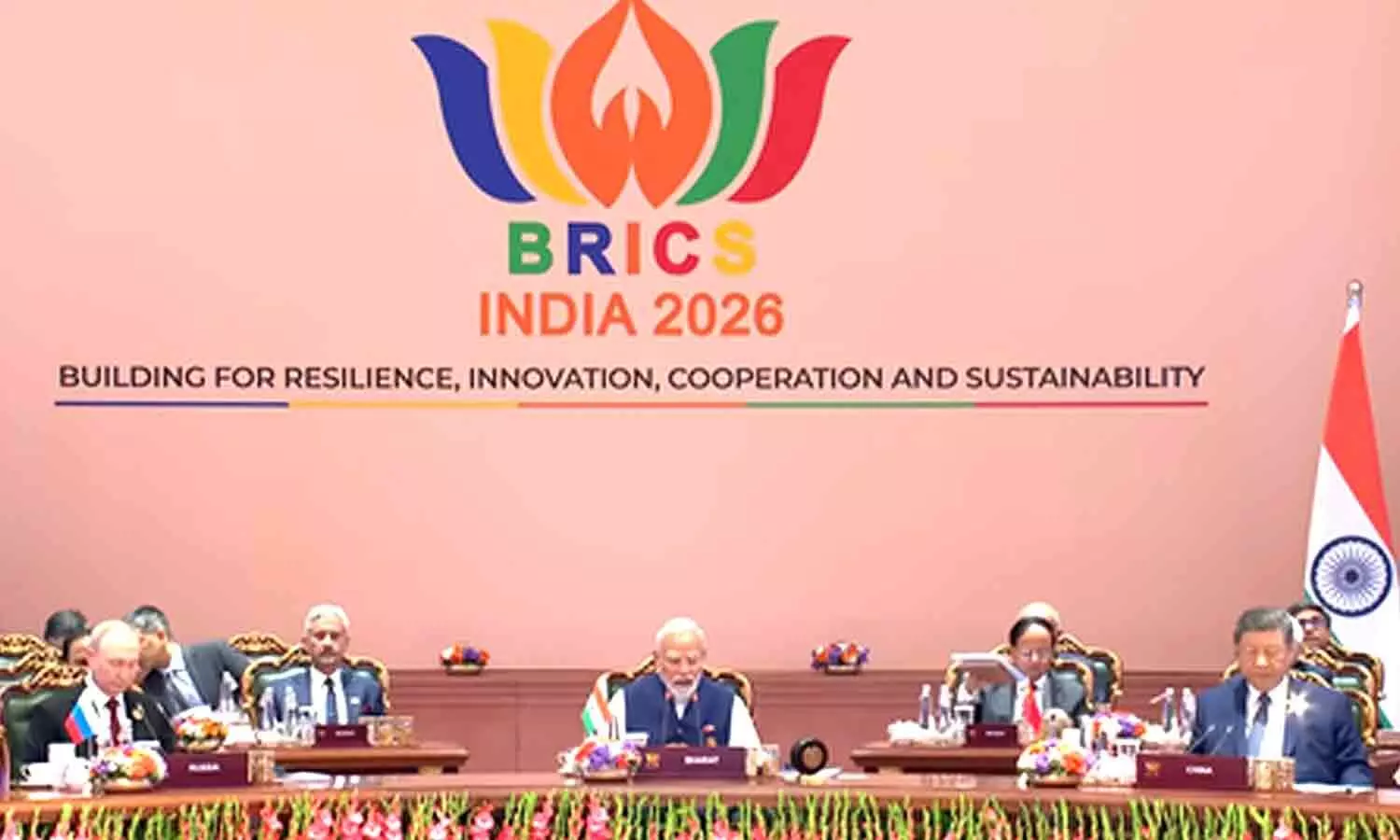
BRICS outcome an eye-opener for Opposition
New Delhi: The statement by BRICS countries that a “pragmatic, inclusive and forward-looking leadership” that Indian foreign policy brings to an evolving global order should be an eye-opener for opposition parties that have been questioning the “tangible” outcome of BRICS.
It may be recalled that senior Congress leader P Chidambaram had questioned what India had gained from recent BRICS summits, saying that he had not seen any tangible benefits from the last two or three meetings. His remarks had triggered a political exchange with the BJP ahead of the summit.
But the New Delhi Declaration, which was adopted by consensus and signed by the leaders of BRICS countries, including Russian President Vladimir Putin and Chinese President Xi Jinping, is being seen as a significant diplomatic achievement for India.
The joint declaration overcame sharp differences between Iran and the UAE over the West Asia conflict. This was achieved after intense negotiations and consultations. The Government wanted a clear consensus on various issues and did not want the summit to be reduced to an event where leaders simply came, met, and left.
“This document (New Delhi Declaration) exemplifies the pragmatic, inclusive and forward-looking leadership that Indian foreign policy brings to an evolving global order,” Prime Minister Narendra Modi said.
The declaration itself commended the progress achieved under India’s BRICS chairship and welcomed its “balanced, practical, actionable, inclusive, development-oriented and people-cantered approach”. It also called for dialogue, consultation and diplomacy to resolve international disputes and urged maximum restraint amid the escalating tensions in West Asia.
Another significant development during India’s BRICS chairship has been the strengthening of energy ties, though it should not be presented as a direct outcome of the summit.
According to the Centre for Research on Energy and Clean Air (CREA), Russia imported a record 172,000 tonnes of oil products in August, more than seven times the previous monthly high since the beginning of the Ukraine conflict and three times the total volume imported during the whole of 2025. Ukrainian drone strikes on Russian refining infrastructure had disrupted domestic fuel production, forcing Moscow to import refined products.
India supplied 70 per cent of Russia’s oil product imports in August, including 120,000 tonnes of gasoline worth 78 million euros, CREA said in its monthly analysis of Russian fossil fuel exports and sanctions. Gasoline accounted for 74 per cent of Russia’s total oil product imports in August.
All the gasoline from India was loaded at the Vadinar refinery and sold by EU-sanctioned Nayara Energy to Rosneft, CREA said. Rosneft owns 49.13 per cent of Nayara Energy. Vadinar sourced 100 per cent of its crude from Russia during the first eight months of 2026, compared with 81 per cent during the whole of 2025, according to the report.
Each cargo of gasoline exported from Vadinar to Russia was transferred between vessels in a ship-to-ship operation at the Damietta Lightering Zone off Egypt before being unloaded at Russia’s Arctic port of Beloe More, the report said.
The developments underline the complex geopolitical and economic dynamics surrounding BRICS, where India is seeking to balance its relations with Russia, China, Iran, the Gulf countries and the West while keeping the grouping focused on practical cooperation.
Indian Navy's INS Kulish arrives at Cambodia's Ream Naval Base to strengthen maritime cooperation
‘Mayawati herself wants BSP to be destroyed’: Udit Raj on succession row
“Will CURE Bill cure civic woes of Hyderabad?”
FM Sitharaman meets Iranian counterpart; discusses ways to boost economic cooperation
“Will CURE Bill cure civic woes of Hyderabad?”
Modi Warns of Rising Geopolitical Tensions, Technology Weaponisation
BRICS outcome an eye-opener for Opposition
Chinese President Xi Jinping departs from Delhi after attending BRICS Summit
AP Judo Association denies irregularities in DSC recruitment
As BRICS chair, India focused on resilience, innovation, cooperation, sustainability: PM Modi


