






- Red Fort car blast probe exposes blueprint for spread of terror modules across India
- iPhone 17 Pro price drops to Rs 54,990 at Reliance Digital with offers
- Irumudi Actress Priya Bhavani Shankar Ties The Knot With Her Long-Time Boyfriend Raj
- Maharashtra CEO debunks claims of polling irregularities in 2024 elections
- Matwada Woman Constable Wins Two Medals in Police Sports Meet
- Praveen’s Latest Update Raises Buzz Around Chiranjeevi’s Vishwambhara
- Siddhu Jonnalagadda’s 10th Movie Gets Launched Officially
- Kalvakuntla Kavitha Urges Graduates to Register to Vote
Sonia Gandhi’s Memoir ‘A Journey of Love’ Is Selective, Analysts Feel
In Short
Sonia Gandhi’s memoir Belonging: A Journey of Love faces criticism from BJP leaders and senior journalists over alleged omissions and selective accounts of major political events, including the Babri Masjid demolition, Godhra riots, Bofors controversy and Emergency.

Share :
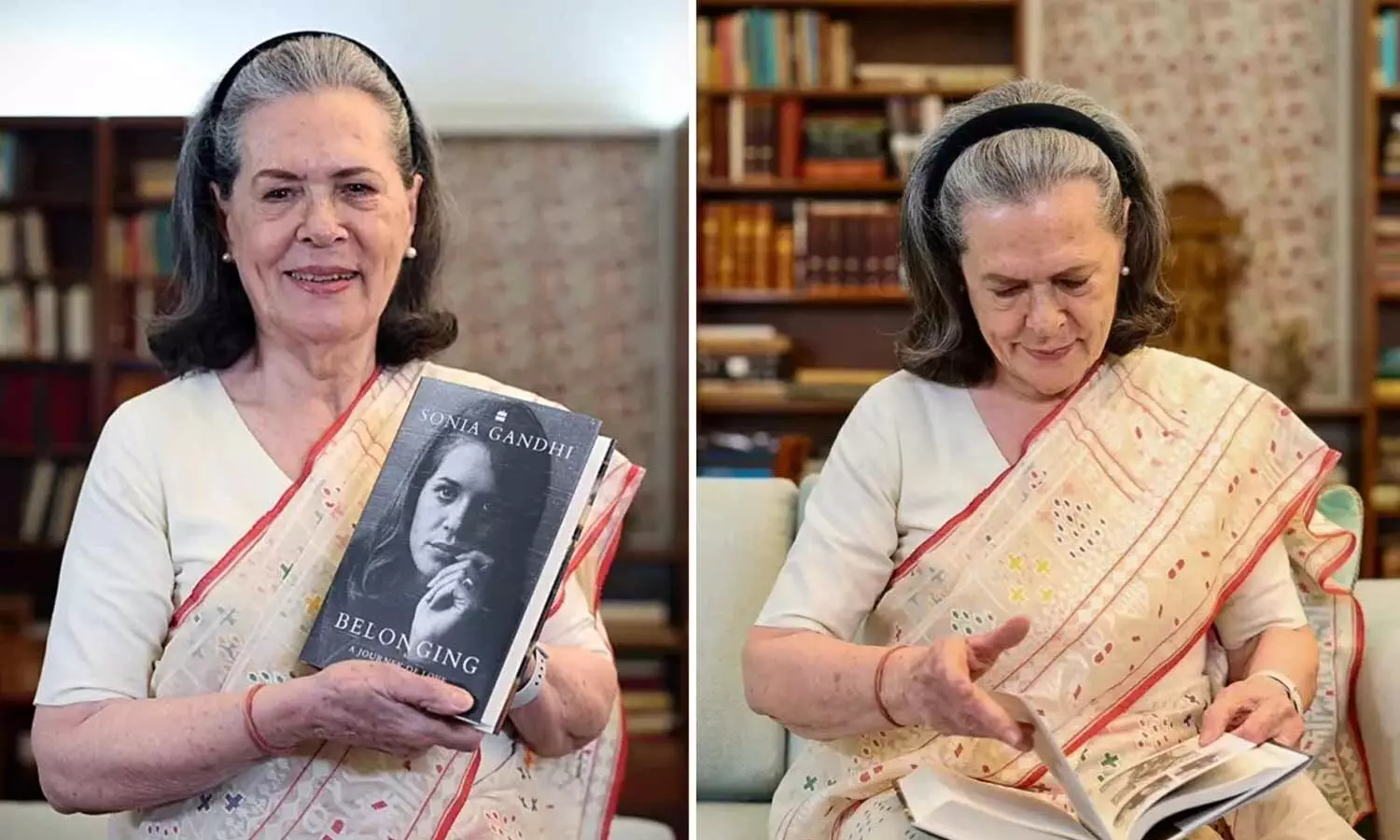
Sonia Gandhi’s Memoir ‘A Journey of Love’ Is Selective, Analysts Feel
Sonia Gandhi’s memoir, Belonging: A Journey of Love, which has stirred considerable political controversy, is set to be formally launched at a five-star hotel in Delhi shortly. Several of her claims have already been contradicted by former editors who witnessed the events and were part of the process of documenting history.
However, the controversy surrounding the memoir shows no signs of abating, particularly over the timing of its release. Some analysts feel that the book may be an attempt to shape the political narrative ahead of the party’s campaign in the Assembly elections in Uttar Pradesh and Punjab early next year.
The BJP feels that the Congress wants to ensure that its Muslim vote bank does not get affected and has hence been highlighting the issue of demolition of Babri Masjid and trying to tell how Sonia Gandhi had shed tears when the mosque was demolished, but she does not mention anything about the kar sevaks who died in police firing ordered by their ally Samajwadi Party, which was in power in UP at that time. Mulayam Singh Yadav was the Chief Minister of UP when firing on kar sevaks was ordered.
Mentioning the Godhra riots, Sonia Gandhi in her memoir wrote: "The riots were triggered when four coaches of the Sabarmati Express were set on fire, and fifty-nine pilgrims died. The train was returning to the state capital, Ahmedabad, from Ayodhya carrying Hindu kar sevaks—volunteers for the Ram temple. The cause of the fire remains disputed, but the turmoil that followed spread to many parts of the state, and the victims were overwhelmingly Muslims. We watched the live reports in horror." Did she not watch the burning of 59 Hindus? Was it not horror, the BJP spokesperson Sudhanshu Trivedi and others asked.
They also wonder why she feels that the cause of the fire remains disputed. Was it not a fact that fire in coach S-6 of the Sabarmati Express at Godhra on February 27, 2002, was investigated by forensic experts, police investigators, a Special Investigation Team (SIT) and judicial commissions? Is it not a fact that the prosecution's case that the coach had been deliberately set on fire as part of a conspiracy was accepted? Did not the courts convict 31 people, they question.
Ignoring all this, she simply mentioned that the victims were muslims. This certainly is aimed at electoral politics, the saffron party leaders feel.
Not just BJP; even senior editors like Prabhu Chawla, S Gurumurthy, and N Ram of The Hindu, who were part of the history in the making, wondered why she conveniently ignored the Bofors scam during Congress rule headed by Rajiv Gandhi.
Prabhu Chawla and N Ram, in an interview on Tuesday, said that they published several investigative reports on the controversy, in which the names of Italian businessman Ottavio Quattrocchi and AE Services and Sonia Gandhi repeatedly figured.
Ram also wondered why Sonia Gandhi blamed Sanjay Gandhi as the prime architect of the emergency. There were many others like Siddharth Shankar Ray who wanted Indira Gandhi to impose the emergency. It is a different matter that Sanjay was an extra-constitutional authority and was responsible for forcible sterilisations across the country during the emergency.
Amidst all this, another Congress leader, Sandeep Dixit, on Wednesday told a news channel that there were RSS and BJP activists too in the anti sikh riots of 1984 and said there might have been some Congress workers also and then tried to deflect the issue by raising the Godhra riots.
As one who witnessed the Delhi riots closely, I know the kind of trauma the common people suffered for three days. No milk or water supplies were affected; no vegetables were available as shops were closed due to fear of attacks, and even hospitals and nursing homes had pulled their shutters down. There used to be a curfew-like situation, and we were keeping our fingers crossed as chilling stories emerged of how some anti-social elements, under the directions of Congress leaders like Sajjan Kumar and others, organised rioting after marking the houses of Sikhs and attacked them. The entire public transport system came to a standstill, and even non-Sikhs feared going out. The trial took a very long time, and some have been convicted is a different story. But the way an attempt to give a new twist to the 1984 riots has been made by the Congress leader is bizarre.
Prabhu Chawla and other analysts felt that even the controversy of the Shah Bano case was not presented in its true perspective. This was one of those cases which people had closely watched on Doordarshan news those days and it was alleged that the government went against the apex courts verdict and came up with the Muslim Women (Protection of Rights on Divorce) Act, 1986 to undo the court judgment under pressure from muslim religious leaders.
The BJP and analysts are also questioning why she did not explain the reason for not getting Indian citizenship for 15 years, being the daughter-in-law of the Prime Minister and staying in the same house.
The senior journalists also questioned her role in the removal of Sitaram Kesari from the post of party president and how he was locked inside a room. There is also no mention of P V Narasimha Rao and his vision of economic reforms. They feel her memoirs are selective in nature.
It now remains to be seen how Sonia Gandhi would respond to the criticism her book had generated in the political circles.
Sonia Gandhi’s Memoir ‘A Journey of Love’ Is Selective, Analysts Feel
Congress govt must pay for farmers’ tears: Errabelli Dayakar Rao
Adilabad to Emerge as IT and Industrial Hub: Minister Sridhar Babu Inaugurates ₹57.85-Crore IT Tower
Ravi Kumar urges CM to withdraw minority department's army training advertisement
Sonia Gandhi’s Memoir ‘A Journey of Love’ Is Selective, Analysts Feel
Telangana: 10+2 system to be implemented from next year: CM Revanth Reddy
Terrorists fire at CRPF checkpost in Kashmir's Kulgam area, three injured
CM Chandrababu assigns lift schemes to Jalaharati Corporation
AP SEC to hold elections in pending municipalitiee
SP's Promising Start Losing Steam as Akhilesh Drifts to Old Issues


