




- Wow! Drought-prone region to blossom into global fruit bowl!
- CM DK Shivakumar calls for strengthening Central Police Command
- Sunnam Cheruvu temple marks Bathukamma Silver Jubilee
- 34 farmers to fly to Delhi for talks on sugarcane support price
- Muddapappu Bathukamma to be celebrated today
- Vijay urges PM to fast-track Madurai, Coimbatore Metro funding
- Thirumavalavan credits VCK for TVK alliance’s bypoll wins
- Leopard video sparks fear near Kotagiri in Nilgiris
Wow! Drought-prone region to blossom into global fruit bowl!
In Short
- Rs 1 L cr Integrated Horticulture Development Plan
- 201 horticulture clusters coming up across 10 districts
- 9.6 lakh farmers expected to benefit

Share :
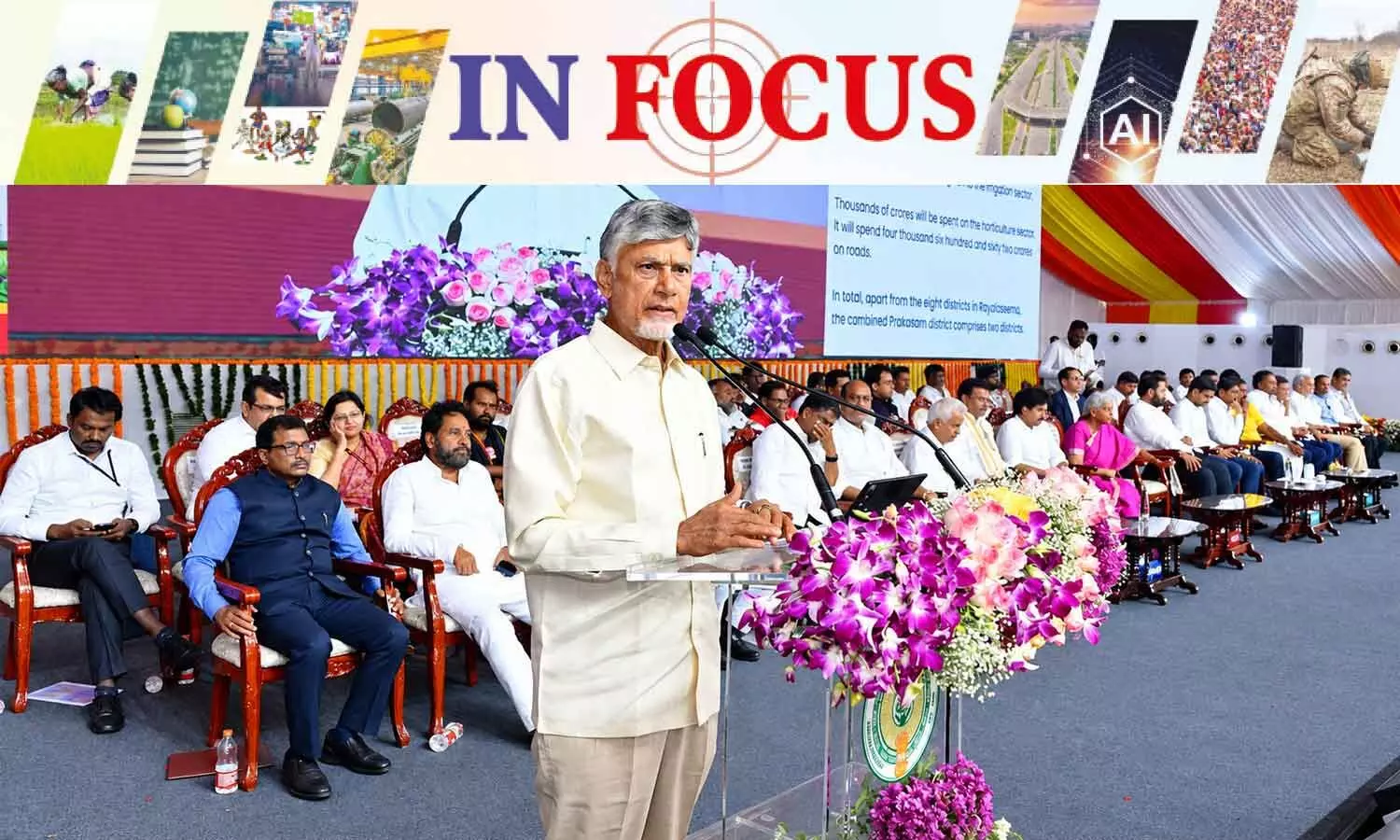
Chief Minister N Chandrababu Naidu speaking at the Global Horticulture launch programme in Madanapalle (File photo)
Tirupati: For generations, farming in Rayalaseema has been closely tied to water availability. With rainfall uncertain and groundwater under increasing pressure, farmers have had limited scope to move beyond traditional crops. The proposed Rs 1 lakh crore Integrated Horticulture Development Plan (IHDP) seeks to change this by putting water infrastructure at the centre of a broader shift towards horticulture.
The Global Horticulture Hub (GHH) – Rising Rayalaseema, launched at Madanapalle on October 3, aims to bring 201 horticulture clusters across 10 districts under a common development framework. It targets 14.41 lakh hectares of horticultural cultivation, with the objective of doubling productivity and improving the incomes of about 9.6 lakh farmers.
Reliable irrigation will be critical to achieving these targets. Rayalaseema receives only about 400 to 700 mm of rainfall annually, forcing farmers in many areas to depend on seasonal rains and groundwater. This uncertainty can discourage investment in crops such as mango, banana, pomegranate, tomato and lemon, which need dependable water at various stages of cultivation.
The IHDP has therefore given irrigation its largest allocation, with Rs 20,884 crore earmarked for the sector. The works include projects associated with Nallamala Sagar, Veligonda phases I and II, the Handri-Neeva Sujala Sravanthi (HNSS) main canal, the Galeru Nagari Sujala Sravanth (GNSS), and the Penna Ahobilam Lift Irrigation Scheme.
The plan proposes creating nine lakh acres of new ayacut and stabilising another 4.3 lakh acres. Alongside major irrigation works, micro irrigation and fertigation are planned for nearly 6.5 lakh hectares of horticultural land. These systems are expected to improve water-use efficiency, particularly in a region where water remains a major constraint. Their effectiveness, however, will depend on proper maintenance, reliable power supply, and effective adoption by farmers.
The irrigation component will be implemented in phases. The first phase, from August 2026 to July 2027, will focus on projects, lift irrigation schemes and tanks to improve water availability. Major canal works are planned in the second phase, followed by distribution networks in the final phase.
The horticulture strategy seeks to also address what happens after crops leave the farm. Rural roads, packhouses, cold storage facilities, food clusters, and processing units are proposed to strengthen links between producers and markets. Around 5,721 km of rural roads are planned for reconstruction or expansion.
This infrastructure is intended to help farmers avoid distress sales and retain greater value from their produce. Mangoes, for instance, can be processed into pulp, bananas into powder and chips, and tomatoes into puree. Processing can also reduce post-harvest losses and provide an alternative when fresh-produce prices weaken during periods of high supply.
Banana exports point to the potential being targeted. From just 246 tonnes in 2016-17, exports have grown with private-sector participation. The state now aims to take exports beyond one lakh tonnes through improved market linkages, including those with the UAE.
Private investment is expected to account for a substantial share of the proposed Rs 1 lakh crore investment, with about Rs 60,000 crore envisaged from private investors. Their participation will be important in building processing, storage and marketing capacity alongside public infrastructure.
The IHDP is thus an attempt to reshape Rayalaseema’s farm economy by linking water, production, infrastructure, and markets. Its success, however, will ultimately be measured by what changes on farms. If irrigation projects reach fields reliably and are supported by efficient water management, processing, and market access; farmers may have greater confidence to shift towards higher-value horticultural crops and earn more from every acre.


