




- Delhi Rains: Heavy Downpour Floods IGI Airport, Nine Flights Diverted Within An Hour
- Congress failed to implement women’s guarantees: Madhusudhanachari
- ‘Dharmasthala Niyojakavargam’ review: A meaningful political drama with a strong social message
- Navies of India and Thailand reaffirm commitment to capacity building, training
- Poco X8, X8 Power Launch in India with Big Batteries and Snapdragon Chips
- AP, Telangana to receive rains amid cyclonic circulation in Bay of Bengal
- Govt to make all efforts for better solution to Bhopal sealing issue: CM Mohan Yadav
- South Korean President Lee designates flood-hit Tongyeong as special disaster zone
51st state of mind: As Alberta votes on independence, will Trump back separation?
In Short
Alberta prepares for a historic referendum on its future in Canada, as debates over independence, U.S. recognition, and political implications intensify ahead of the October 19 vote.

Share :
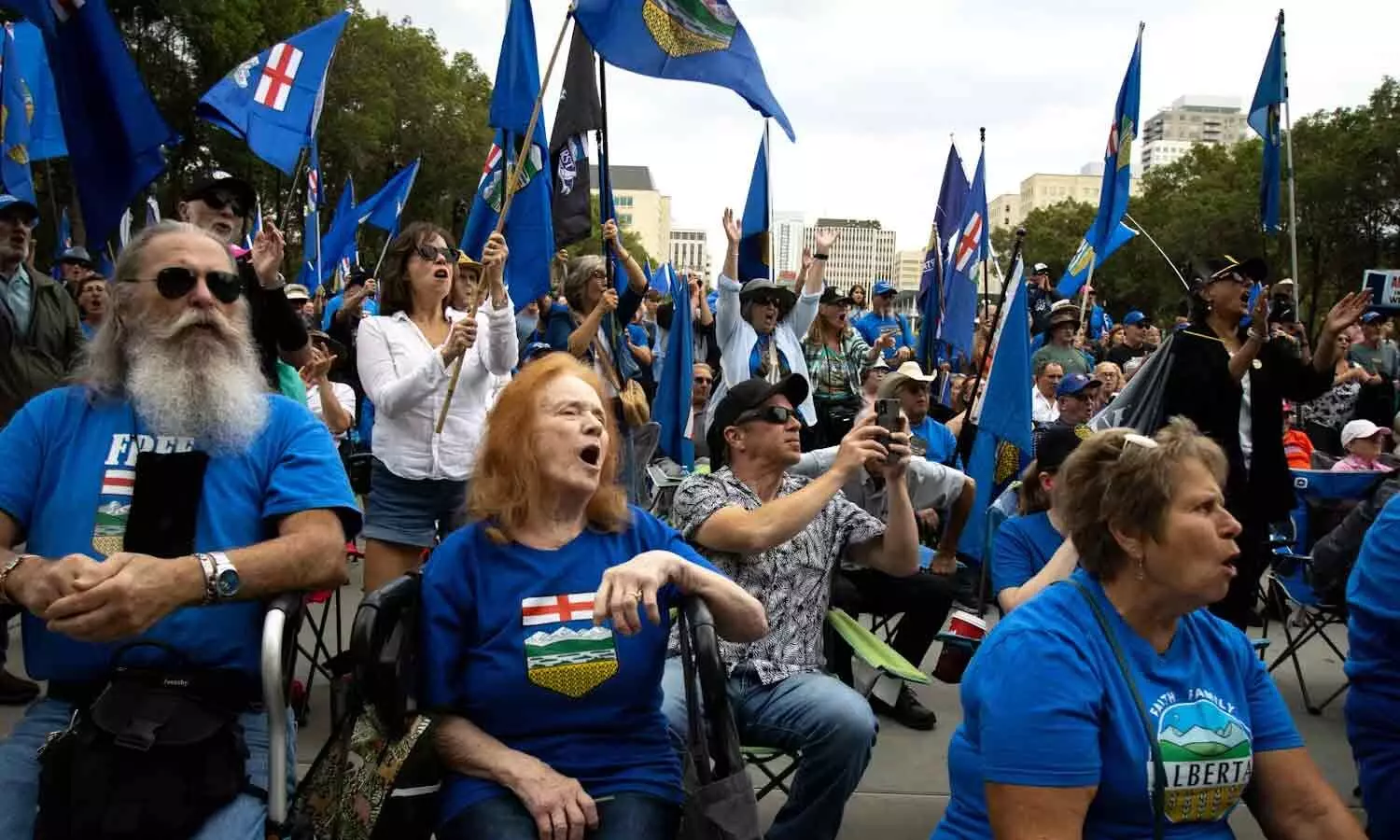
51st state of mind: As Alberta votes on independence, will Trump back separation?
Calgary (Canada): In a few weeks, Albertans will be asked in a referendum whether they want the province to remain in Canada or move toward a second referendum on independence.
An independent Alberta would not only have to meet the requirements of statehood -- people, territory, an effective government and the capacity to deal with states -- but it would also have to be recognised by other countries, most importantly the United States.
Without recognition, an aspiring state has no international standing. It could not engage in diplomacy, enter into international agreements or join international organisations.
The Alberta referendum will be Canada’s third, after those in Quebec in 1980 and 1995. Given the deep ties between Canada and the United States, it’s not surprising that, in both earlier cases, American governments under presidents Jimmy Carter and Bill Clinton supported a united Canada.
But President Donald Trump, who has frequently threatened to make Canada a 51st state, has not openly declared his support of a united Canada in the run-up to the Alberta vote, and some around him have spoken positively about the prospect of an independent Alberta.
The 1980 Quebec referendum
Parti Quebecois Premier Rene Levesque came to power in November 1976, pledging a referendum on Quebec independence. The possibility of a divided Canada and an independent Quebec on his country’s northern border concerned Carter, who said Canada’s stability “is of crucial importance to us,” while noting it was for Canadians to decide.
He declined to say whether his government would recognise an independent Quebec.
In a speech to Congress in February 1977, Prime Minister Pierre Trudeau assured Americans that “Canada’s unity will not be fractured.” Carter expressed confidence in the outcome. Vice President Walter Mondale reiterated the administration’s support during a visit to Ottawa the following year.
Levesque told Americans that an independent Quebec would remain a reliable economic and security partner. But the Carter administration did not change its stand.
The issue became moot in May 1980 when the province’s voters rejected by 60-40 per cent the government’s sovereignty-association referendum. Had it been successful, Quebec would have become politically independent while maintaining economic ties to Canada.
Quebec referendum of 1995
The independence issue remained on the back burner until September 1995, when another Parti Quebecois premier, Jacques Parizeau, announced a referendum vote would be held the following month on a vague plan to create a sovereign Quebec after proposing new political and economic arrangements with Canada.
The campaign began with the No side in a healthy lead. But it tightened dramatically after Lucien Bouchard, a charismatic federal politician, took over leadership of the pro-independence forces.
With alarm bells ringing in Ottawa and Washington, US Secretary of State Warren Christopher, though observing that the referendum was an internal matter, emphasised “the high value that we place on the relationships that we have with a strong and united Canada” and that an independent Quebec should not expect to have the same connections.
That was a pointed reference to Parizeau’s claim that it would automatically join the North American Free Trade Agreement. After President Jacques Chirac said France would recognise an independent Quebec, Clinton spoke out, declaring: “A strong and united Canada has been a wonderful partner for the United States and an incredibly important and constructive citizen throughout the entire world.”
The Clinton administration did not intend to recognise an independent Quebec in the wake of a successful vote. The federal side won a slim victory (50.6-49.4 per cent), putting the matter to rest, although a resurgent Parti Quebecois has promised another independence referendum if it wins this fall’s election.
Supportive Americans
In May, Alberta Premier Danielle Smith said Albertans will go to the polls on October 19 in a referendum to decide whether the province should stay in Canada or initiate a legal process leading to a second binding referendum on separation.
This followed rival citizen petitions circulating in the province both for and against independence. After appearing to hedge her bets, Smith said she will vote to remain, citing the responsiveness of Prime Minister Mark Carney’s government to Alberta’s concerns.
Trump has yet to weigh in publicly, although he has repeatedly mused about making Canada the 51st state and US Ambassador Pete Hoekstra has said that would be “a great discussion for the president and the prime minister to have.”
The province, with its rich energy resources and Smith’s MAGA-friendly policies, would be an attractive target. It has been largely spared the effects of Trump’s tariff assaults on Canada because Canadian oil and gas exports are exempt.
Treasury Secretary Scott Bessent calls Alberta a “natural partner for the US … People want sovereignty. They want what the US has got.”
Utah Senator Mike Lee has said: “It might be like our own little frozen Texas of the North. They may even want to join us.”
Alberta’s Trump relationship
A recent Angus Reid poll found that only 23 per cent of Albertans view Trump favourably, but many separatists see his administration as a crucial ally.
Alberta Prosperity Project leaders have met three times with US government officials who, they claim, have a direct line to the White House, to discuss separation.
Hoekstra, after initially denying the meetings had taken place, brushed them aside as routine contacts and said no commitments had been made. He has “clear direction” not to intervene in the referendum debate but it’s “the president’s call.” Both Carney and Smith have said they expect the administration to respect Canada’s sovereignty.
Polls show the “remain in Canada side” with a large lead, which assuming it holds, will ensure a significant win in the referendum.
Whatever happens, neither past precedents nor Canadian admonitions are likely to sway Trump, who calls Canada “a country that should be a state.” (The Conversation) FHK
PM Modi congratulates Giorgia Meloni on becoming Italy's longest-serving Prime Minister
ISRO launches EOS 05 satellite successfully from Sriharikota
Nepal Flood Rescue: 2 Workers Pulled Alive From Hydropower Tunnel After 9 Days
CM Chandrababu wishes Telugu People on Sri Krishna Janmashtami
IndiGo flight hits pole while parking at Srinagar airport; passengers, crew safe
Teacher’s Day 2026: Why Do India Celebrates Teacher’s Day On September 5


