




- 'Want to strengthen BJP in Tamil Nadu': L. Murugan seeks to quit as Union Minister and Rajya Sabha member
- Draw up coordinated strategy to make Haryana drug-free, says CM Saini
- Union Territory of Ladakh integral and inalienable part of India: MEA rejects China's claims
- AP SEC briefs media on meeting political parties over local body elections
- Trinamool questions Bengal CEO’s campaign for enrolment of deleted eligible, new voters
- Education Ministry forms three-member panel to probe IIIT-Ranchi student's death
- K'taka sting Op row: Siddaramaiah moves court; BJP accuses Cong of betrayal
- BJP women MPs turn up heat on Cong MP caught in ‘sex for marks’ row, to meet President
After Monday, Tandav Oppn to Continue Flash Protests
In Short
Addressing the media briefly, Rahul did not reveal the action plan discussed or the decisions taken. He merely said that the protests would continue until they achieved their goal.

Share :
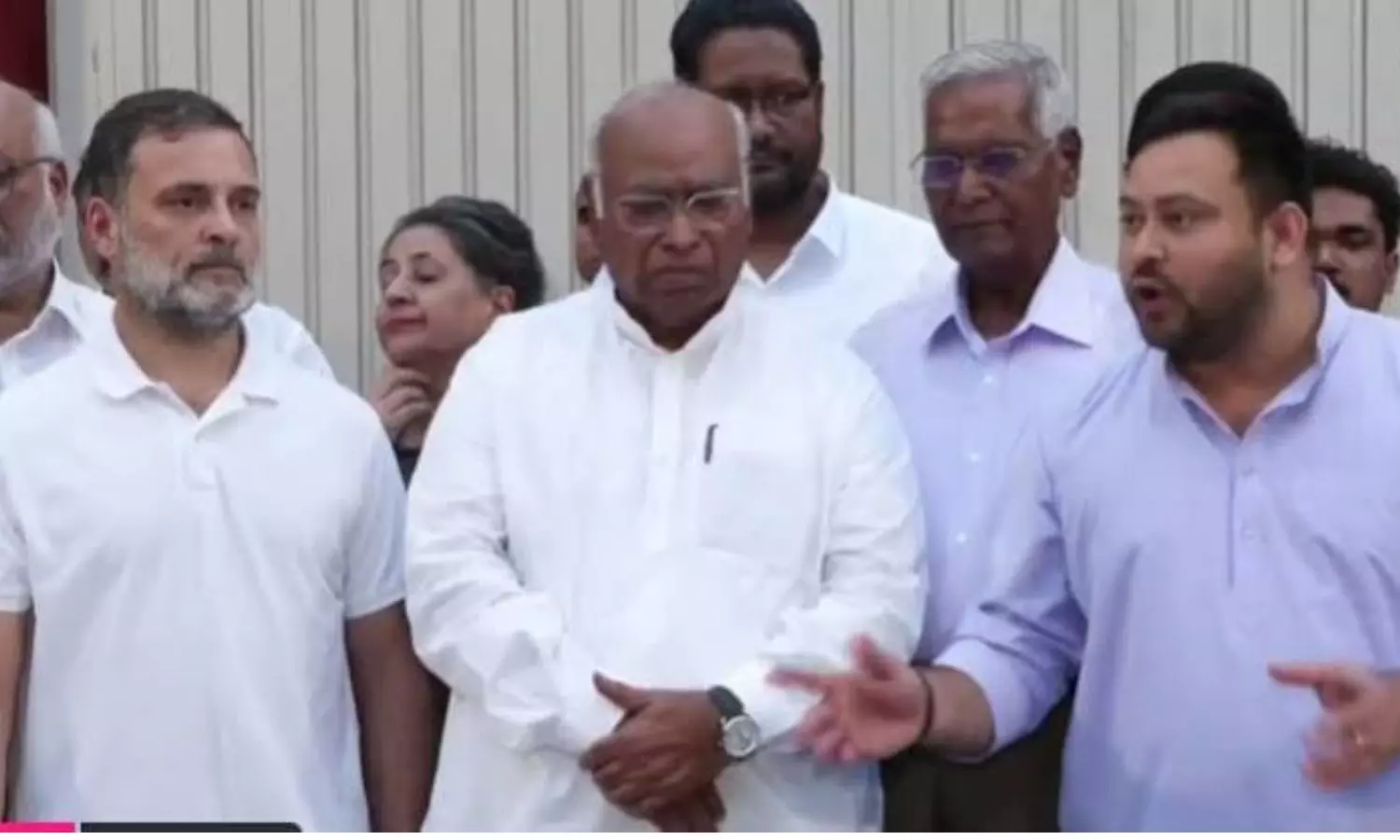
Tuesday was a day of hectic political activity over cups of tea.
Tuesday was a day of hectic political activity over cups of tea. At the “Chai Pe Charcha” meeting of INDIA bloc members at the residence of Leader of the Opposition Rahul Gandhi, the opposition parties decided to hold flash protests to maintain the momentum of their agitation, demanding the resignation of Chief Election Commissioner Gyanesh Kumar.
Addressing the media briefly, Rahul did not reveal the action plan discussed or the decisions taken. He merely said that the protests would continue until they achieved their goal. He alleged that the “main architect, Modi, implementer Amit Shah, and Gyanesh Kumar and others cannot get away”. He added that the noose was tightening around their necks and that they could not escape.
The opposition parties have decided to take a break from the agitations against the Chief Election Commissioner till the Dussehra festival is over. They would restart their protests with a mega rally on November 1 at the Ramlila Maidan, according to sources.
While expressing “extreme respect” for the Supreme Court, Rahul said the Opposition hoped the court would play its role. However, irrespective of the court’s actions, political resistance would continue. The BJP reacted by asking the Congress to clarify whether it would abide by the Supreme Court’s verdict or not.
Union Minister Piyush Goyal, addressing a press conference earlier in the day, remarked that the biggest “red flag” for the Congress was Rahul Gandhi himself. He attributed the party’s electoral defeats to Rahul’s leadership and said he was in “delusion” mode.
The other Opposition leaders had little to add beyond reiterating their resolve to fight unitedly. CPI leader D. Raja said civil society groups, farmers’ organisations and labour unions would also join the protests soon. Sanjay Raut of the Shiv Sena (UBT) described CEC Gyanesh Kumar as “Mafia”.
Social activist and advocate Prashant Bhushan argued that the government cannot denotify Jantar Mantar as a protest site, asserting that it had no right to decide who could protest and where. He maintained that people could protest in various public spaces, including footpaths and parks.
Representatives of the Samajwadi Party and Supriya Sule of the NCP were among those who participated in the meeting.
Meanwhile, the Congress has asked its cadres, mobilised from different states, to stay back in Delhi, indicating that more flash protests could follow.
On the other hand, the BJP has taken up the case of Richa Pasricha, a woman journalist who was allegedly pushed by Rahul Gandhi while attempting to get a sound bite for her news channel, causing her to fall and sustain injuries. She is now recovering in a hospital. She said she was three months pregnant. BJP leaders accused Rahul and the Congress of lacking basic humanity, alleging that nobody from the party had even enquired about her condition. When asked about the incident, Congress leaders said they did not believe Rahul would have done anything of the sort. Is this smash patriarchy mark of Rahul, they asked.
The BJP also raised the issue of dismissed JNU professor Angomcha Bimol Akoijam, against whom allegations of seeking sexual favours from female students have been made. BJP workers staged a protest outside the Congress headquarters in Delhi. BJP women MPs also met President Droupadi Murmu, seeking action against Akoijam, a Congress MP, and demanding his suspension from the Lok Sabha.
The BJP delegation was led by MP D. Purandeswari and included Mahila Morcha president Roop Kumari Choudhary and Delhi MP Bansuri Swaraj.
'Prem Keetanu' actress Aafiya Sayed to make her Telugu debut with 'Alias Rukmini'
Meghalaya autonomous council polls to be held at earliest: CM Conard Sangma
Male elephant suspected to have died of electrocution in MP's Shahdol
Mayank Yadav must back pace with execution of plans in T20Is in New Zealand, says Bharat Arun
Telangana Dy CM Bhatti Vikramarka announces measures for Singareni workers
SIR Hearing Deferred to Thursday; Rahul Must Refile Petition
Modi says India grows 'with the world, not at anyone's cost', cites strong economic fundamentals
CJP Challenges Jantar Mantar De-notification; Police Register Four FIRs Against Congress
Srisailam Project earns international recognitionl, included in World Book is Records
CJP Leaders Saurav Das, Ashutosh Ranka Detained After Jumping Gate To Enter Jantar Mantar


