




- Tripura CM calls for collective efforts for inclusive development of tribal, non-tribal communities
- Gujarat leaders meet HM Shah, exchange 'Saal Mubarak' wishes on New Year
- Sonia Gandhi Recalls ‘Midnight Chat’ With Rahul Before Turning Down PM Post In 2004
- Sundar Pichai Welcomes Meta’s AI Models to Google Cloud
- Google Unveils New AI Chips in Major Challenge to Nvidia
- Kia Car wrecked in PVNR Expressway Accident in Hyderabad
- Deepavali pollution pushes two AP cities into ‘poor’ air category
- Vizag gears up for CII Partnership Summit
Nvidia Chip War: How Jensen Huang Scandal Has Put US-China AI Rivalry Back In Focus
In Short
Nvidia CEO Jensen Huang's scandal has renewed scrutiny of the US-China AI chip war, from export curbs and alleged smuggling to China's push for chip independence.

Share :
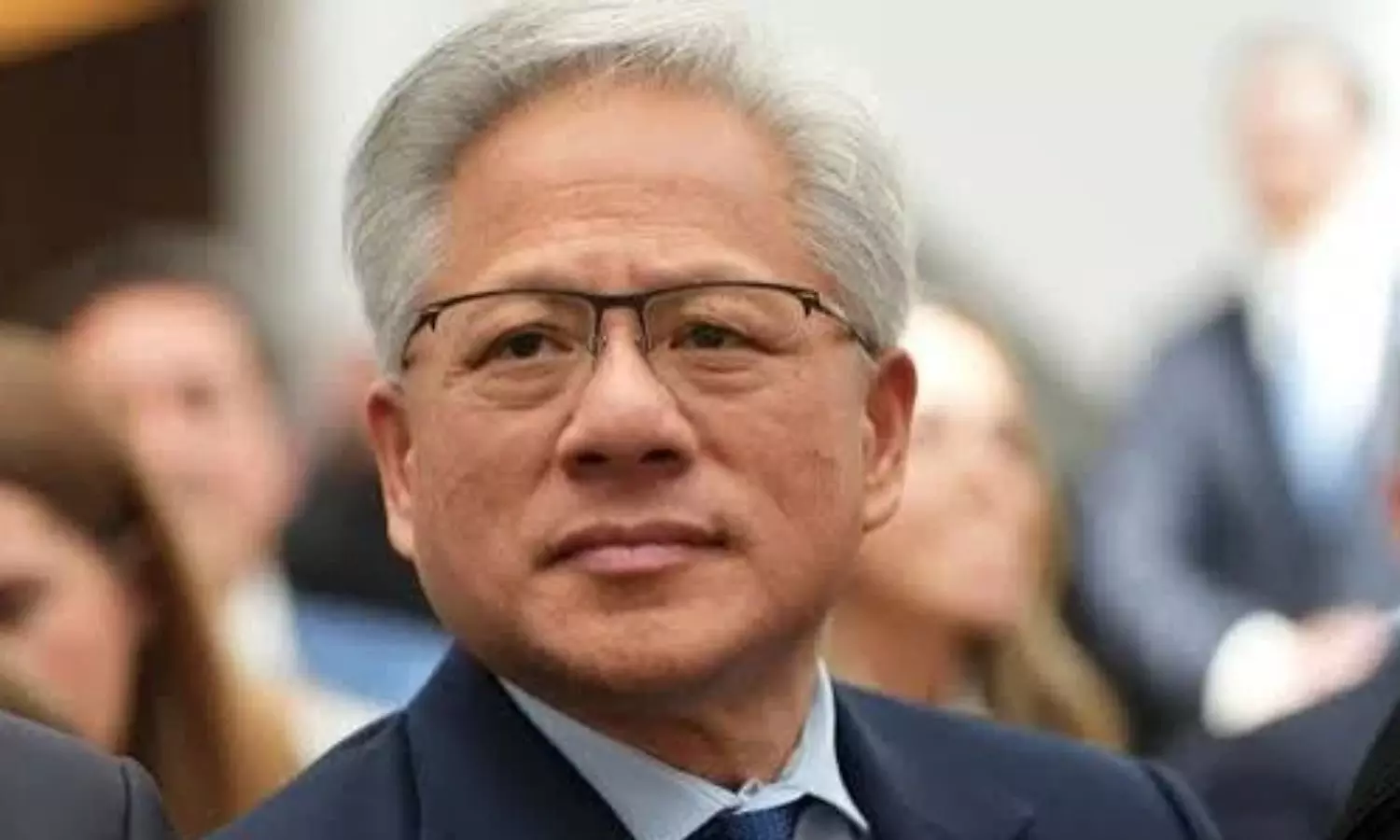
Nvidia's CEO Jensen Huang
Nvidia's CEO Jensen Huang and a woman allegedly a foreign spy has been in the news again and has sparked renewed interest in the global turf war for cutting edge artificial intelligence chips. The issue underscores the dominance of a handful of firms in the access to key AI hardware, from U.S. export controls and suspected importation of such technology through U.S.-based firms, to China's own advances in AI tech.
On November 8, Huang admitted that he cheated on the woman, after having appealed to Washington on multiple occasions to make it easier for Nvidia to sell more advanced chips in China. The development has brought the company's ties with its business and overall competition between Washington and Beijing for access to artificial intelligence technology under closer scrutiny.
The Companies At The Centre Of The Chip War
Few companies have the ability to make or provide the latest, most sophisticated hardware needed to build and run AI systems.
Nvidia creates graphics processing units (GPUs) that are often employed to train and execute AI models. The company uses Taiwan Semiconductor Manufacturing Company (TSMC) for the production of its processors.
TSMC relies on a specialised set of equipment made by ASML, also based in the Netherlands. ASML, the sole manufacturer of extreme ultraviolet (EUV) lithography machines, is creating extremely fine circuit patterns on silicon wafers using light.
According to Reuters, the most sophisticated EUV machines weigh about 180 tonnes and are about the size of a school bus.
Sources indicate that China has not caught up to Nvidia, TSMC or ASML's capabilities yet. Washington has been trying to safeguard this technological edge by restricting Beijing's access to “world class” chips and their manufacturing equipment.
How The US Built Restrictions Around China
Washington began urging the Netherlands in 2018 to prevent ASML from exporting EUV machines to China. ASML has maintained that it has never sold an EUV machine to a Chinese customer.
The US expanded its restrictions on October 7, 2022, by imposing controls on exports of advanced AI chips to China. The Commerce Department's Bureau of Industry and Security (BIS), which oversees export controls, said the measures were intended to limit China's ability to acquire and manufacture high-end chips that could be used in military applications.
The restrictions also covered chipmaking equipment and limited the ability of US companies and citizens to support advanced semiconductor production at certain facilities in China without government approval.
Nvidia initially responded by developing less powerful processors for the Chinese market, including the A800 and H800. However, Washington introduced fresh performance-based restrictions in October 2023, closing that route. Nvidia subsequently developed another China-specific chip, the H20.
The Netherlands also tightened controls. From September 1, 2023, ASML required a Dutch government licence to export certain advanced deep ultraviolet (DUV) lithography machines to China. In January 2024, the company said the government had partially revoked a licence covering some shipments, affecting a limited number of Chinese customers. Beijing criticised the move.
Alleged Smuggling Of Nvidia Chips To China
Despite export restrictions, US authorities have faced challenges in tracking advanced chips once they are shipped to buyers in third countries.
In March 2026, federal prosecutors in New York charged Supermicro co-founder Yih-Shyan "Wally" Liaw and two others with allegedly diverting servers containing restricted Nvidia chips to China.
According to the indictment, a Southeast Asian company purchased around $2.5 billion worth of Supermicro servers during 2024 and 2025. The shipments allegedly involved false documents identifying the company as the final user. The servers were then repackaged in unmarked boxes and sent to China.
Prosecutors also alleged that the accused arranged thousands of non-functional replica servers, described as "dummy" machines, to deceive auditors. Before one inspection by the US Commerce Department, two brokers allegedly used a hair dryer to transfer labels and serial-number stickers from genuine machines onto the replicas. Surveillance cameras reportedly captured the activity.
Supermicro has not been named as a defendant and has said it is cooperating with the government investigation. Liaw has pleaded not guilty. Broker Ting-Wei "Willy" Sun pleaded guilty in October under an agreement with prosecutors, while the third accused has not appeared in the case, Bloomberg reported.
In a separate case, Texas businessman Alan Hao Hsu and his company pleaded guilty in October 2025 to smuggling-related charges. US prosecutors said the network had exported or attempted to export at least $160 million worth of Nvidia H100 and H200 chips. The hardware was allegedly relabelled under the fictitious brand name "Sandkyan".
Huang had previously dismissed concerns about chip diversion. In May 2025, he told Bloomberg that there was no evidence of AI chip diversion.
Megaspeed's Role Under Scrutiny
Megaspeed, a Singapore-based cloud computing company that employed the woman at the centre of the Huang controversy, has also faced scrutiny over allegations that it helped China gain access to restricted Nvidia chips.
Bloomberg reported that Megaspeed had imported more than $4.6 billion worth of Nvidia products and rented the company's chips to China's Alibaba from facilities in Southeast Asia.
An examination of trade records by the news agency also suggested that Nvidia's inventory checks for US officials had undercounted by 50,000 the number of chips sold to Megaspeed through its partners.
Megaspeed has denied allegations of chip diversion, saying an investigation in Singapore ended without any adverse action against it. Nvidia has also said its own inquiry found no evidence of diversion.
ASML's equipment has come under scrutiny as well. In June 2026, Bloomberg reported that US Commerce Secretary Howard Lutnick had told ASML executives that Washington was concerned an EUV machine might have reached China. Officials reportedly said they had evidence but did not disclose details.
ASML denied the possibility, telling Reuters that it had never shipped an EUV machine or any equipment specifically designed for such a machine to China. Dutch authorities have also said they strictly enforce export restrictions.
US Policy On AI Chip Exports Keeps Shifting
Washington's approach to semiconductor exports has been shaped by two competing arguments.
One view is that allowing China to obtain advanced chips could strengthen its military capabilities and accelerate the development of its AI industry. The other, supported by Huang, is that excluding Nvidia from the Chinese market would encourage Beijing to rely on domestic manufacturers and build a stronger independent semiconductor industry.
In April 2025, the Trump administration required licences for Nvidia's H20 chip exports to China. Nvidia estimated that the restrictions would cost it $5.5 billion, according to the Associated Press.
Speaking in Taiwan on May 21, 2025, Huang called the export controls a failure. He said Nvidia's share of China's market had fallen from 95% at the beginning of the Biden administration to 50%.
In December 2025, US President Donald Trump announced that Nvidia would be allowed to sell its H200 processors to approved customers in China, subject to a 25% fee for the US government. A Commerce Department rule implementing the decision took effect in January 2026.
China's Push To Build Its Own AI Chips
Beijing has responded to US restrictions by investing in domestic semiconductor technology and encouraging companies to reduce their dependence on American hardware.
Huawei designs its Ascend AI processors, which are manufactured by China's largest contract chipmaker, Semiconductor Manufacturing International Corporation (SMIC), using an enhanced version of its 7-nanometre process. However, Huawei's chips continue to lag behind Nvidia's products.
In September 2025, Huawei rotating chairman Eric Xu promised that the company would introduce a new generation of Ascend processors every year until 2028.
China is also attempting to develop its own advanced chipmaking equipment. Reuters reported in December 2025 that scientists in Shenzhen had built a prototype EUV machine with assistance from former ASML engineers. The machine can generate EUV light but has not yet produced working chips. China's official target is to achieve that by 2028, although people involved in the project told Reuters that 2030 may be a more realistic timeline.
Beijing has also directed newly built, state-funded data centres to use only Chinese AI chips, Reuters reported in November 2025.
Nvidia has disclosed that it has sold only a limited number of H200 chips to China. Huang said in May 2026 that the company had largely given up the Chinese AI chip market to Huawei, according to Reuters.
However, demand for Nvidia products has not disappeared. ByteDance, Alibaba and Tencent reportedly ordered more than three million of Nvidia's RTX PRO 5500 workstation chips in October. The processors are less powerful than the company's leading AI chips but can still be sold to China. Their combined list price was estimated at more than $35 billion.
China also has leverage over the global technology supply chain through its control of critical minerals. In 2023, Beijing introduced export licensing requirements for gallium and germanium, two metals used in semiconductor manufacturing. China produces more than 90% of the world's gallium and around 60% of its germanium.
It subsequently imposed restrictions on rare earth exports in April 2025 and expanded them in October. The curbs were later paused under a trade agreement with Washington. On November 9, China extended the pause by another two months.
What The Nvidia Controversy Could Mean Next
Huang has apologised to his family and Nvidia employees over the affair. The company's board has also formed a committee of independent directors to examine reports that he was targeted in a foreign intelligence operation.
Nvidia has said it has no reason to believe that national security or company secrets were compromised.
China's Foreign Ministry has rejected the spy allegations, describing them as baseless accusations and an attempt to smear the country.
The controversy could also increase pressure on US lawmakers to tighten restrictions on China's access to advanced AI chips. The Senate's version of the annual defence policy bill includes three proposed measures.
The AI Overwatch Act would give Congress greater authority over exports of advanced chips. The Chip Security Act would require exported processors to have location-verification technology, while the Match Act would encourage US allies to impose tighter restrictions on chipmaking equipment supplied to China.
A former congressional staffer told Reuters that Nvidia was seen as the strongest opponent of the first two proposals. The company declined to comment.
The political developments could further complicate Nvidia's position. Democrats are set to take control of congressional committees in January, while Huang has been asked to attend a closed-door joint meeting of House committees on November 18.
Trump is also scheduled to meet Chinese President Xi Jinping at the APEC summit in Shenzhen next week. The talks will take place weeks before China's pause on rare earth export restrictions is due to expire on January 10, 2027.
Sonia’s Memoir forgets PV Narasimha Rao from the History of Economic Reforms
Sonia’s Memoir: Selective Memories, Convenient History
AP Cabinet to meet today, to discuss major investment proposals
‘May your lives overflow with health, joy and enthusiasm’: PM Modi extends Gujarati New Year wishes
'Have no real contact with him': Sonia Gandhi on PM Modi in her memoir
Priyank Kharge questions Mohan Bhagwat over RSS 'links' in interstate ammunition smuggling racket


