
Param Shakti’s supercomputing facility launched at IIT Madras

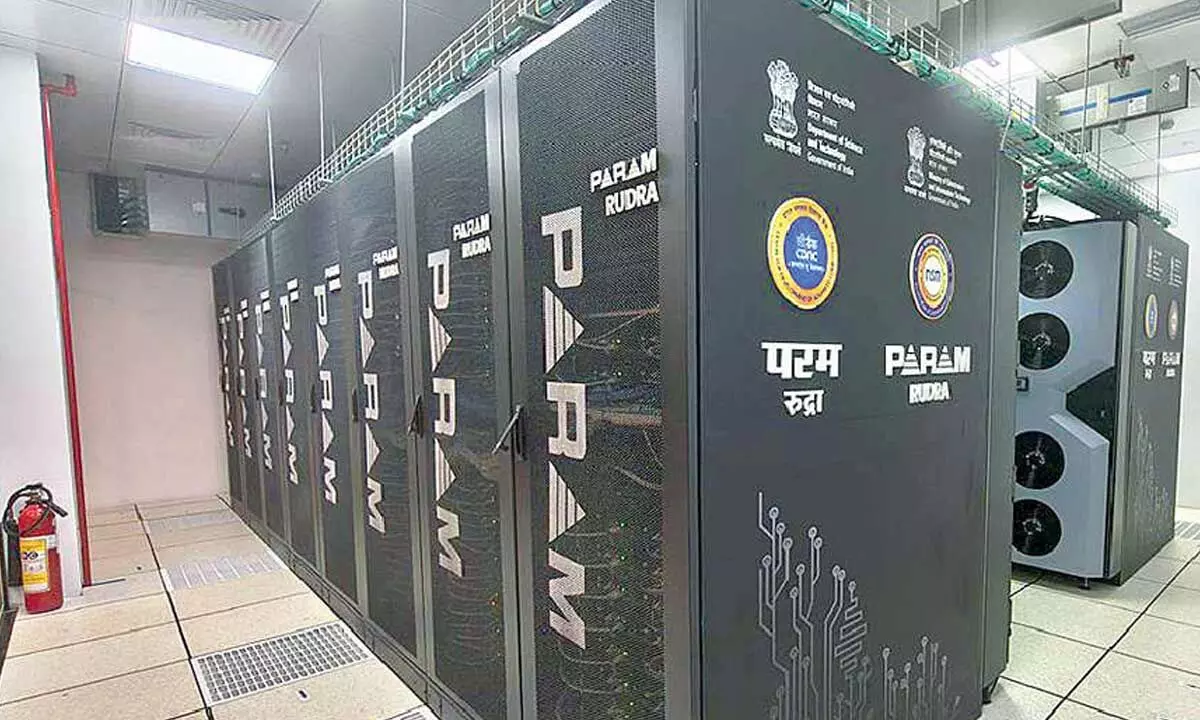
Hyderabad/Chennai: Empowering research and development across disciplines, Param Shakti’s supercomputing facility hosted the Indigenous PARAM RUDRA supercomputing system, unveiled at IIT, Chennai.
The Ministry of Electronics and Information Technology (MeitY) Secretary S Krishnan formally launched Param Shakti, a state-of-the-art supercomputing facility, hosting the indigenous PARAM RUDRA system at IIT Madras. The facility, backed by the National Supercomputing Mission (NSM), represents a major leap in India’s high-performance computing ecosystem and reinforces the nation’s commitment to technological self-reliance.
Developed by the Centre for Development of Advanced Computing (C-DAC), the PARAM RUDRA cluster delivers a peak performance of 3.1 petaflops, capable of executing over 3.1 quadrillion calculations per second. This places it among the most powerful computing systems in Indian academia. The system is built entirely in India using C-DAC’s RUDRA series of servers and runs on open-source software, including AlmaLinux and C-DAC’s indigenously designed system software stack.
The facility was inaugurated on January 3 in the presence of Prof V Kamakoti, Director of IIT Madras, E Magesh, the Director General of C-DAC, senior MeitY officials, faculty members, and students. Addressing the gathering, S Krishnan emphasised the interdisciplinary nature of IIT Madras and the importance of collaborative research enabled by such advanced infrastructure. He noted that under NSM, 37 supercomputers have already been installed nationwide, with more in the pipeline, including India’s largest system planned for Bengaluru.
Highlighting the broader vision, Krishnan explained that the IndiaAI Mission is deliberately fostering diversity in GPU architectures to ensure resilience and avoid dependence on a single technology. This approach, he said, will empower innovators and researchers to master multiple platforms, strengthening India’s AI ecosystem.
The Param Shakti facility integrates advanced cooling, round-the-clock power, and efficient data centre operations. It is expected to accelerate research in aerospace engineering, materials science, climate modelling, drug discovery, combustion studies, molecular dynamics, and nuclear sciences. Large-scale simulations enabled by the system will reduce experimental trial-and-error, making research faster, cost-effective and globally competitive.
Prof V Kamakoti urged students to focus on energy-efficient coding and effective GPU resource sharing, while E Magesh traced C-DAC’s journey in developing the Rudra platform. Prof G Phanikumar highlighted MicroSim, a multi-GPU solver suite for microstructure evolution developed under NSM support, which has been made open source and ranks among the fastest globally.
Operational since May 2025, the facility has already achieved over 80% utilisation, reflecting strong demand from researchers. With a power usage effectiveness (PUE) between 1.2 and 1.4, it also demonstrates high standards in energy efficiency. Researchers at IIT Madras are leveraging the system for tasks ranging from sub-atomic electronic structure calculations to large-scale structural simulations.
As India moves towards exascale computing capacity in the coming years, facilities like Param Shakti will play a pivotal role in enabling indigenous, globally competitive computational tools and solutions.


