




- Delhi Rains: Heavy Downpour Floods IGI Airport, Nine Flights Diverted Within An Hour
- Congress failed to implement women’s guarantees: Madhusudhanachari
- ‘Dharmasthala Niyojakavargam’ review: A meaningful political drama with a strong social message
- Navies of India and Thailand reaffirm commitment to capacity building, training
- Poco X8, X8 Power Launch in India with Big Batteries and Snapdragon Chips
- AP, Telangana to receive rains amid cyclonic circulation in Bay of Bengal
- Govt to make all efforts for better solution to Bhopal sealing issue: CM Mohan Yadav
- South Korean President Lee designates flood-hit Tongyeong as special disaster zone
How to Build a Tennis Player Profile Page That Feels Useful, Not Generic
In Short
A practical guide for developers, sports publishers and product teams who want player pages that go beyond a name, country, ranking and list of recent scores.

Share :
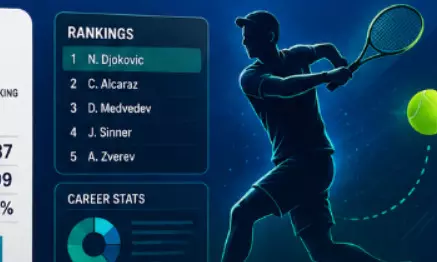
Most tennis player profile pages show a player’s name, country, ranking and recent results. That information is useful, but it often feels generic because it confirms who the player is without explaining the player’s current story.
For developers and sports product teams, the challenge is rarely getting one API response onto a screen. The harder work is building a data model that survives real match conditions, supports future features and gives users enough context to trust what they are seeing.
This guide explains the product and data requirements behind the topic, using exactly two approved references: Tennis Stats API on RapidAPI and MatchStat’s tennis data API guide.
Key Takeaway
A useful tennis player profile page needs stable identity, rankings, recent results, upcoming fixtures, surface context, stats and clean links to match and tournament records.
The Problem with Generic Player Pages
A generic player page displays facts without explaining their meaning. A ranking appears, but the page does not show whether the player is moving up or down.
A useful page helps users understand form, surface performance, ranking context, recent results and upcoming fixtures.
Start with Stable Player Identity
The foundation is player identity. Names can vary by spelling, accent, initials or formatting. A profile should be anchored by a stable player ID.
That ID connects rankings, fixtures, results, stats, tournaments and historical records.
Recent Form Needs Context
A list of recent results is helpful, but it should include surface, tournament, round, opponent and match status. A clay win streak means something different before a grass event.
Retirements and walkovers should be labelled so users and automated systems interpret form correctly.
Stats Turn Profiles into Insight Pages
Stats help explain how a player is performing, not just whether they won. Serve performance, return numbers, break points, tiebreaks and surface records can make a profile more useful.
The goal is not to overload the page. It is to add context that helps users understand the player.
AI-Ready Profiles Need Structure
AI summaries can improve player pages, but only when the data layer is connected. The system should retrieve the right player, recent matches, rankings and surfaces before writing anything.
A strong profile is a live data hub, not a static biography.
Common Mistakes to Avoid
The most common mistake is building for a clean demo instead of real tennis. Demos usually show scheduled matches, live scores and normal completed results. Production needs to handle delays, suspensions, retirements, walkovers, tiebreaks, duplicate-looking names and changing tournament context.
Another mistake is treating data fields as isolated. Player IDs, match IDs, tournament IDs, round values, surfaces, rankings and status fields should work together. If they do not, every future feature becomes harder to maintain.
- Using player names instead of stable IDs.
- Ignoring match status and result type.
- Failing to connect fixtures to live scores and final results.
- Adding AI summaries before the data layer is trustworthy.
- Caching all tennis data with the same refresh rules.
Expert Perspective
“A good tennis product should help users understand the context behind a player, not just show a name, ranking and score. The value is in connecting the data points.”
— James Morris, Founder
Implementation Detail That Matters
One practical way to improve reliability is to design the database around the lifecycle of a match. A fixture should not be treated as a temporary object that disappears when play begins. It should become the live match, then the completed result, while retaining the same identity and relationships.
This approach helps frontend teams, backend services and content workflows use the same source of truth. The player page, tournament page, live scoreboard, archive and AI summary should all point back to the same underlying records rather than separate copies of similar data.
It also makes testing easier. Developers can test scheduled, live, suspended, retired, walkover and completed states against one consistent model. That is much safer than building one-off handling for each page template.
It also makes testing easier. Developers can test scheduled, live, suspended, retired, walkover and completed states against one consistent model. That is much safer than building one-off handling for each page template.
Final Verdict
How to Build a Tennis Player Profile Page That Feels Useful, Not Generic is ultimately about product trust. A tennis site or app can look polished while still breaking when match states change, rankings move, fixtures shift, or historical records need context.
The strongest implementations start with structure. They connect players, matches, tournaments, rankings, scores, stats and results through stable IDs and clear status fields. That gives developers a foundation for live pages, archives, search, analytics and AI-assisted product features.
For teams building serious tennis products, the priority is not just getting data onto a page. It is making the data reliable enough that users, editors, developers and automated systems can depend on it every day.
PV Sunitha Selected as Best Teacher in Hyderabad District
Kappan conviction reopens old Pala battle, Jose K. Mani calls verdict an insult to constituency
In Jharkhand's Jamtara, beneficiaries explain transformation in their lives under PMAY scheme
Sr Men Inter-Department Hockey: PSPB, RSPB, FCI, SAI win one-sided matches
PM Modi congratulates Giorgia Meloni on becoming Italy's longest-serving Prime Minister
ISRO launches EOS 05 satellite successfully from Sriharikota
Nepal Flood Rescue: 2 Workers Pulled Alive From Hydropower Tunnel After 9 Days
CM Chandrababu wishes Telugu People on Sri Krishna Janmashtami
IndiGo flight hits pole while parking at Srinagar airport; passengers, crew safe
PV Sunitha Selected as Best Teacher in Hyderabad District


