‘AI is not replacing engineers - it is redefining them’


Prof. Harish Reddy Gantla explains how artificial intelligence is reshaping engineering education, skills, and career readiness
Artificial intelligence (AI) is rapidly transforming the landscape of engineering education, prompting institutions to rethink traditional teaching models and align with the demands of an increasingly technology-driven world. As industries evolve, the need for engineers equipped with AI knowledge and practical skills has become more critical than ever.
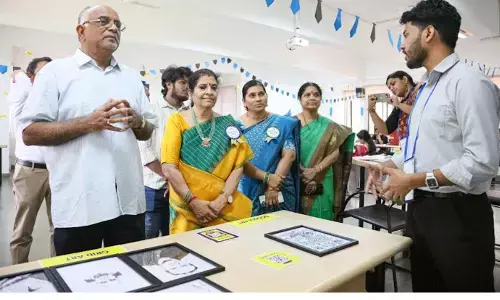
In speaking to The Hans India at The Hans India, hmtv Education Awards 2026 recently, Prof. Harish Reddy Gantla, Associate Professor at Vignan Institute, emphasised that AI represents not just a technological advancement but a fundamental shift in the way education is delivered and consumed. Engineering institutions, he noted, are moving beyond conventional disciplines and integrating AI into diverse fields of study.
One of the most visible changes is the introduction of specialised programmes such as Artificial Intelligence and Machine Learning (AIML), Data Science, and AI integrated with the Internet of Things (AIoT). These courses focus on building a strong foundation in AI concepts, including machine learning, data-driven decision-making, and intelligent systems. Unlike traditional curricula, they emphasise real-world applications, preparing students to solve complex industry problems.
Equally important is the shift from theoretical learning to experiential education. Classrooms are no longer limited to lectures and textbooks. Students are encouraged to explore online platforms, use open-source tools, and work on live projects. Prof. Gantla stressed that understanding concepts alone is not enough—students must apply their knowledge through experimentation and project-based learning.
He noted that by 2030, AI is expected to be embedded in most devices and systems, making adaptability and continuous learning essential. Engineering graduates must evolve alongside technology, embracing lifelong learning to stay relevant.
Addressing concerns about job displacement, Prof. Gantla clarified that AI will not replace engineers but redefine their roles. While AI can automate tasks like coding and data analysis, it cannot replicate human creativity, critical thinking, and emotional intelligence. Students must therefore develop a balanced skill set combining technical expertise with cognitive abilities.
Programming knowledge, especially in Python, has become essential for those entering AI-driven fields. However, technical skills alone are insufficient. Students must also learn to critically evaluate AI-generated outputs instead of accepting them blindly. This analytical approach distinguishes skilled professionals from passive users of technology.
Curiosity and self-learning are key traits for success. Students should go beyond classroom learning by exploring research papers, online resources, and industry trends. Building small applications and models can help them understand system design and real-world problem-solving.
Interdisciplinary learning is another major trend. AI is now applied in healthcare, agriculture, finance, and environmental science. Students who combine AI expertise with domain knowledge will have a significant advantage in the job market.
Prof. Gantla also emphasised the need for institutions to adopt application-oriented teaching. Curricula should include case studies, live projects, and problem-solving exercises. Creating an ecosystem that fosters innovation through workshops, hackathons, and research initiatives is equally important.
He said that AI should be seen as an enabler, not a threat. While it may automate repetitive tasks, it also creates new opportunities. In the future, it will not be AI that replaces humans, but people who effectively use AI who will replace those who do not.