




- Sundar Pichai Welcomes Meta’s AI Models to Google Cloud
- Google Unveils New AI Chips in Major Challenge to Nvidia
- Kia Car wrecked in PVNR Expressway Accident in Hyderabad
- Deepavali pollution pushes two AP cities into ‘poor’ air category
- Vizag gears up for CII Partnership Summit
- Supervisory failure under scrutiny as official avoids transfer proceedings
- Eight Nandyal students complete state-level Red Cross training programmes
- Onions to be sold at Rs 35 per kg in Madanapalle, Rayachoti
Arnab and Murasu Leave Over 4.6 Lakh Hectares of Crops Damaged
In Short
Cyclones Arnab and Murasu damaged over 4.61 lakh hectares of crops and affected thousands of farmers, with Andhra Pradesh officials estimating agricultural losses worth more than Rs 3,200 crore.

Share :
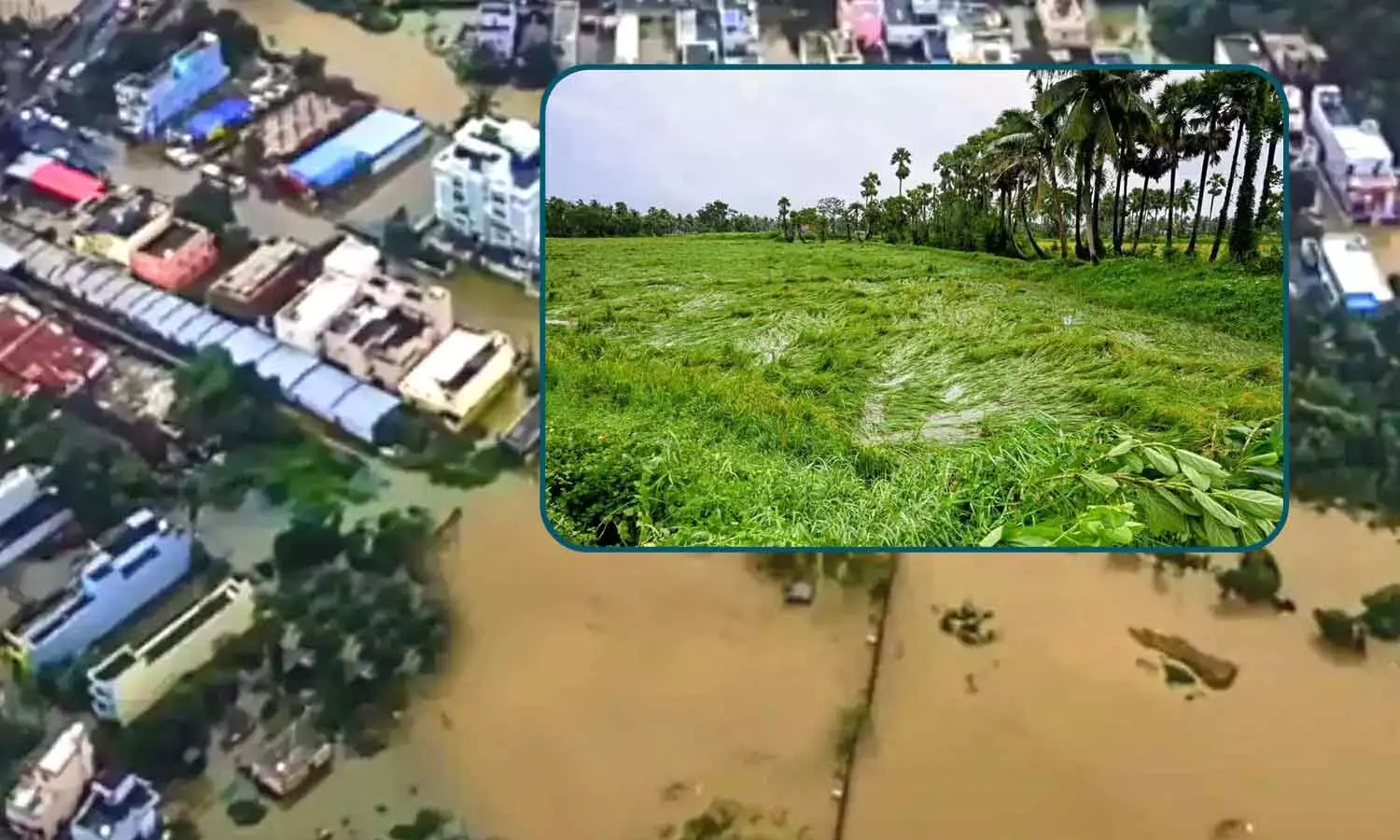
Arnab and Murasu Leave Over 4.6 Lakh Hectares of Crops Damaged
According to officials, crops over 4,61,194 hectares were damaged. The cyclone also damaged horticultural crops across 29,960 hectares.
Officials reported that, under the impact of Cyclone ‘Arnab’, crops over 3,27,843 hectares suffered damage in 15 districts, affecting 5,23,136 farmers. The damaged crop area was 30.05 per cent of the 10,90,933 hectares under cultivation in the affected districts. The officials estimated a production loss of 9,78,091 tonnes, resulting in a financial loss of Rs 2,392.84 crore.
In Dr B.R. Ambedkar Konaseema district alone, 99.19 per cent of the cultivated area was damaged, affecting 94,808 farmers and resulting in a financial loss of Rs 348.88 crore. The estimated requirements under the State Disaster Response Fund (SDRF) and the National Disaster Response Fund (NDRF) are Rs 815.57 crore and Rs 714.96 crore, respectively.
Due to the impact of Cyclone ‘Murasu’, crops across 1,33,351 hectares were damaged across nine districts, affecting 186,269 farmers. The damaged crop area was 23.71 per cent of the total cultivated area of 5,62,445 hectares. The financial loss is estimated at Rs 816.53 crore, with a production loss of 3,38,302 tonnes. The estimated requirements under the SDRF and NDRF are Rs 321.64 crore and Rs 266.67 crore, respectively.
The officials also stated that due to Cyclone ‘Arnab’, 23,211.48 hectares of horticultural crops were damaged across 215 mandals and 1,310 villages in 15 districts, affecting 58,990 farmers. Enumeration has been completed for 23,035.08 hectares (99.24 per cent), involving 58,630 farmers. The enumeration for the remaining 176.40 hectares, involving 360 farmers, is still pending. Out of the 15 districts, 14 have completed 100 per cent of the enumeration, while Krishna district has reached 86.67 per cent.
Minister Atchannaidu, who reviewed the progress, directed officials to conduct a comprehensive field-level assessment of the damages caused by the two cyclones and to identify, on a district-wise basis, the remaining crop area and the number of farmers yet to be registered. He emphasised that the enumeration process must be expedited to ensure that no eligible farmer is left out.
Sonia’s Memoir forgets PV Narasimha Rao from the History of Economic Reforms
Sonia’s Memoir: Selective Memories, Convenient History
AP Cabinet to meet today, to discuss major investment proposals
‘May your lives overflow with health, joy and enthusiasm’: PM Modi extends Gujarati New Year wishes
Arnab and Murasu Leave Over 4.6 Lakh Hectares of Crops Damaged
AP ministers congratulate CM Chandrababu and Pawan in local body elections victory


