




- South Hyderabad set to emerge as city’s next major growth corridor
- Assembly seeks Central aid over rainfall deficit
- Residents cry foul over mounds of garbage in the vicinity of JBS
- HYDRAA chief inspects IDL lake to ensure hassle-free immersion
- Trade body urges Centre to roll back UPI charges
- Mamata backs Cong in Nandigram after her candidate withdraws
- Football vs Envelope: Mamata, rebels get new names, symbols
- Modi to open environment meet today
South Hyderabad set to emerge as city’s next major growth corridor
In Short
Aerospace, IT, manufacturing and mega infrastructure projects are opening up fresh real estate opportunities across the southern belt

Share :
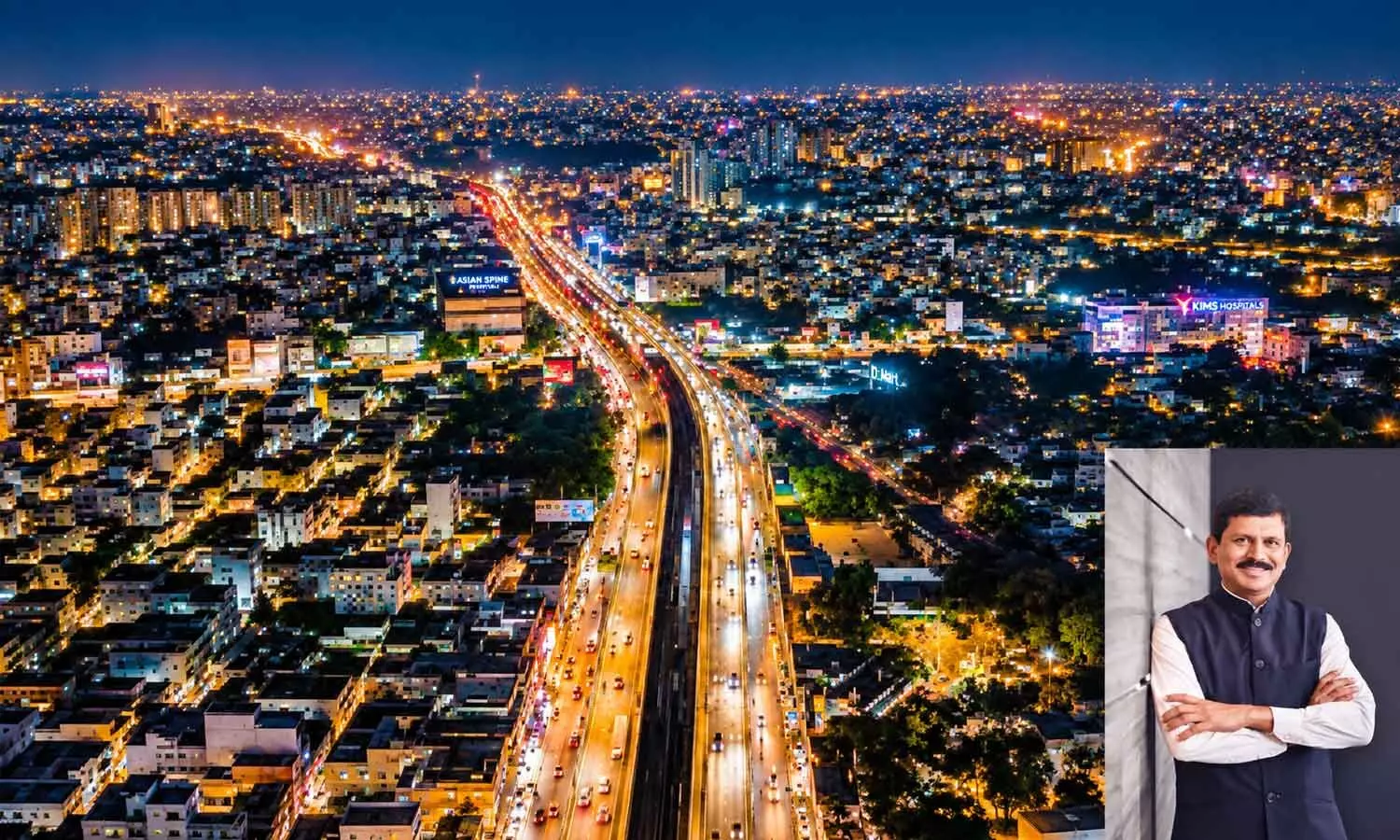
South Hyderabad set to emerge as city’s next major growth corridor
‘‘The western corridor took the better part of two decades to mature into the commercial hub it is today, and much of its growth story has already played out. South Hyderabad is still early in that curve, and that is exactly what gives it its headroom -Gummi Ram Reddy, CMD, Ark Group& president-elect, Credai National
Hyderabad: Hyderabad’s southern belt is emerging as the city’s next major real estate growth corridor, with a convergence of employment, infrastructure and connectivity creating the conditions for sustained residential, commercial and mixed use development.
Gummi Ram Reddy, Chairman and Managing Director, Ark Group, said the region was benefiting from a combination that had the potential to reshape Hyderabad’s real estate map.
“South Hyderabad’s rise is being driven by a rare convergence of employment, infrastructure and connectivity — three forces that don’t often come together at this scale in one part of a city,” he said.Major aerospace, IT and manufacturing companies are establishing a presence in the region, while Bharat Future City and a fresh wave of road and transit corridors are adding to its growth potential. This will together create employment, support infrastructure and sustain demand for residential and commercial real estate, Reddy, who is also president-elect of Credai National, noted.
“The western corridor took the better part of two decades to mature into the commercial hub it is today, and much of its growth story has already played out. South Hyderabad is still early in that curve, and that is exactly what gives it its headroom,” Reddy said. He identified Kongarkalan, Tukkuguda, Adibatla, Maheshwaram and Shamshabad, along with areas around Future City, as key micro markets.“What makes this corridor compelling is its proximity to the airport, to major employment hubs, and to the infrastructure coming up around it.”For developers, he said, “that combination of access and headroom is rare”, while for long term investors, the region provides an entry point that the western corridor no longer offers.
“The airport ecosystem and the Outer Ring Road connectivity have done more to reshape South Hyderabad than perhaps any other factor.It has been the single biggest catalyst,” Reddy said.’
Bharat Future City is expected to provide another major growth engine. Reddy pointed to investments and proposals including Amazon Web Services’ planned $7 billion data centre investment, TCS HyperVault’s Rs 70,000 crore AI data centre campus and UPC Volt’s proposed Rs 5,000 crore AI data centre investment.
The Future City plans also include a 300 acre AI and technology hub, a 200 acre Health City, a 500 acre Education Hub and a 3,000 acre life sciences hub. The focus, he said, is on attracting Fortune 500 companies and GCCs.
“Four things stand out for me: Future City, the proposed Ratan Tata Roadplanned as a 41.5 km corridor connecting the ORR, the planned expansion of metro and regional rail connectivity with Bullet train connectivity to various parts of the country, and the continued growth of aerospace, IT and manufacturing hubs in the region,” Reddy said.The infrastructure push is already prompting developers to look South. “We are seeing a sustained shift in developer interest towards South of Hyderabad, across residential, villa, commercial and mixed use formats. This is not speculative interest.It is being driven directly by the infrastructure and employment growth in the region, and I expect that momentum to strengthen considerably over the next five to ten years,” he noted.
The real advantage, he believes, is that the locations in South Hyderabad still have significant room to mature, compared with a western corridor where much of the appreciation has already been priced in. Reddy also sees the region evolving beyond a residential extension of Hyderabad.The scale of development is already significant, particularly along the airport corridor, where many residential units are under development. However, Reddy declined to put an artificial figure on the total investment made over the past three years or the future pipeline.
“With Future City, industrial and aerospace investments, and major connectivity projects in the pipeline, I expect substantial additional private investment over the next five years,” he said, adding that continued expansion of employment, infrastructure and development activity was a more reliable indicator of the region’s investment potential.
Property prices have already seen healthy appreciation over the past five years in Tukkuguda, Adibatla, Kongarkalan, Maheshwaram and Shamshabad. Reddy expects the momentum to continue through 2030, though he is cautious about putting a fixed percentage on future appreciation.
“I would be cautious about predicting a fixed percentage, but I can say with confidence that strategically located micro markets with strong infrastructure potential are likely to see substantial appreciation over the next five years,” he said.
The biggest challenge, however, will be ensuring that civic infrastructure keeps pace with development, he noted. Public transport, water supply, roads, civic and social infrastructure, land aggregation and faster approval timelines will all be critical, he added. “If these keep pace with the employment and investment coming into the region, South Hyderabad can realise its full potential as an integrated urban corridor. If they lag, that is where the risk lies,” he said.
Danam disqualified: HC 'punishes' Khairatabad BRS MLA for joining Cong
Danam: Ready to contest Khairatabad bypoll
KTR welcomes High Court verdict
CM Revanth seeks Centre's help to tackle El Nino effect
Ties with US: India must stay focused on national interest
Land Chori returns to haunt Telangana politics - Will 2028 throw up a hung Assembly?


