




- Bhagwat’s Dasara message highlights Hindu undivided family
- VH presents prizes to winners at Bathukamma Kunta
- Bus operators look beyond Telangana to cut tax costs
- Yadadri plant’s fifth 800 MW unit synchronised with grid
- VIT invites applications for engineering entrance test
- Bathukamma draws 10,000 people in Australia
- Revanth will continue as CM, says TPCC chief
- Hyderabad: GHMC gives floral waste an eco-friendly makeover
Bhagwat’s Dasara message highlights Hindu undivided family
In Short
The newspaper has been publishing donation theft news in Ayodhya very prominently, which was seen as an attempt to annoy the Narendra Modi regime.

Share :
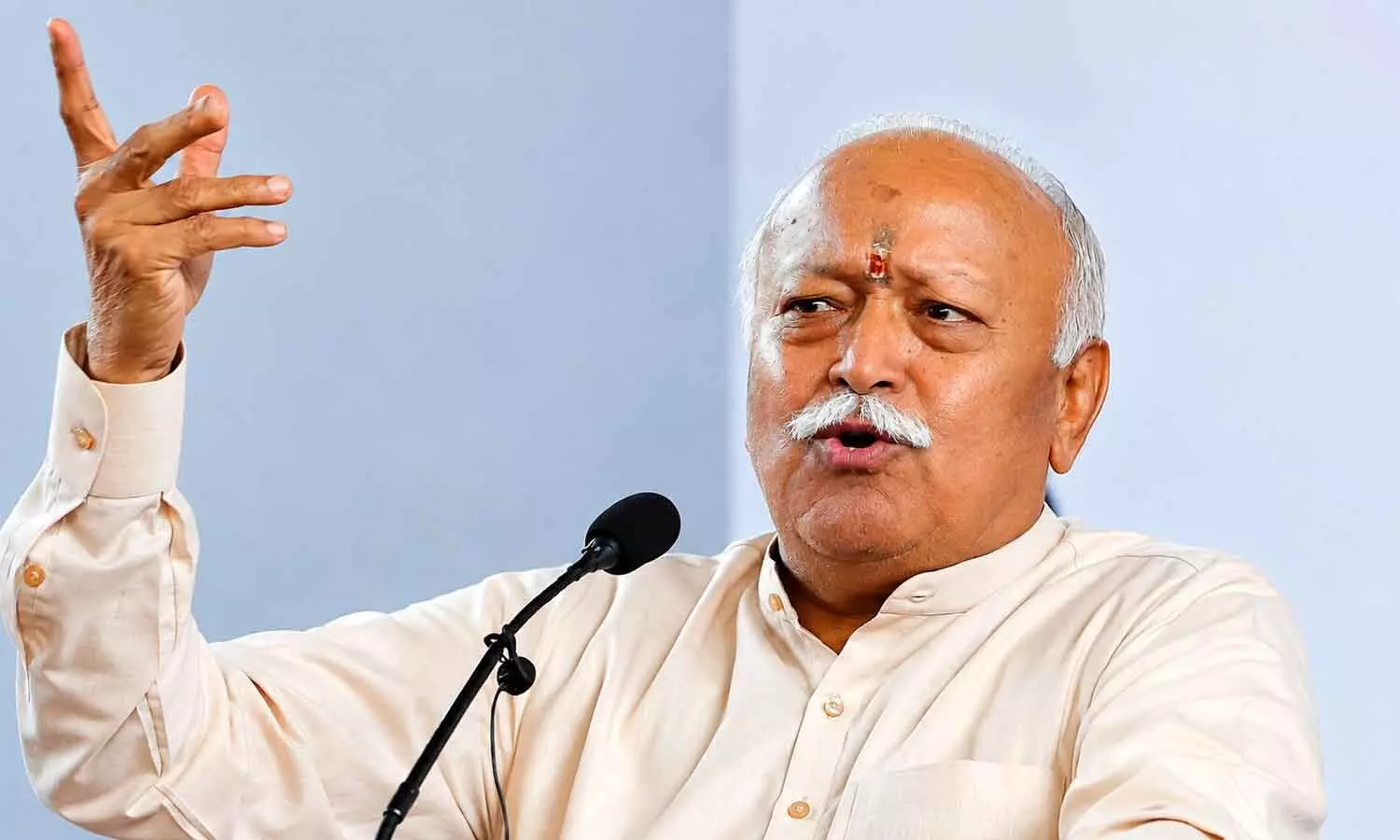
RSS chief Mohan Bhagwat
Aheadof RSS chief Mohan Bhagwat’s annual Dasara speech on Tuesday morning, there were speculations among anti-government commentators and analysts that there would be hints of a rift within the saffron brotherhood. The invitation to former vice-president Jagdeep Dhankhar and the proprietor-editor of a prominent eight-leaning newspaper, whose ties with the government have recently reportedly been strained, kept the rumour mill churning. Dhankhar’s unceremonious removal last year—though it was technically a resignation on health grounds—resulted in his complete marginalisation in the Sangh ecosystem.
The newspaper has been publishing donation theft news in Ayodhya very prominently, which was seen as an attempt to annoy the Narendra Modi regime. The speculation, however, seems to be the result of wishful thinking rather than information and intelligence. At least, Bhagwat has not said anything that can be called critical of the government. In fact, he has come to the rescue of the powers that be by trying to link the ongoing violent protests in France and other European countries, and the earlier ones in Bangladesh and Nepal, with the agitation in India, thus validating the government’s narrative that the movement against Chief Election Commissioner (CEC) Gyanesh Kumar is politically motivated. “A storm has blown in the west. Look at what transpired in France, Bangladesh and Nepal. Regime change will not happen in India.
Such attempts continue in India as well. India has moved forward with steadfast resolve, and the collective vitality (purushartha) of its society has grown,” he said. This must be music to the government’s ears. “Problems arise and movements take shape; however, these should be directed toward finding solutions. The primary objective must be a resolution. Our actions should not sow animosity, and the boundaries of propriety (maryada) must be respected,” he said. RSS functionaries are known not to name persons or groups; in this case, the use of the term maryada must be seen as a rebuke to the Cockroach Janta Party (CJP). During its successful agitation against the then education minister Dharmendra Pradhan in July, many activists used foul language (amaryadit bhasha, in RSS lingo). Whatever the RSS may be thinking, it doesn’t look like regime change.
The organisation may have its differences with the government, and its leaders may occasionally be displeased with the way the BJP functions, but such discontent should not be mistaken for a desire to dislodge the regime. The RSS has invested decades in building the political and ideological ecosystem of which the BJP is the principal beneficiary. Besides, Sangh functionaries, their friends and families have also benefited hugely. To expect that it would now seek to destabilise this symbiotic relationship will be unrealistic. The Sangh may want the government to be more attentive to the concerns of Gen Z and even the demands of CJP, but it is unlikely to jeopardise saffron hegemony because of such issues. Indeed, the RSS has little to gain from destabilising a government led by a party that has brought its ideological project closer to the centre of national politics than ever before. Any serious confrontation would risk weakening not merely the BJP but the larger Sangh Parivar, while potentially creating political opportunities for its ideological adversaries. The RSS’s preference has traditionally been to settle differences through organisational channels rather than advertise them in public domain.
Over 700 Durga idols immersed in Hooghly river till 7 pm
President Murmu to visit Chhattisgarh on Oct 22
CJP Leaders Saurav Das and Ashutosh Ranka Released
CM Chandrababu urges TDP ranks to work for alliance candidates in local polls
J&K Govt issues order enhancing monthly stipend of medical interns from Rs 12,300 to Rs 25,000
Rain and Thunderstorms Forecast Across Andhra Pradesh and Telangana


