Blending tech with education should be a measured move

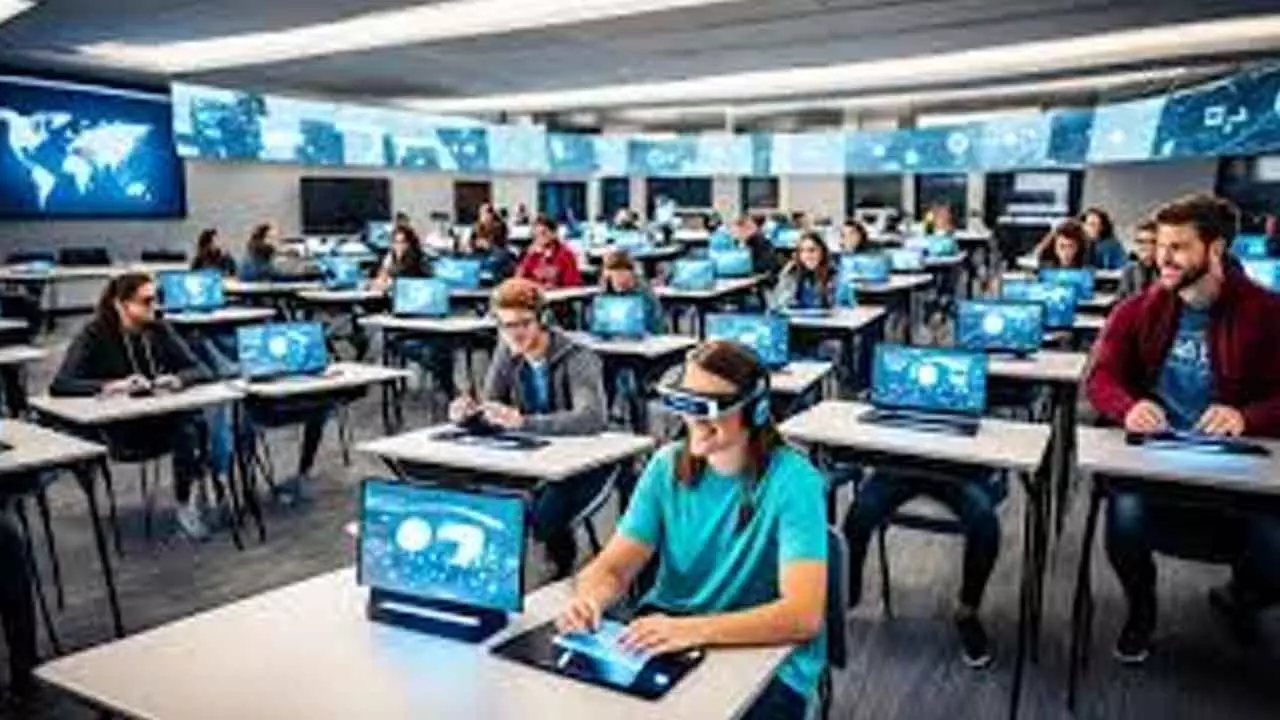
On the face of it, the Telangana government has done well by coming up with a slew of measures that are aimed at making students, right from the school level, to be career ready. Bringing in education reforms that are intended at boost public schooling through technology integration and student welfare initiatives are steps in the right direction.
Among the decisions that will ‘prepare’ them for a secure future is the proposal to introduce Artificial Intelligence (AI) concepts in school curriculum. The phased introduction is to make the students adept at handling all emerging technologies and be competition ready. Towards this, spreading digital awareness and equipping them with problem solving skills, is a sound move.
The government’s seriousness in achieving the intended goals is evidenced by the fact that foremost among the plans is in strengthening school infrastructure. Upgrading curriculum that keeps pace with prevailing trends and current requirements and are complemented with improved academic, administrative models and qualified teachers will all be progressive and workable ideas, provided they are implemented with the earnest with which the authorities plan to go about.
However, in their overwhelming focus on introducing tech-backed education, the authorities are overlooking some crucial aspects, which, if left unaddressed, could kill the very purpose of the grandiose reforms. A keen follower of the changes that are being rung opined that there are some latent lacunae that somehow do not sink with the intention of the authorities.
Despite it not being said in the open, a heated debate is underway over the pros and cons of the proposed reforms. On the one side, policymakers, who will back every move of the government as is their wont and for obvious reasons, and technology experts see is as a forward looking move that helps students to enthusiastically embrace the digital future, while on the other hand cognitive researchers remain wary while contending that this could undermine the knowledge gained naturally about the evolution and growth of human cognition. Ironically, both sides are seemingly right.
Whispers doing the rounds in the corridors of power are that some higher-ups are hastily (read it as blindly) promoting the proposal merely to be in the good books of the government, perhaps for later day gains. This explains the push for Artificial Intelligence into school education, despite the inherent flaws. IT modules for classroom access are being drafted in consultation with IT professionals, which makes sense given the expertise they bring along.
Taken as a whole, one comes across many ifs and buts with the most glaring one being the manner experts from fundamental sciences, including physics, life sciences, and cognitive psychology, are not being consulted. In fact, they remain virtually sidelined, even though their inputs could have given a sense of completeness to the reforms and made them relevant.
Speaking about a proposed major transformation of the state’s education system, Chief Minister A Revanth Reddy on February 27 declared that AI will be integrated into the school curriculum starting from the 2026-27 academic year. Towards this, he wanted officials to implement short-term AI training for teachers to help them adapt to the shifting technological landscape.
Indeed, rejecting technology per se is not the answer but designing education that respects the natural trajectory of cognition while preparing children for the digital age makes for an all-encompassing shift. However, one fails to understand why in their quest for AI one-upmanship, the government is calling for English medium of instruction, while meting out a step motherly treatment for Telugu language.