




- Resolve to fight darkness
- Factional feud escalates in Manthani Congress
- KU Inter-Collegiate Powerlifting and Best Physique competitions held successfully
- NRI University celebrates Freshers’ Day
- CM Revanth Reddy greets people on Diwali
- Int’l conference at Siddhartha University concludes
- CM Revanth Reddy to distribute 4.5 lakh new pensions in Kodangal today
- APSECM launches state-level short video contest for students
Poetic Celebration of India’s Heritage
In Short
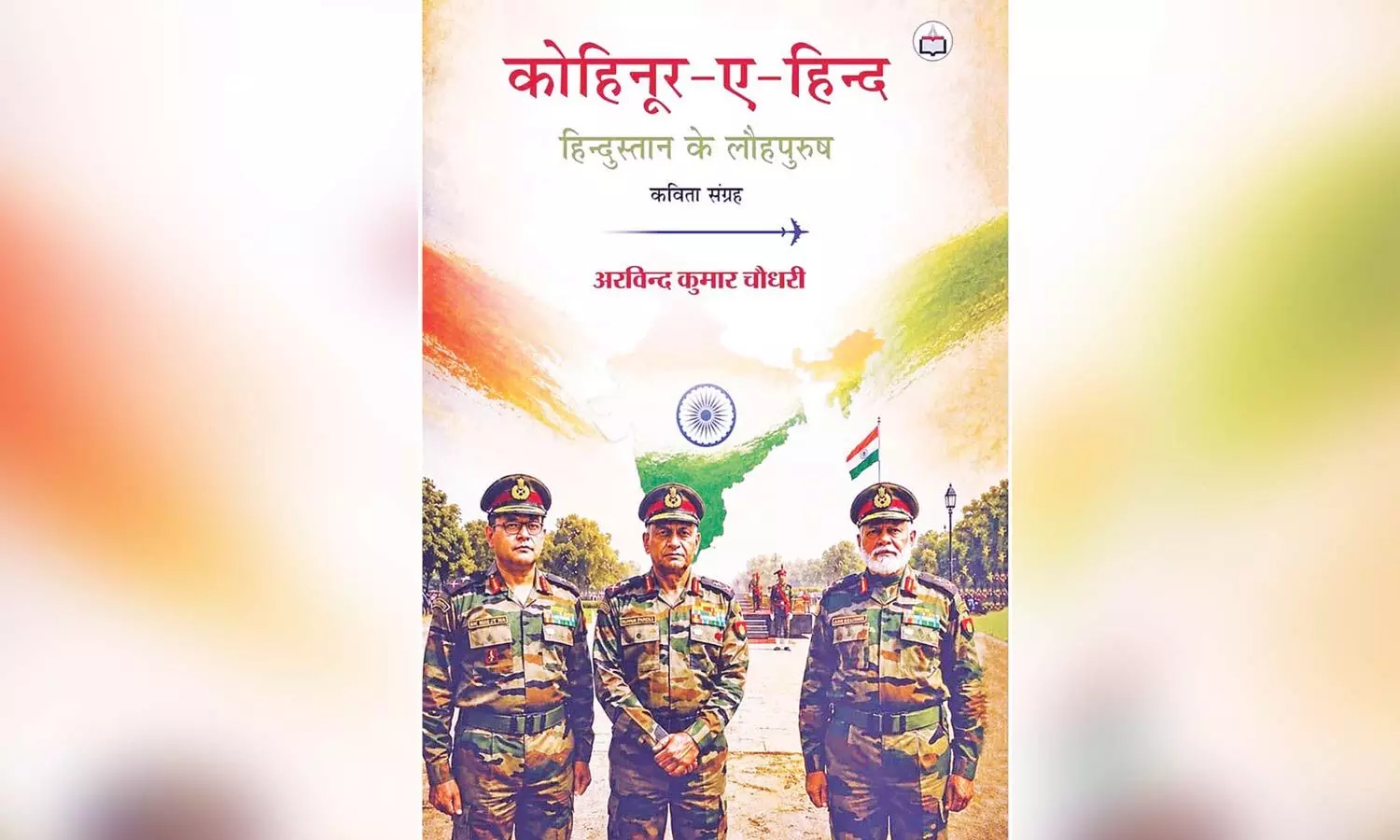
‘Kohinoor-e-Hind’ by Arbind Kumar Choudhary is a Hindi poetry collection that explores India’s history, mythology, patriotism and cultural identity through 100 distinctive sonnets. Blending traditional literary influences with contemporary national themes, the collection celebrates the country’s heritage, prominent leaders and civilisational legacy

Share :
Poetic Celebration of India’s Heritage
‘Kohinoor-e-Hind’, a Hindi poetry collection by Arbind Kumar Choudhary, is an ambitious literary exploration of India’s historical legacy, cultural identity and contemporary national consciousness. Comprising 100 Arbindonean sonnets, the collection brings together history, mythology, patriotism and political thought through the poet’s distinctive creative expression. Three prominent national figures, Subhas Chandra Bose, Sardar Vallabhbhai Patel and Prime Minister Narendra Modi, occupy a central position in the poet’s imagination. Through their respective contributions and public legacies, Choudhary explores themes of courage, sacrifice, leadership, national unity and cultural resurgence. His portrayal of Bose reflects the revolutionary spirit and uncompromising determination associated with India’s freedom struggle, while Patel’s contribution to the integration of princely states represents political vision, diplomacy and national consolidation. The poet also examines contemporary political developments through his admiration for Narendra Modi, presenting him as a decisive leader associated with significant changes in India’s political and constitutional landscape. Rather than approaching these personalities merely as historical subjects, Choudhary uses them as symbols through which he expresses his understanding of patriotism and national identity.
An important dimension of the collection is its extensive engagement with Indian mythology and traditional cultural symbolism. Drawing inspiration from the Ramayana, Mahabharata and other mythological traditions, the poet introduces legendary personalities and archetypal figures to explore ideas of righteousness, justice, sacrifice, devotion and moral responsibility. These references create an interesting dialogue between India’s ancient heritage and its contemporary realities. The poems frequently move beyond individual personalities to address larger questions concerning society, national character and cultural values. The title itself, ‘Kohinoor-e-Hind’, reflects this broader vision of India’s historical and civilisational brilliance. Particularly interesting is the poet’s reference to Lord Rama as ‘Imam-e-Hind’, an expression that demonstrates his willingness to experiment with linguistic and cultural associations. Such references suggest an attempt to bring diverse traditions into a shared poetic framework. The collection therefore functions not merely as a tribute to selected national personalities but also as an expression of the poet’s fascination with India’s pluralistic cultural inheritance and its continuing relevance in modern times.
The most distinctive feature of Choudhary’s work is perhaps his experimentation with poetic form and language. He describes his compositions as Arbindonean sonnets, presenting an individual interpretation of the traditional sonnet structure through fourteen rhyming lines arranged in seven couplets. His effort to adapt this pattern to Hindi poetry reflects an interesting engagement with the possibilities of combining Western poetic conventions with Indian literary sensibilities. Equally noteworthy is his command over compound expressions and his creative blending of Hindi and Urdu vocabulary. Expressions such as ‘Shahid-e-Vatan’, ‘Gulzar-e-Hasti’, ‘Rustam-e-Hind’ and ‘Imam-e-Hind’ illustrate his fascination with linguistic combinations and their expressive potential. The poet also employs unusual word associations, internal rhymes and imaginative verbal constructions to give his compositions a distinctive identity. His experiments demonstrate an enthusiasm for language that goes beyond conventional poetic expression. The frequent interplay of sound, meaning and cultural reference adds another layer to the reading experience. By bringing together Eastern and Western mythological influences, traditional symbolism and contemporary references, Choudhary attempts to establish a poetic vocabulary that is recognisably his own.
Overall, ‘Kohinoor-e-Hind’ is an ambitious and unconventional literary undertaking that reflects Arbind Kumar Choudhary’s commitment to patriotic themes and formal experimentation. Its greatest strength lies in the poet’s effort to connect historical personalities, mythological traditions and contemporary national aspirations within a single poetic framework. At certain points, the abundance of symbolic references and elaborate linguistic constructions may demand additional attention from readers, but this also reflects the expansive nature of the poet’s imagination. The collection will particularly appeal to readers interested in Hindi poetry that explores nationalism, Indian mythology, historical personalities and cultural identity. Choudhary’s attempt to develop an individualised sonnet form while experimenting with Hindi-Urdu expressions gives the book a distinctive literary character. Ultimately, ‘Kohinoor-e-Hind’ stands as a celebration of India’s heritage and the poet’s personal vision of a nation shaped by its historical sacrifices, cultural traditions and continuing aspirations.
NDA sweeps AP Parishad polls
CM Naidu extends Diwali greetings to people
CII Partnership Summit in Vizag to boost global biz, tech ties: CM Naidu
Govt to develop Vanvasi Ram Lok, Ram Raja Lok: MP CM
TN BJP chief Nagenthran extends Deepavali greetings, warns against forces seeking to destabilise India
From ‘one district, one mafia’ to ‘one district, one product’: Nitin Nabin’s jibe at Akhilesh Yadav over Azam Khan


