




- Resolve to fight darkness
- Factional feud escalates in Manthani Congress
- KU Inter-Collegiate Powerlifting and Best Physique competitions held successfully
- NRI University celebrates Freshers’ Day
- CM Revanth Reddy greets people on Diwali
- Int’l conference at Siddhartha University concludes
- CM Revanth Reddy to distribute 4.5 lakh new pensions in Kodangal today
- APSECM launches state-level short video contest for students
Rediscovering the Wisdom Within
In Short
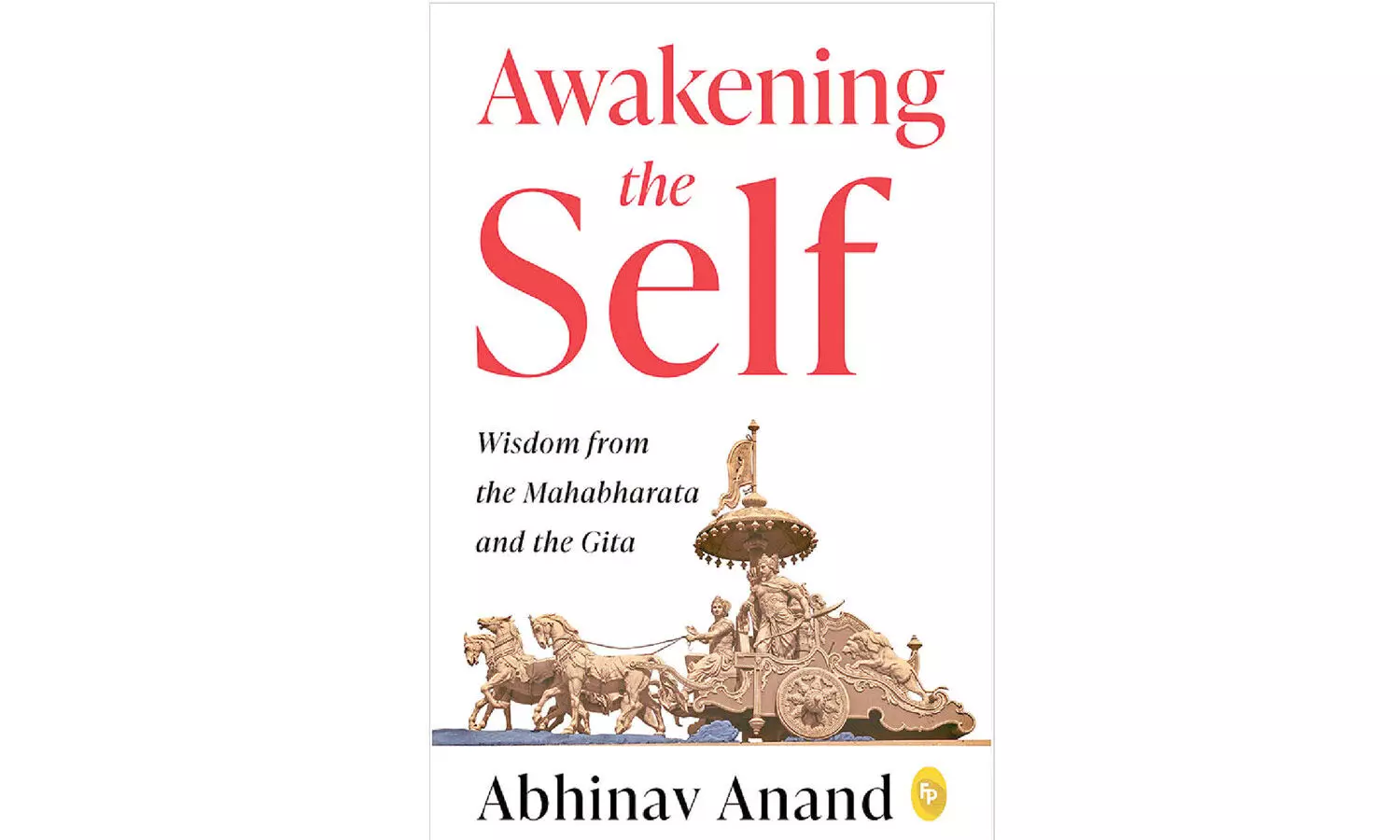
‘Awakening the Self’ by Abhinav Anand explores the timeless wisdom of the Bhagavad Gita and Mahabharata through contemporary perspectives, encouraging readers to reflect on duty, desire, self-awareness and the deeper meaning of life

Share :
Rediscovering the Wisdom Within
Some books provide answers, while others encourage us to ask better questions. ‘Awakening the Self’ by author Abhinav Anand belongs to the latter category, inviting readers to revisit the timeless philosophical wisdom of the Bhagavad Gita and the Mahabharata through the lens of contemporary thinking and logic. Have you ever wondered, why was the message of the Bhagavad Gita delivered to a warrior, and no one else? Or how do Indian scriptures approach human tendencies such as desire and anger? At a time when individuals are increasingly negotiating questions of identity, ambition, emotional conflict and moral responsibility, the book offers an opportunity to pause and ponder over the principles that govern human choices. Arjuna’s predicament was a profound human crisis involving attachment, duty, fear and conflicting responsibilities. The battlefield of Kurukshetra thus becomes a metaphor for the psychological and ethical battles that individuals continue to encounter in modern life.
The book places the Bhagavad Gita within the larger philosophical and human landscape of the Mahabharata, an epic that offers considerably more than a confrontation between two opposing armies. Its characters represent the contradictions inherent in human nature, where righteousness and ambition, loyalty and responsibility, desire and restraint frequently intersect. Through this broader perspective, the concepts of Dharma, Sva-Dharma and Karma acquire greater relevance. The distinction between knowing what is right and finding the courage to act upon it remains one of humanity’s most enduring dilemmas. The exploration of Karma Yoga is particularly meaningful in this context. The celebrated teaching, “Karmanye vadhikaraste ma phaleshu kadachana,” reminds us that our responsibility lies in performing our duties rather than becoming excessively attached to their outcomes. The book beautifully explains the true meaning of Karma Yoga and points out the real intent behind the teaching.
Another interesting dimension is the examination of human tendencies such as desire, anger, attachment and the restless nature of the mind. These are not merely abstract philosophical concerns; they influence relationships, professional decisions, personal ambitions and our responses to adversity. The discussion also raises an intriguing question about Krishna’s different teachings to different individuals through the various Gitas associated with the Mahabharata tradition.
Can wisdom be universal while its application remains deeply personal? Much like a physician approaches different patients according to their individual conditions, spiritual instruction often responds to the particular limitations and circumstances of the seeker.
This perspective adds depth to the book’s engagement with self-discipline, emotional balance and self-realisation. Its philosophical concerns also invite comparisons with the Socratic tradition of self-examination, particularly the proposition that an unexamined life is not worth living. However, Indian philosophical thought adds its distinctive understanding of consciousness, Yoga and the ultimate pursuit of Moksha. What makes ‘Awakening the Self’ relevant is its attempt to connect ancient Indian philosophy and Sanatan Dharma with questions that contemporary readers encounter in everyday existence. Rather than approaching spirituality merely through ritualistic observance, the book directs attention towards the underlying principles of awareness, purposeful action and personal responsibility. Its exploration of Moksha presents liberation not simply as a distant spiritual destination but as an inward journey towards understanding oneself and overcoming self-limiting beliefs.
The book will appeal to readers interested in the Bhagavad Gita, the Mahabharata, Hindu philosophy, spiritual inquiry and personal development. Ultimately, its greatest invitation is perhaps also its simplest: before attempting to understand the complexities of the world, one must begin by understanding oneself. After all, the most consequential journey is not always towards a distant destination; sometimes, it is towards the self.
(The writer is an Internationally Acclaimed Literary Critic, an eminent Columnist and the Founder of Authors Paradise Literary Group.)
NDA sweeps AP Parishad polls
CM Naidu extends Diwali greetings to people
CII Partnership Summit in Vizag to boost global biz, tech ties: CM Naidu
Govt to develop Vanvasi Ram Lok, Ram Raja Lok: MP CM
TN BJP chief Nagenthran extends Deepavali greetings, warns against forces seeking to destabilise India
From ‘one district, one mafia’ to ‘one district, one product’: Nitin Nabin’s jibe at Akhilesh Yadav over Azam Khan


