




- Cultural celebration: Redefining true talent
- Furqan Ahmed on the art of a successful podcast
- Will AI replace you?
- Why didn’t you just go to Pakistan?
- Impact of tariffs on BRICS: India can take lead in measuring the economic burden
- Women leaders take centre stage at HBA India Leadership Summit 2026
- Neha Dhupia: Becoming a mother has made me very shaky
- Exploring a world where time has no boundaries
Will AI replace you?
In Short
It is understandable, then, that people are worried. But perhaps we are worried about the wrong thing. Every major technological shift has changed the nature of work.

Share :
Will AI replace you?
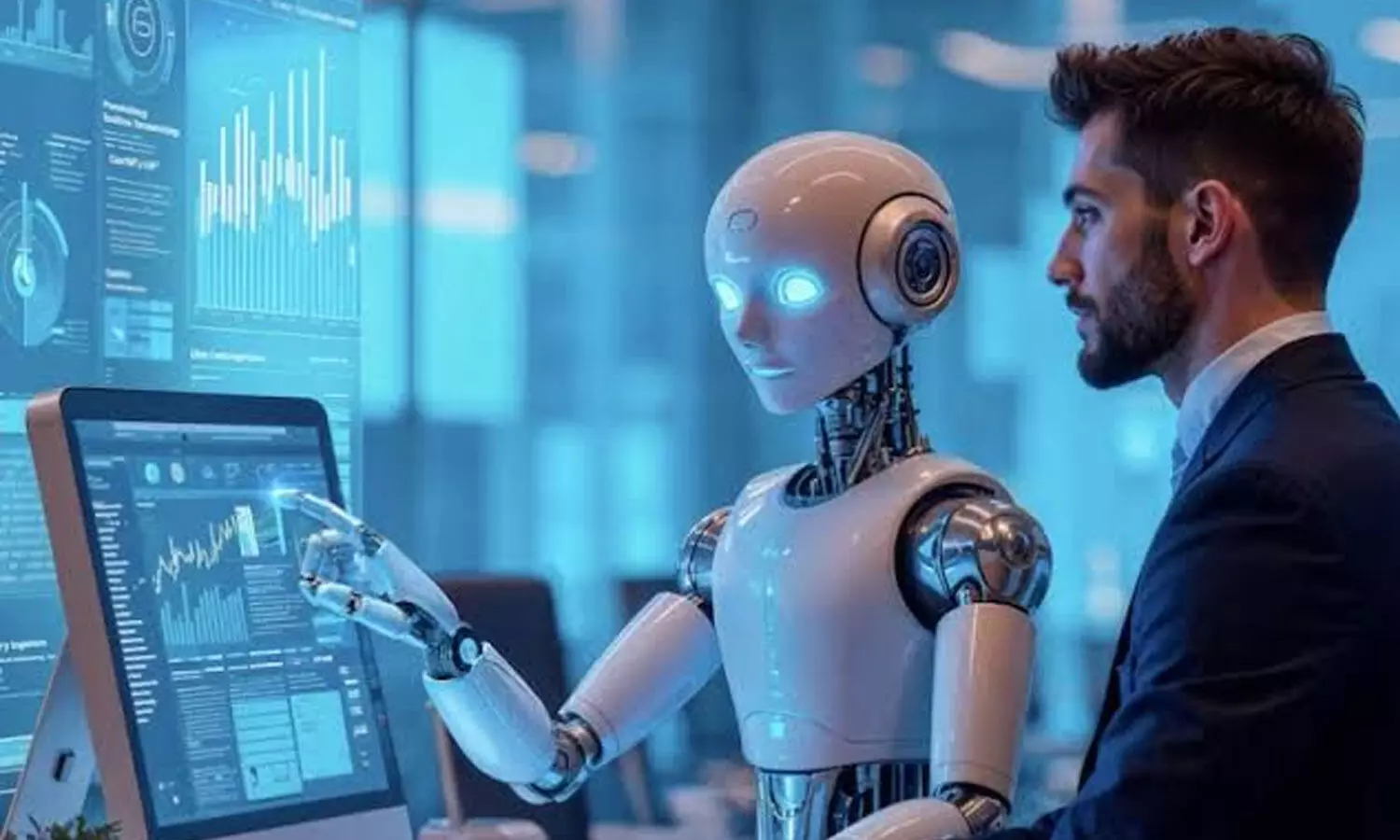
It is perhaps the most uncomfortable question of the artificial intelligence era: Will AI replace you? Until recently, that question seemed relevant mainly to repetitive and routine jobs. Machines worked in factories, software automated transactions, and humans remained comfortably in charge of thinking. That distinction is becoming harder to make. Artificial intelligence can now write, analyse financial statements, create presentations, generate computer code and examine enormous amounts of information within seconds. Work that once required years of education and experience can increasingly be assisted, and sometimes performed, by a machine.
It is understandable, then, that people are worried. But perhaps we are worried about the wrong thing. Every major technological shift has changed the nature of work. Calculators did not eliminate mathematicians. Spreadsheets did not eliminate accountants. Search engines did not make knowledge irrelevant. They changed what humans were expected to do with their knowledge. AI may be doing something similar, although the speed and scale of change feel considerably greater. For decades, professional success has been built around a familiar set of advantages. We were rewarded for knowing more, remembering more, analysing faster and executing accurately. Our education systems were designed around these abilities. Companies recruited for them, examinations tested them and careers were built upon them. AI is beginning to challenge that equation.
If everyone has access to a machine capable of reading a hundred-page report and summarising it in seconds, summarising information becomes less valuable. If AI can produce ten possible strategies before lunch, simply producing options is no longer the scarce capability. The value begins to move elsewhere. Which option should be chosen? What question was never asked? What does the data fail to capture? What might happen five years from now? What should not be done even if technology makes it possible? These are not merely questions of intelligence. They require judgment, curiosity, imagination, context and values. Imagine two professionals in the same organisation. Both have access to exactly the same AI tools. Both can generate similar analysis and receive similar recommendations. Yet one accepts the answer placed before him, while the other challenges its assumptions, notices what is missing, understands the people who will be affected and asks a question the machine was never prompted to consider. Their advantage is no longer access to intelligence. It is what they choose to do with it.
This could become one of the great paradoxes of the AI age. As machines become more capable, some deeply human capabilities may become more valuable, not less. Curiosity matters when answers are abundant. Judgment matters when recommendations are instantaneous. Creativity matters when competent content can be produced endlessly. Empathy matters when conversations can be automated. Courage matters when an algorithm can calculate the safest course but cannot decide what is worth taking a risk. Perhaps, then, the future should not be reduced to a contest between humans and machines. The more interesting possibility is that machines will force humans to rediscover what makes them valuable in the first place. So instead of repeatedly asking, “Will AI replace me?”, there may be a better question to consider: As AI becomes more capable, what will I become more capable of?
(The writer is Singapore based Banker and Author. He is an explorer of human potential in the era of artificial intelligence.)
Centre offers to back Quantum Bio Valley
Vijaya Dairy to hike milk prices by up to Rs 2/Litre from tomorrow
AP to digitise citizens’ health records from Jan 1
CM Revanth Reddy firms up steps for Ganesh festivities
Make health a priority, says Director of Public Health
Holy Darbha mat procession taken out in Tirumala


