




- V-P Radhakrishnan lays foundation for Rs 110 crore infrastructure projects at Gauhati University
- India and Bangladesh discuss ways to deepen cooperation through forward-looking approach
- Orange alert issued for rain in six south Bengal districts
- Telangana BJP chief detained during fee reimbursement protest, clash with police
- Piyush Goyal floats 5-point plan to boost ecosystem to target 10 million medical value tourists
- 'Hanuman Ansh' Producer Confirms Sequel After Film's Blockbuster Success
- CM Adhikari says Bengal economy on slow road to recovery
- 'Confident he can contribute': Bailey defends Labuschagne retaining Test spot for SA tour
IIIT Hyderabad launches centre to study learning in the AI era
In Short
IIIT Hyderabad has launched the Centre for Educational Technology and Learning Sciences (CETLS) to study how AI is transforming learning, education, critical thinking, and lifelong skill development.

Share :
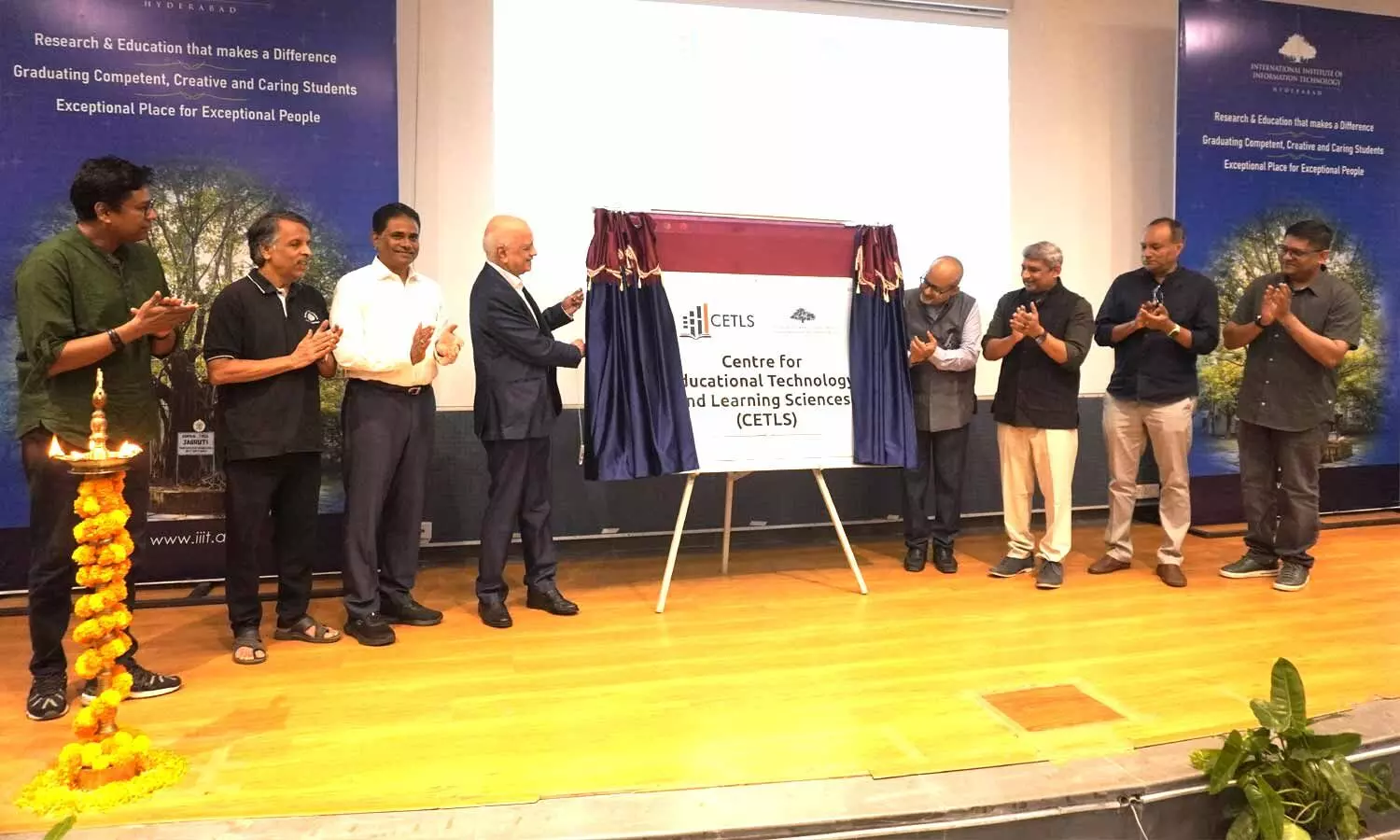
IIIT Hyderabad launches centre to study learning in the AI era
Hyderabad: The International Institute of Information Technology Hyderabad (IIIT Hyderabad) has launched the Centre for Educational Technology and Learning Sciences (CETLS), an interdisciplinary research centre focused on understanding how people learn in an age increasingly shaped by Artificial Intelligence (AI), here on Monday.
R. Chandrashekhar, former President, NASSCOM, launched the Centre in the presence of Prof. Sandeep Shukla, Director, IIIT Hyderabad; Srini Raju, Governing Council Member; Prof. P.J. Narayanan, former Director, IIIT Hyderabad; Prof. Vasudeva Varma and around 100 guests, faculty members and education practitioners. Srini Raju also unveiled the logo of CETLS.
The Centre will bring together learning sciences, cognitive science, psychology and technology to study learning across the lifespan, covering K-12 and higher education as well as workplace and later-life learning.
A key area of its work will be examining how AI can support deeper and more meaningful learning rather than simply making information and answers easier to access. CETLS will study the distinction between using AI to complete a task and using AI as part of the learning process.
The Centre will also explore “slow learning”, which allows learners time for experimentation, reflection and productive struggle. Its research will examine how technology can balance challenge and support without removing the difficulties that can contribute to deeper understanding.
Launching CETLS, R. Chandrashekhar said AI was bringing significant changes to education and that its implications needed to be understood alongside its potential benefits.
“Every powerful technology introduced over the years has carried both risks and benefits. AI is no exception,” he said, adding that CETLS could contribute to understanding how AI can improve learning outcomes.
Prof. Raj Reddy, Chief Mentor, CETLS and Founding Chairman, IIIT Hyderabad, who addressed the gathering virtually, said the emergence of AI requires education systems to reconsider existing approaches.
“With the emergence of AI, all known forms of education—from KG to PG—need to be re-examined,” he said, questioning what should be taught when information is increasingly accessible through the web and AI systems.
Prof. Reddy also highlighted the potential for AI-enabled one-to-one learning support, particularly for learners who may not have access to personalised guidance. At the same time, he said critical and skeptical thinking would become increasingly important because AI-generated information can be incorrect.
Prof. Sandeep Shukla said CETLS would examine the short-, medium- and long-term impact of AI on education and ask how learning should change in an AI-native world.
“This is not simply about introducing AI into education. We need to understand how AI changes learning itself, how curricula should evolve, how research will change and how people should be prepared for a workplace where AI is likely to be as commonplace as computers and smartphones are today,” he said.
Prof. Vasudeva Varma said the Centre would focus on understanding learning before developing technology around it. “The objective is not technology for technology’s sake, but to understand learning first and then use technology to improve it,” he said.
CETLS will work across four broad areas: K-12 education, higher education, executive education and third-age learning. Its research will examine experiential learning, AI-enabled personalised support, upskilling and reskilling, and learning environments suited to older adults.
The Centre will also study how AI-based tools can provide individualised support while encouraging learners to question, experiment, practise and develop independent understanding rather than becoming dependent on machine-generated answers.
South Africa envoy says trade with India to get booster shot at BRICS meet (IANS Interview)
V-P Radhakrishnan lays foundation for Rs 110 crore infrastructure projects at Gauhati University
UEFA to pay tribute to Nepal flood victims ahead of Champions League matches
PM Modi's Vadodara event draws huge public response, 42,000 on waiting list
Vijayasai Reddy announces about new party, outlines vision, says he is not CM candidate
BRS MLAs Protest At Gunpark Over Congress Government’s 1,000 Days In Power
Delhi Satya Niketan Building Collapse: HC To Hear Plea As Death Toll Rises To Six
Air India Express Kochi-Abu Dhabi Flight Returns After Engine Oil Drops Mid-Air
South Africa envoy says trade with India to get booster shot at BRICS meet (IANS Interview)
International Literacy Day 2026: Theme, History, Importance, Significance


