




- AI’s next disruption could be retirement planning
- Market volatility calls for caution, disciplined bets
- Unity vital for Arya Vysyas to secure political share: Revanth
- Task force push for stability, security and transparency in Maharashtra competitive exams
- BRICS emerging as key platform for Global South cooperation: Experts
- One Indian missing after attack on commercial vessel off Oman coast: MEA
- UCC will be implemented in 21 NDA-ruled states before 2029: HM Amit Shah
- Telangana Police facilitates refund of Rs 139 crore to cyber fraud victims
FCRA Amendment Bill: A threat to national security or civil society?
In Short
Explore the political debate surrounding the FCRA Amendment Bill, 2026, balancing transparency, national security oversight, and concerns over NGO autonomy.

Share :
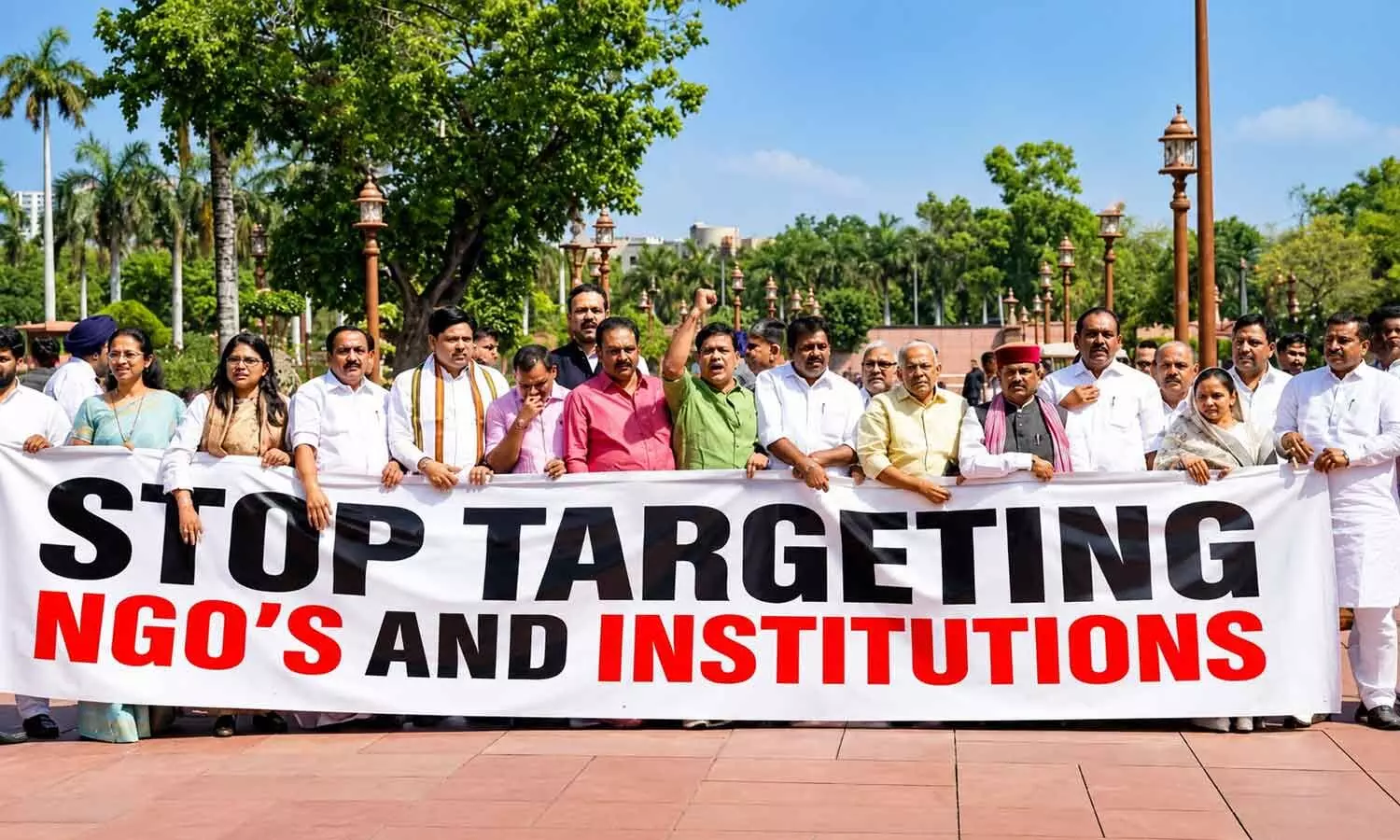
FCRA Amendment Bill: A threat to national security or civil society?
An intense political debate between the Union Government and the Opposition is underway over the Foreign Contribution (Regulation) (FCRA) Amendment Bill, 2026. The Foreign Contribution (Regulation) Amendment Bill, 2026 seeks to amend the FCRA Act, 2010. Introduced in the Lok Sabha on March 25, its primary objective is to make the regulation of foreign contributions more transparent and accountable. The government states that the proposed amendments are aimed at protecting national interests and preventing the misuse of foreign funds.
However, critics have expressed concerns that the proposed provisions could affect the functioning and independence of non-governmental organizations (NGOs) and other organizations. The Bill also proposes to reduce the maximum imprisonment for certain types of FCRA violations from five years to one year. As of August 2026, the Bill has been referred to a 31-member Joint Parliamentary Committee (JPC) for further examination.
There are genuine concerns and legal cases in India relating to the misuse, diversion, or non-compliance of foreign contributions. However, these cases should not be generalized to all NGOs or all minority organizations. In 2022, the Supreme Court noted that the flow of foreign contributions had nearly doubled between 2010 and 2019, while the government had cancelled FCRA registrations of more than 19,000 entities during the same period. Criminal investigations were also initiated against dozens of organisations over allegations of misuse or misappropriation of funds.
In 2018, registrations of more than 13,000 associations were cancelled for violations, while 86 offences had been disposed of with total penalties amounting to ₹3.14 crore. A prominent example was Greenpeace India, whose FCRA registration was cancelled in 2015 after the government alleged several violations. Another record referred to the Tuticorin Diocesan Association.
Importantly, these examples show that alleged violations have occurred among organizations working in religious, social, environmental, and other fields. Therefore, the issue should not be viewed as a problem confined to any single minority community. The major concerns alleged include failure to file annual returns, receiving foreign contributions without registration or prior permission, diversion of funds, inaccurate financial reporting, and spending foreign contributions for purposes outside those approved under the FCRA.
At the same time, courts have also scrutinized government actions. In 2024, the Delhi High Court found that the authorities had not properly considered the explanations submitted by the Commonwealth Human Rights Initiative before issuing an order cancelling its FCRA registration. This highlighted the importance of procedural fairness and impartiality in government action.
National security and transparency:
The government argues that the FCRA Amendment Bill is necessary to ensure transparency and accountability in the management of foreign funds and to prevent foreign money from being used against India’s sovereignty, security, and public interest. During 2019–20, India received approximately ₹15,853.94 crore in foreign contributions, highlighting the need for effective monitoring of such substantial financial flows. The government maintains that the amendment does not ban foreign funding, but instead strengthens regulatory procedures for legitimate NGOs, charitable organizations, and research institutions.
The Bill proposes the appointment of a “Designated Authority” to monitor and manage assets acquired through foreign contributions when an organization loses its FCRA registration. The government argues that this would address an existing administrative gap. It has pointed out that approximately 22,000 FCRA registrations were cancelled over the past decade, demonstrating the need for stronger oversight. The government has clarified that if an organization’s registration is subsequently restored, its assets and unused foreign funds would be returned in full.
The government also argues that tens of thousands of India-based organizations remain eligible to receive foreign contributions, demonstrating that the policy is regulatory rather than a blanket prohibition on foreign funding. It further points out that countries like the United States, the UK, Australia, and Canada regulate foreign funding to protect their national interests.
While the Bill is currently under parliamentary examination by a 31-member Joint Parliamentary Committee, the government defends it as a measure aimed not at targeting NGOs, but at strengthening transparency, national security, and financial accountability.
Opposition concerns:
The main objection of the opposition parties is that the FCRA Amendment Bill, 2026 would give the government greater powers over NGOs and organizations receiving foreign contributions. The Congress, Left parties, and Trinamool Congress (TMC) have described these provisions as “draconian” and have called for greater parliamentary scrutiny.
They argue that the Bill could disproportionately affect minority and religious organizations that depend on foreign contributions for activities such as education, healthcare, and charitable work. Critics also contend that the legislation could weaken the autonomy of civil-society organizations and increase executive interference in their activities.
Laws in other countries:
Although FCRA has a broad regulatory purpose, several countries have laws that regulate different aspects of foreign funding or foreign influence. The United States has the Foreign Agents Registration Act (FARA); the UK has the National Security Act 2023 and Foreign Influence Registration Scheme (FIRS); Australia has the Foreign Influence Transparency Scheme Act 2018 in place, while Canada has also been developing a foreign-influence transparency framework aimed at increasing disclosure of foreign influence and related activities.
These laws generally do not prohibit legitimate international cooperation. Instead, they seek to make foreign funding, lobbying, and influence more visible and accountable. Their broader purpose is to prevent foreign powers from secretly influencing political processes, public policy, or democratic institutions.
The best way to resolve the FCRA controversy is to avoid viewing it as a government-versus-NGO conflict and instead seek a balance between national security and the constitutional freedoms of civil society. The government should continue to maintain strict oversight of foreign funding, but the rules should be religion-neutral, transparent, and based on proven violations rather than the identity of an organization.
The 2026 rules explicitly list permissible faith-based activities, including the management of places of worship and religious education. This could help reassure minority organisations. Before cancelling an NGO’s registration or taking permanent control of its assets, the proposed Bill should provide clear reasons, prior notice, and a meaningful opportunity to respond. There should also be effective judicial review.
Since nearly 22,000 FCRA registrations have reportedly been cancelled over the past decade, an independent review mechanism would be important to prevent arbitrary action. At the same time, NGOs should accept stronger requirements for project-wise financial reporting, ultimate-donor disclosure, and audited utilization of funds. These measures are already included in the 2026 rules.
The Bill’s referral to a 31-member Joint Parliamentary Committee (JPC) provides an opportunity for the government, Opposition, NGOs, and minority representatives to examine each provision carefully and suggest improvements. Therefore, the ideal solution is to protect India’s sovereignty and national security while ensuring that genuine NGOs and minority organizations are not discouraged from carrying out legitimate humanitarian, educational, religious, or social activities.
(The writer is Professor (School of Commerce and Management), Mohan Babu University, Tirupati)
“Will CURE Bill cure civic woes of Hyderabad?”
Damodar Rajanarasimha launches state-level robotic surgery workshop at TIMS
Modi Warns of Rising Geopolitical Tensions, Technology Weaponisation
BRICS outcome an eye-opener for Opposition
FCRA Amendment Bill: A threat to national security or civil society?
Let us stay away from de-democratisation


