
Tsunami warnings triggering mass evacuations across the Pacific

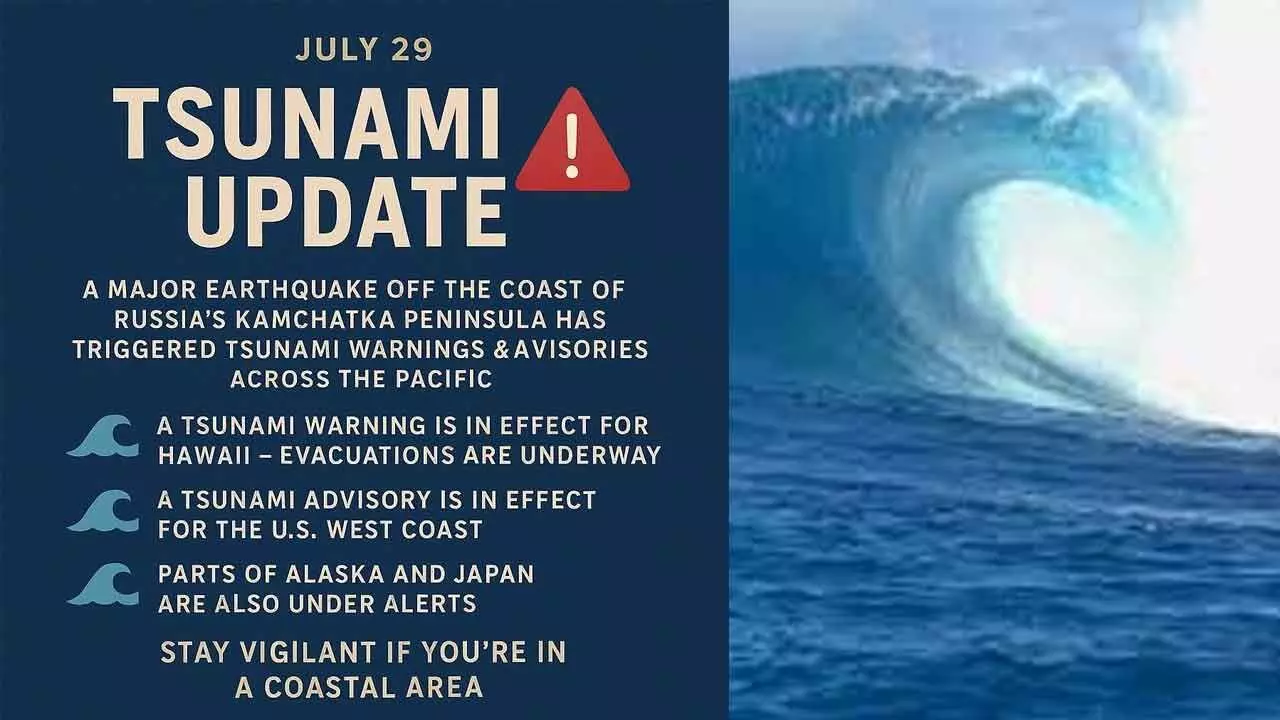
One of the ten largest earthquakes ever recorded struck Kamchatka, the sparsely populated Russian peninsula facing the Pacific. The magnitude 8.8 quake had its epicentre in the sea just off the Kamchatka coast. Huge quakes such as these can cause devastating tsunamis. It’s no surprise this quake has triggered mass evacuations in Russia, Japan and Hawaii. But despite the enormous strength of the quake, the waves expected from the resulting tsunami are projected to be remarkably small.
Four-metre-high waves have been reported in Russia. But the waves are projected to be far smaller elsewhere. For one thing, tsunami waves can suddenly escalate and even the smaller tsunami waves can pack surprising force. But the main reason is that late evacuation orders can cause panic and chaos. It’s far better to err on the side of caution.
Too early is far better than too late:
When tsunami monitoring centres issue early warnings about waves, there’s often a wide range given. That represents the significant uncertainty about what the final wave size will be. As earthquake scientists Judith Hubbard and Kyle Bradley write: “the actual wave height at the shore depends on the specific bathymetry [underwater topography] of the ocean floor and shape of the coastline.”
If evacuations are done well, authorities will direct people down safe roads to shelters or safe zones located high enough above the ocean.
Vulnerable groups such as older people and those with a disability often evacuate more slowly or not at all, putting them at much greater risk. In wealthy nations such as Japan where tsunamis are a regular threat, drills and risk education have made evacuations run more smoothly and get more people to evacuate. Japan also has designated vertical shelters – buildings to which people can flee – as well as coastal sirens and signs pointing to tsunami “safe zones”.
By contrast, most developing nations affected by tsunamis don’t have these systems or infrastructure in place. Death tolls are inevitably higher as a result. More accurate warnings, fewer false alarms
A false alarm occurs when a tsunami warning is issued, but no hazardous waves arrive. False alarms often stem from the need to act fast. Because tsunamis can reach coastlines within minutes of an undersea earthquake, early warnings are based on limited and imprecise data — mainly the quake’s location and magnitude — before the tsunami’s actual size or impact is known. In the past, tsunami alerts were issued using worst-case estimates based on simple tables linking quake size and location to fixed alert levels.
Even when waves are small at sea, they can behave unpredictably near shore. Tide gauge readings are easily distorted by nearby bays, seafloor shape and water depth. This approach often came at the cost of frequent false alarms.
In 2004, a huge 9.1 magnitude earthquake off the coast of Aceh in Indonesia triggered the Indian Ocean tsunami, the deadliest in recorded history. Waves up to 30 metres high inundated entire cities and towns. More than 227,000 people died throughout the region, primarily in Indonesia, Sri Lanka, India and Thailand. All these countries had low tsunami preparedness. At the time, there were no tsunami warning systems in the Indian Ocean. The even stronger 2011 earthquake and tsunami in Japan killed just under 20,000 people. It was a terrible toll, but far fewer than the 2004 Indian Ocean tsunami. More than 4,000 people died. These examples show the importance of warning systems and evacuations. But they also show their limitations. Even with warning systems in place, major loss of life can still ensue due to public scepticism and communication failures. What should people do? At their worst, tsunamis can devastate swathes of coastline and kill hundreds of thousands of people. They should not be underestimated. If authorities issue an evacuation order, it is worth following.
(Milad Haghani is from the University of Melbourne and Zahra Shahhoseini is associated with Monash University


