




- Hariprasad’s remarks on RSS, BJP trigger political row
- Khader expedites action on coastal projects after Mangaluru cabinet meet
- BJP’s hypocrisy will be exposed if it refuses to join all-party delegation: CM
- Kiran Bedi highlights self-discipline, positive thinking at happiness summit
- MLAs, ministers and CM failed to take drought seriously: BJP Kisan Morcha
- Eastern India to become aluminium manufacturing hub: Kishan Reddy
- CM seeks Centre’s intervention to expedite key water projects
- SIR will have no bearing on Khairatabad bypoll: Danam
A failed attempt is information, not a verdict on your potential: IIT Roorkee Prof Sugata
In Short
IIT Roorkee Prof. Sugata Gangopadhyay on helping students approach research with patience, learn from setbacks and develop curiosity. He emphasises that one unsuccessful result does not define a student’s potential, as reflection, persistence and learning from mistakes can turn setbacks into growth

Share :
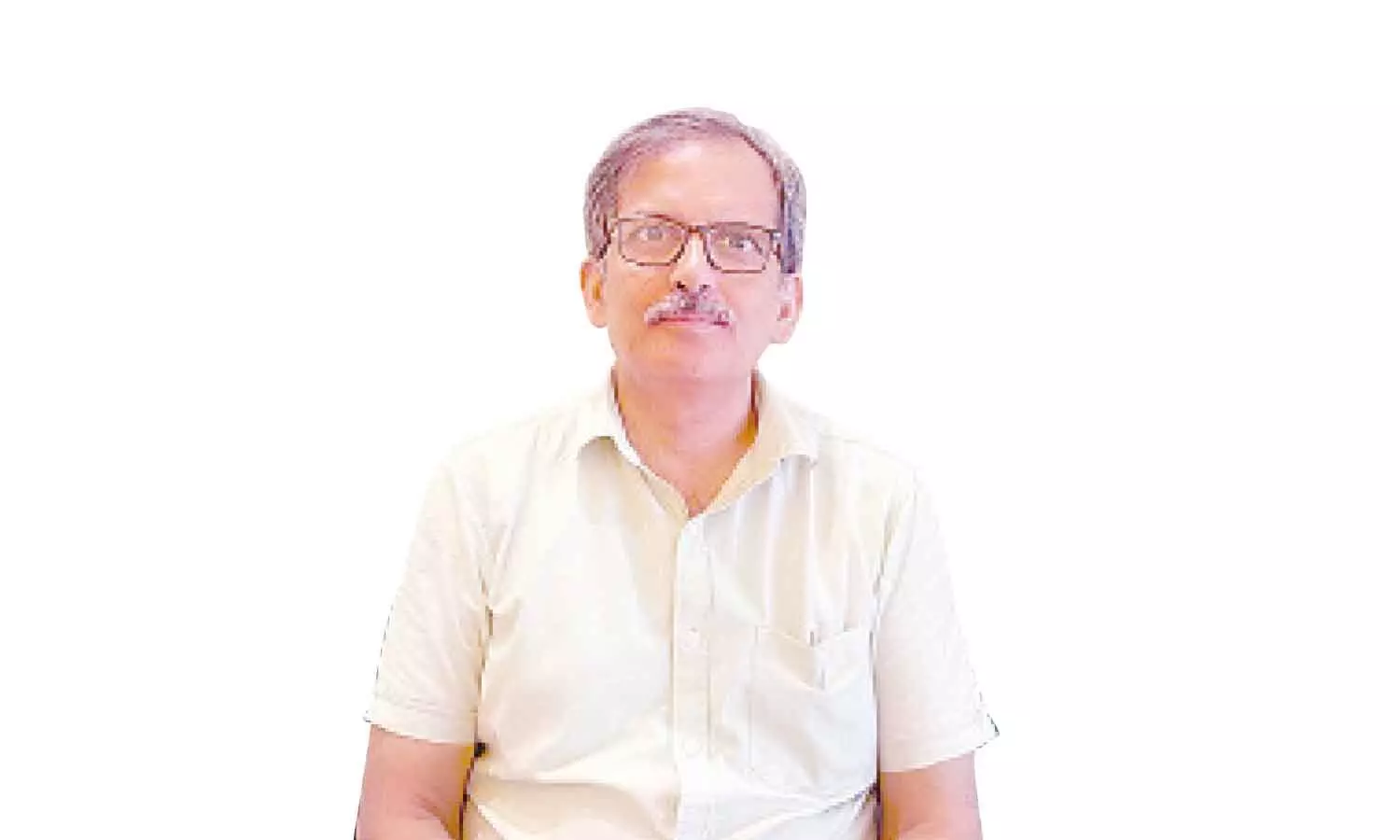
IIT Roorkee Prof Sugata
As artificial intelligence, quantum computing and cybersecurity become increasingly important areas of study and research, students are entering a rapidly changing technology landscape. For those pursuing these fields, the challenge is not simply learning the latest tools, but developing the mathematical, programming and problem-solving foundations needed to understand how technologies work.
Sugata Gangopadhyay, Professor in the Department of Computer Science and Engineering at IIT Roorkee, brings an interdisciplinary perspective to this changing landscape. His academic journey began in mathematics, with a B.Sc, Kolkata, followed by an M.Sc. and Ph.D. from IIT Kharagpur. His research interests include Boolean functions, cryptography and quantum computing. He has also been involved in international research collaborations and work related to quantum computing tools and capacity building. In an interview with The Hans India , Sugata Gangopadhyay, Professor, IIT Roorkee shares advice for students navigating education, research and emerging technologies.
Your academic journey moved from mathematics to computer science and cryptography. What advice would you give students who are still deciding what they want to pursue?
My own path was not a straight line, and students should not feel they need to know their final destination at 18. I studied mathematics and taught it for several years before moving more fully into computer science and cryptography. My advice is to choose a field with strong foundations and then follow problems that genuinely interest you. Mathematics gave me a foundation that has remained useful in cryptography and quantum computing. Interests can develop and change, but strong fundamentals stay with you.
With AI and quantum computing attracting growing interest, what should students learn first?
Start with the mathematics, not the tools. Linear algebra is important for both machine learning and quantum computing, while probability and discrete mathematics are also valuable. Students should learn to program properly and develop the habit of understanding what lies behind the libraries and functions they use. It is easy to call a function, but understanding what it actually computes is more useful in the long term.
Students should also experiment with available tools. In quantum computing, simulators allow learners to explore concepts without requiring access to specialised hardware. Curiosity combined with strong fundamentals will remain useful even as technologies and frameworks change.
How important are marks compared with curiosity, problem-solving and persistence?
Marks do matter. They can open the first few doors, but they do not walk you through them. Research and problem-solving require qualities that examinations cannot fully measure. A difficult research question may require weeks of work, repeated mistakes and several attempts before progress is made. Some excellent researchers are not necessarily the highest scorers in their classes. Students should aim to understand what they are learning rather than focusing only on marks. Curiosity and persistence help students continue working when an answer is not immediately available.
What cybersecurity habits should every student develop?
Students should use long, unique passwords, preferably with a password manager, and enable two-factor authentication wherever possible. They should be cautious about unexpected links and messages, keep software updated and think carefully before sharing personal information online. Many security incidents involve human error or manipulation, so developing good digital habits is an important first step.
What makes a teacher memorable and impactful for students?
A memorable teacher respects the intelligence of students. A teacher does not have to have every answer and can sometimes say, “I don’t know, let us find out together.” Being approachable and connecting a subject to larger questions can make learning more meaningful. Students also remember teachers who challenge them while making them feel that their questions and ideas are valued.
What lesson from research can students apply when they experience failure?
In research, many approaches do not work and many assumptions turn out to be incorrect. Failure is part of the process. A failed attempt should be treated as information rather than a verdict on the individual. Students should record what they tried and understand why it did not work. That information can sometimes lead to the next useful idea. Patience and careful documentation can turn setbacks into learning.
What opportunities should students explore if they are interested in AI, cybersecurity, quantum computing or research?
Students should consider getting involved in research early rather than waiting until postgraduate study. Undergraduate and postgraduate students can work on research problems and learn through practical experience. They can explore laboratory projects, internships, faculty-led research and available computing tools.
Students should also be willing to approach faculty members even if they feel they are not fully prepared. Working on a concrete problem is often one of the best ways to understand what a field involves. Projects in areas such as intrusion detection, post-quantum cryptography and quantum machine learning can also help students connect classroom learning with research questions.
What areas of research and teaching do you see becoming increasingly important in the coming years?
Post-quantum cryptography is likely to remain an important area as quantum computing develops. As quantum computers become more capable, some current cryptographic methods may need to be replaced or strengthened. Our group is looking at areas such as lattice-based cryptography, noncommutative NTRU-type constructions and post-quantum stream ciphers.
Quantum computing will also remain important for research and education, with scope for work at the intersection of quantum computing, machine learning and cybersecurity. Another area of interest is the application of artificial intelligence to the physical world. Work being explored through the proposed Avathon–IIT Roorkee Physical AI Lab collaboration is part of this broader area.
For students, emerging fields such as physical AI provide opportunities to understand how AI systems can interact with real-world environments. Such work brings together areas including artificial intelligence, sensing, robotics, data processing and decision-making, while raising questions about reliability and real-time responses.
Be it temporary or long term… ‘Maun’ of ministerial aspirants gives CM Revanth a breather
Fund crunch necessitating capex cut: 2,000 files pending in TG Finance wing
Amit Shah to visit Telangana on Oct 4
CM Revanth for nationwide stir against SIR
Why do dogs behave the way they do?
Value of dissent in CEC: BJP, Congress and changed perceptions


