Invisible Bugs, Visible Damage: How Tiny Testing Gaps Break Giant Systems

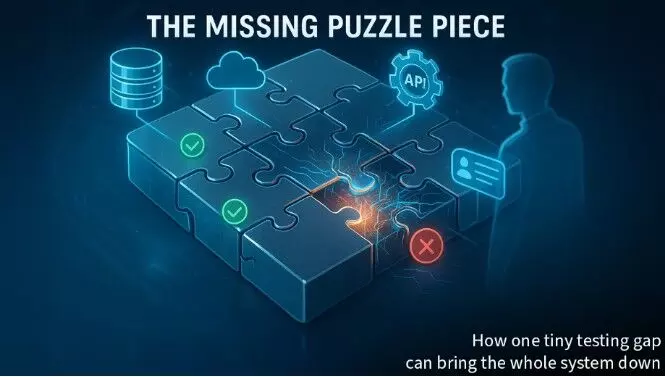
The Crack That Split the System
It started with a single unchecked line of code.
A configuration flag that defaulted to “false” instead of “true.”
That one decision — one character, really — brought down a global payment gateway for six hours. Millions in losses, reputation shaken, engineers sleepless. Postmortem reports called it “an oversight.” But the truth? It was a test that nobody thought was worth writing.
That’s the silent killer in modern software systems: not the bugs we find, but the ones we never look for.
Why Bugs Don’t Hide — We Just Don’t Look There
Most so-called “invisible bugs” aren’t invisible at all. They live in plain sight, buried under our assumptions. A tester might skip an edge case because “no user would ever do that.” A developer might skip a validation check because “the API always returns valid data.”
And yet, systems crash, users panic, and teams scramble because somewhere — someone believed a small thing wouldn’t matter.
In an era of billion-line codebases and hyperconnected APIs, the smallest testing gap can ripple across the system like a fault line. We think we’re testing the code, but really, we’re testing our own ability to anticipate reality.
Software Testing Basics, Rewired
Let’s be honest — the traditional “software testing basics” feel outdated.
Checklists, documentation, and repetitive regression cycles can’t keep up with how modern systems evolve. Testing today isn’t a box to tick; it’s a mindset to cultivate.
Old Testing Basics | Modern Testing Basics |
Focused on pass/fail outcomes | Focused on behavioral insight |
Tested modules in isolation | Tests interactions across systems |
Relied on fixed scripts | Relies on adaptive, exploratory thinking |
Measured success by defect count | Measures resilience and predictability |
Seen as a QA phase | Seen as a shared engineering philosophy |
The modern tester is less of a gatekeeper and more of a system detective — curious, skeptical, and creatively paranoid.
The Butterfly Effect of Untested Logic
Small bugs don’t stay small. They grow through neglect.
Here’s how a single missing test case can quietly destroy a system:
A timestamp rounding error leads to slightly mismatched entries in a database.
The analytics dashboard shows inconsistent metrics.
Business teams make decisions based on faulty data.
API consumers downstream receive malformed payloads.
The client’s app crashes. Users churn. Reputation tanks.
One untested assumption → A cascade of visible damage.
That’s the butterfly effect of untested logic — a system collapsing not under complexity, but under complacency.
Humans in the Loop: The Real Testing Variable
Automation covers 95% of your tests. But the 5% it misses? That’s where chaos lives.
Developer: “CI passed. We’re good to deploy.”
Tester: “Did CI test for daylight savings in UTC+13?”
Developer: “…Wait. What?”
That’s not a joke — that’s a real-world blind spot. Automation doesn’t fail because it’s weak; it fails because it’s obedient. It only checks what you tell it to check.
That’s why smart automation platforms — like GuestPostCRM — emphasize control, visibility, and human validation alongside automation. Because even the most efficient systems need mindful oversight to prevent invisible errors from scaling.
Humans, on the other hand, question the patterns. They test the absurd, the unlikely, the “that would never happen.” And in doing so, they discover where systems truly break — not in the code, but in the expectations behind it.
Building Systems That Expect Failure
You can’t test every possibility — but you can build systems that expect failure.
That’s the shift from fragile architecture to antifragile design.
Here’s what that looks like in practice:
Chaos Testing: Introduce controlled failure to study resilience.
Shadow Deployments: Test new releases alongside old ones in real traffic.
Observability by Design: Treat logs, metrics, and traces as part of testing, not postmortems.
Cultural Curiosity: Reward the testers who break things creatively.
When you make failure part of your process, you turn every bug into an insight. Every incident becomes a classroom.
Callout Reflection
Software doesn’t break where it’s weak. It breaks where we stop asking questions.
That’s the real essence of software testing basics in the modern world — not rigid steps, but relentless curiosity. Testing isn’t just about protecting systems; it’s about understanding them deeply enough to anticipate where they’ll fail.
Invisible bugs will always exist. But if we train ourselves to see the invisible — the assumptions, the skipped cases, the “too small to test” — we can stop watching systems fall apart from the tiniest cracks.
Because in software, as in life, it’s rarely the storm that breaks the bridge — it’s the unnoticed rust beneath.