




Self-registration of cyclone crop losses introduced

Share :
Self-registration of cyclone crop losses introduced
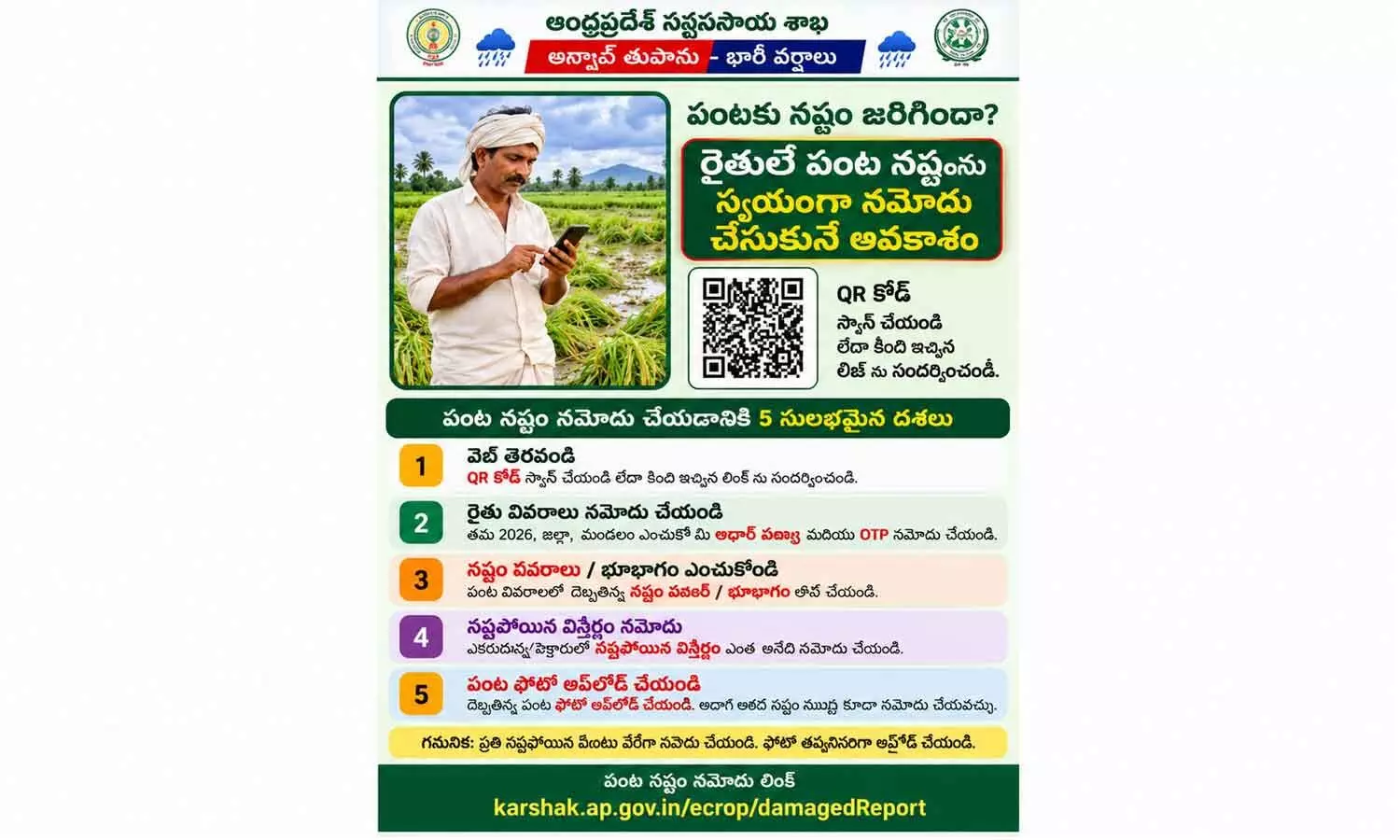
Vijayawada: In a first-of-its-kind initiative in the state, the agriculture department has introduced a self-registration facility enabling farmers to report crop losses caused by Cyclone Arnab and the accompanying heavy rains. The initiative aims to speed up damage reporting and address farmers’ complaints that their losses are sometimes omitted from official assessments.
Agriculture director Dr Manazir Jeelani Samoon announced the facility on Wednesday, allowing farmers to register affected crop areas through the e-Panta website or the APAIMS Farmer app using Aadhaar OTP authentication. Farmers are required to upload photographs of their damaged crops while submitting details of the affected fields.
Traditionally, preliminary assessments following cyclones and floods are carried out by officials from the agriculture, horticulture and revenue departments. Field inspections and consolidation of reports can take considerable time, while sometimes farmers would have complained that their affected fields were left out of the enumeration.
The new facility provides farmers with a direct channel to report crop damage alongside the ongoing official assessment process. Field-level agriculture officers have been instructed to create awareness about the facility and assist farmers in using it.
According to preliminary estimates, Cyclone Arnab and the heavy rains have inundated crops across 3,08,791 hectares, equivalent to around 7.63 lakh acres, affecting 4,62,923 farmers in 2,747 villages across 249 mandals in 16 districts.
West Godavari reported the largest affected area at 74,175 hectares, followed by Kakinada with 50,993 hectares, Dr B R Ambedkar Konaseema with 48,449 hectares, East Godavari with 42,635 hectares and Krishna with 40,142 hectares.
Paddy accounts for the bulk of the inundated area. In Krishna district alone, paddy was affected across 39,709 hectares. Cotton, blackgram, maize, sugarcane, groundnut and other crops were also affected in various districts.


