




- What a shame, ED making baseless allegations, says Pinarayi Vijayan
- Anti-national forces and those insulting saffron will be uprooted from Bengal: CM Adhikari
- CM Patel inaugurates 'BHISHM Cube-R300' demonstration at Gujarat Assembly
- EAM Jaishankar and French counterpart Barrot discuss developments related to Ukraine, Gulf
- OpenAI launches ChatGPT Images 2.5 with faster generation and better editing
- NIA Says Terror Probe Against US Mercenary Matthew VanDyke Still Underway Amid Chargesheet Row
- MCD launches demolition drive against unauthorised, unsafe buildings across Delhi
- Vijay Deverakonda’s Ranabali Teaser Is Out
Nepal Floods-A Wake Up Call for India
In Short
The massive flooding was triggered by a glacier breaking loose, sending a wall of ice, rock and water downstream and leaving behind a massive trail of destruction.

Share :
Nepal Floods-A Wake Up Call for India
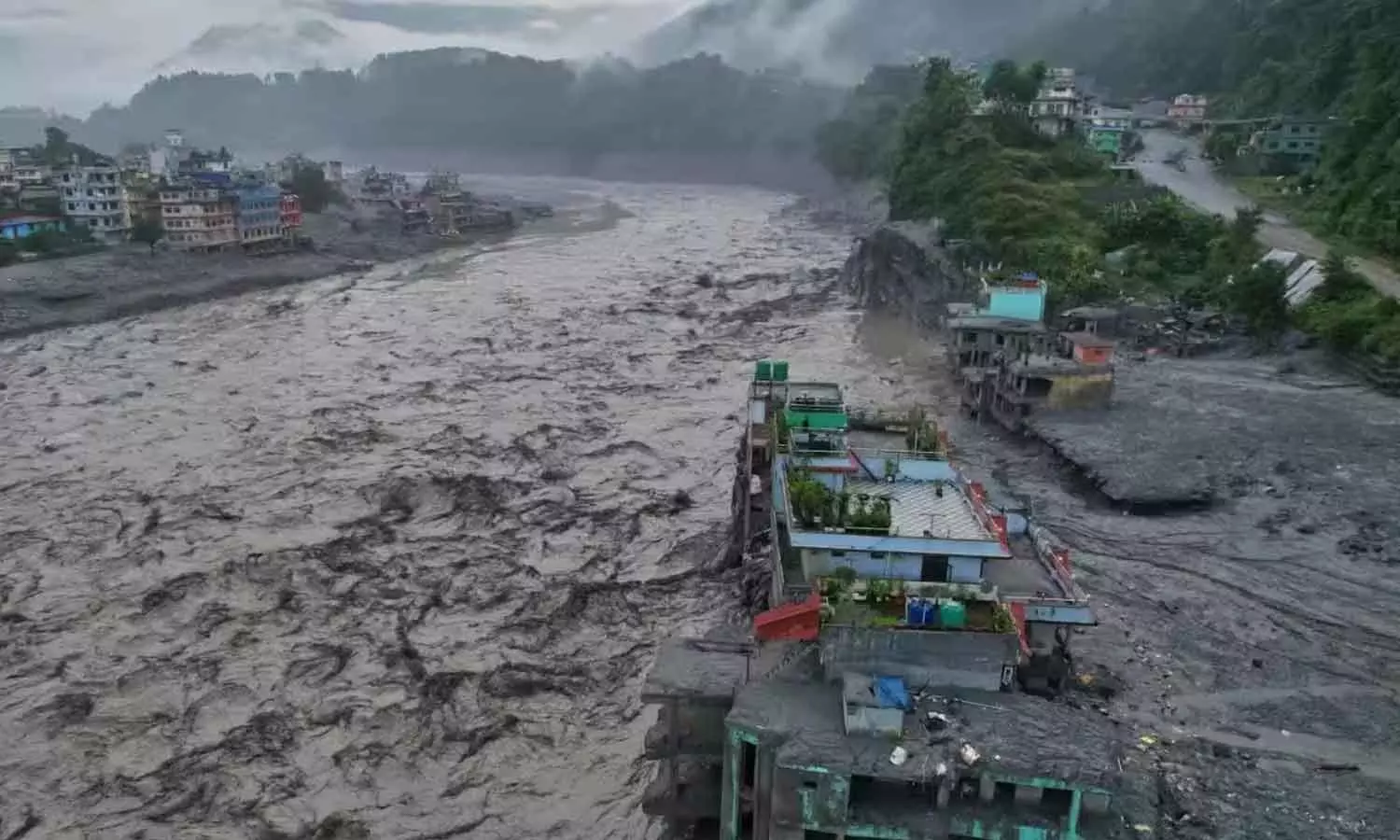
Khatmandu: The unprecedented and catastrophic floods along the Nepal-China border have raised several questions about the dangers posed to the environment and the disasters that can subsequently occur. The August 26 floods in the Bhote Koshi Valley were so sudden and devastating that more than 1,300 people are reported to have lost their lives, while thousands are said to be missing.
The massive flooding was triggered by a glacier breaking loose, sending a wall of ice, rock and water downstream and leaving behind a massive trail of destruction. The disaster has exposed the vulnerability of the Himalayan region to extreme weather events and naturally raises questions about the risks involved in tampering with the green cover in the name of infrastructure development and altering the fragile Himalayan landscape.
The tragedy in Nepal calls for urgent steps towards the timely sharing of hydrological information, greater transparency and the development of effective early-warning mechanisms. This requires greater coordination and regional cooperation to manage the fragile Himalayan ecosystem. It is time to question the Chinese policy of “build fast and let silence do the rest of the work.” Silence could be highly dangerous, and that is the lesson the floods in Nepal have taught us.
It is not just Nepal that is under threat. India too could face major floods similar to those witnessed in Nepal if there is no proper sharing of information and close monitoring of the gigantic hydropower project China is building on the Brahmaputra, known as the Yarlung Tsangpo in Tibet, near Arunachal Pradesh. The project is being built near the Great Bend. Though India has said that it is closely monitoring the project, it needs to use its diplomatic channels to ensure that China does not remain silent and shares all necessary information so that the interests of people living downstream are not harmed. It is a known fact that a sudden release of water, an emergency release or a dam failure could have serious downstream consequences.
Another concern for India is that China controls the upstream region. During a drought or a period of low flow, this control could potentially become politically and economically significant, including through possible changes in the quantity of water and sediment reaching India. However, China denies that its projects would adversely affect downstream countries.
China's existing Brahmaputra projects have largely been described as run-of-the-river projects, which have less capacity to store huge quantities of water than conventional storage dams. However, India cannot afford to turn a blind eye to any possible threat and needs to revisit the entire project from a safety perspective, particularly in the backdrop of the Bhote Koshi floods.
It may be recalled that China wants to develop a world-class clean-energy frontier through hydropower dams on the Yarlung Tsangpo in Tibet, an autonomous region of China. India's Takshashila Institution has tracked several gigawatts of new renewable capacity added since 2013, with sharp increases of 700 megawatts in 2023, 860 MW in 2024 and an estimated 2,600 MW in 2025.
A Washington-based CSIS study has described the resulting pattern as a “gray-zone infrastructure strategy” involving dams, roads, railways and digital systems that could build coercive leverage over India and Nepal without a single shot being fired. The energy grid feeds a network of electrified border villages, microgrids and garrisons that China has expanded since 2017. These settlements have helped China establish a permanent military footprint opposite Arunachal Pradesh, Sikkim and the Ladakh sector.
The advantage China would have is that electricity at high altitudes can sustain communication equipment such as radar systems, drones and military barracks. If a disaster strikes, information about what happens in Tibet could be heavily restricted, leaving little independent visual evidence or detailed information about destruction or damage on the Tibetan side.
Though China says it provided information about the glacier break, Nepal did not receive an effective early warning. Why this happened is the biggest question that needs to be analysed. It is possible that Nepal does not have adequate early-warning tools. Following the massive damage, Nepal and China have agreed to share real-time data.
Put together, the pattern is difficult to miss. Energy infrastructure marketed as green development anchors a military presence along a disputed border. That same infrastructure, together with the political system built to protect it, can produce a default of secrecy whenever something goes wrong on the Tibetan side. The region where all of this is happening is precisely the region least able to absorb rapid and opaque construction without ecological costs.
The floods in Nepal should be an eye-opener for India. New Delhi should ensure timely data sharing and strengthen its own monitoring mechanisms, because in a Himalayan disaster, any delay could matter enormously.
From policy paralysis to PM Modi’s India: BJP’s sharpest contrast with the past
Nepal Floods-A Wake Up Call for India
Tamil Nadu: Vijay-Led TVK Alliance Named ‘Secular Social Justice Victory Alliance’
Gujarat Congress MLA Sits During Vande Mataram
Gold Appeal, Litmus Test For Modi's Economic Strategy
Arunachal Pradesh plays vital role in safeguarding India’s borders: V-P Radhakrishnan


