




- Jaishankar, Advani, Sisodia get SIR notices
- System run by six individuals
- Reappointment of Chandra not valid
- Vaishnaw cautions industry about cyberattacks
- Bengal: SER takes steps to supply clean water at stations
- TN: Singapennu task force marks 100 days, acts on 4231 complaints
- Punjab CM launches door-to-door election campaign
- Alliance with NC won’t stop Congress from raising public issues: Tariq Karra
No country owns the Moon
In Short
Not even the US, despite Trump's claim

Share :
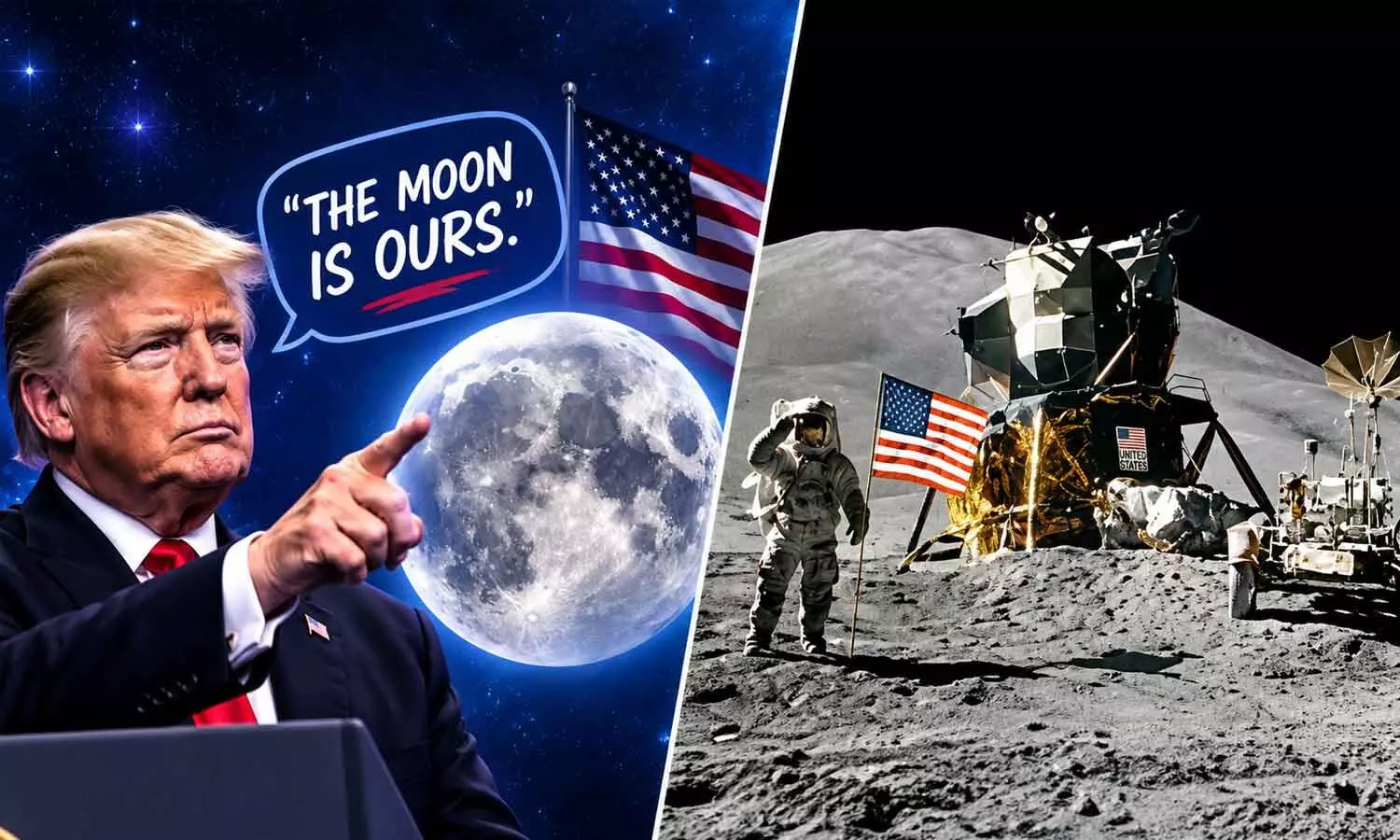
No country owns the Moon
Washington: US President Donald Trump declared "The Moon is ours" in a Truth Social post recently, accompanied by an image of the lunar surface with an American flag and a series of other posts featuring the US Space Force and AI-generated imagery.
The US remains one of the leading nations in lunar exploration, but the claim collides with more than half a century of international law that says no country, including the US, can own the Moon.
The relevant law is the Outer Space Treaty of 1967, negotiated with American backing amidst the Cold War. Its principles are clear on sovereignty, but what it leaves unresolved is a more commercially urgent question: whether a country or a company can own the resources it digs out of the lunar surface.
Article II of the treaty states that outer space, including the Moon and other celestial bodies, is "not subject to national appropriation" by sovereignty, occupation or any other means. Planting a flag, building a base or using a particular patch of lunar surface does not hand any country sovereignty over that territory.
Article I sets out the broader principle: exploration and use of outer space, including the Moon, must serve the interests of all countries, and remains free for exploration and use by every state on an equal footing. The treaty also holds countries responsible for space activities carried out bytheir government agencies and any private entities operating under their jurisdiction.
Moon mining
This is where it gets murky. The treaty rules out claiming the Moon, but it sets out no detailed system for the commercial extraction or ownership of lunar resources.
The US moved to fill that gap in 2015 with the Commercial Space Launch Competitiveness Act, which recognises the right of American citizens to commercially recover and use space resources — while explicitly denying that this gives the US sovereignty or ownership over any celestial body. The US law separates ownership of what is extracted from ownership of the territory it came from.
NASA has built resource extraction into its own lunar plans. In 2020, it selected commercial companies to collect lunar material under the Artemis programme, arguing such resources could support future lunar missions and eventually human trips to Mars.
Launched by NASA in 2020, the Artemis Accords are a set of US-led international guidelines for peaceful, transparent and cooperative lunar exploration. Signatories commit to the Outer Space Treaty’s principles while agreeing that extracting and using resources from the Moon, Mars and asteroids can be done legally without claiming territory.
The Accords also allow for “safety zones” around lunar operations, intended to prevent interference between missions rather than establish ownership; signatories are expected to notify each other of activities and coordinate where necessary. Turkiye became the 71st country to sign the Accords on August 31, 2026, according to NASA. The Accords do not replace the Outer Space Treaty, they operate alongside it.
A separate 1979 UN treaty, the Moon Agreement, tackles commercial mining head-on, declaring the Moon and its resources the “common heritage of mankind”. Unlike the Artemis Accords, it forbids any nation or company from owning unextracted lunar resources, and requires that commercial mining be managed by an international body so that profits and scientific benefits are shared equitably among all countries.
But the Moon Agreement has drawn far fewer signatories than the Outer Space Treaty, and major space powers. Among other, the US has not accepted it. This limited participation is one reason the debate over commercial lunar mining has never been settled.
Space law draws a distinction between a resource still in place and one that has already been extracted. The Outer Space Treaty rules out owning a piece of the Moon, but it offers no commercial mining code covering who owns minerals, water or other material once it has been taken out of the ground, leaving experts with competing interpretations.
One view holds that extracting and possessing lunar material does not amount to claiming sovereignty, so long as the activity complies with international law. Another argues that allowing states or companies to commercially appropriate resources could undermine the treaty’s founding principle that space use must serve the interests of every country.
The legal uncertainty matters because lunar resources could have real practical value.
Telangana govt. declares Dussehra holidays 2026 for schools from 10 October
Those who made UP 'BIMARU' cannot question govt: Yogi Adityanath
Rahul Gandhi Faces BJP Criticism Over Comedian’s PM Modi Skit At Indore Event
'Congress has become party of comedians and jokers': Kiren Rijiju on Chhatron Ki Goonj mimicry row
Nara Lokesh Emphasises Morality in Education and Reflects on Political Journey
Union Minister Bandi Sanjay Kumar comes to aid of road accident victims in Telangana


