




- Don’t ignore persistent joint pain & stiffness, warns rheumatologist
- The Deccan Hospital, creates awareness on prostate cancer and importance of early detection
- The hidden health cost of traffic: When daily commute becomes a health hazard
- Rahul accuses Modi, CEC of treason
- Governor Quota MLC Seat: Cong may nominate Konda Laxman Bapuji ’s daughter to checkmate BRS
- Workers should support united alliance candidates: Revuri Prakash Reddy
- Parents must support children with disabilities: Srinivasa Reddy
- Purani Haveli’s 1,000-ft wing gets heritage makeover
Physicist Francis wins Nobel Prize for IceCube neutrino discovery
In Short
The Belgian-born scientist said it was predicted that he would win the prize, but the announcement still made him feel strange

Share :
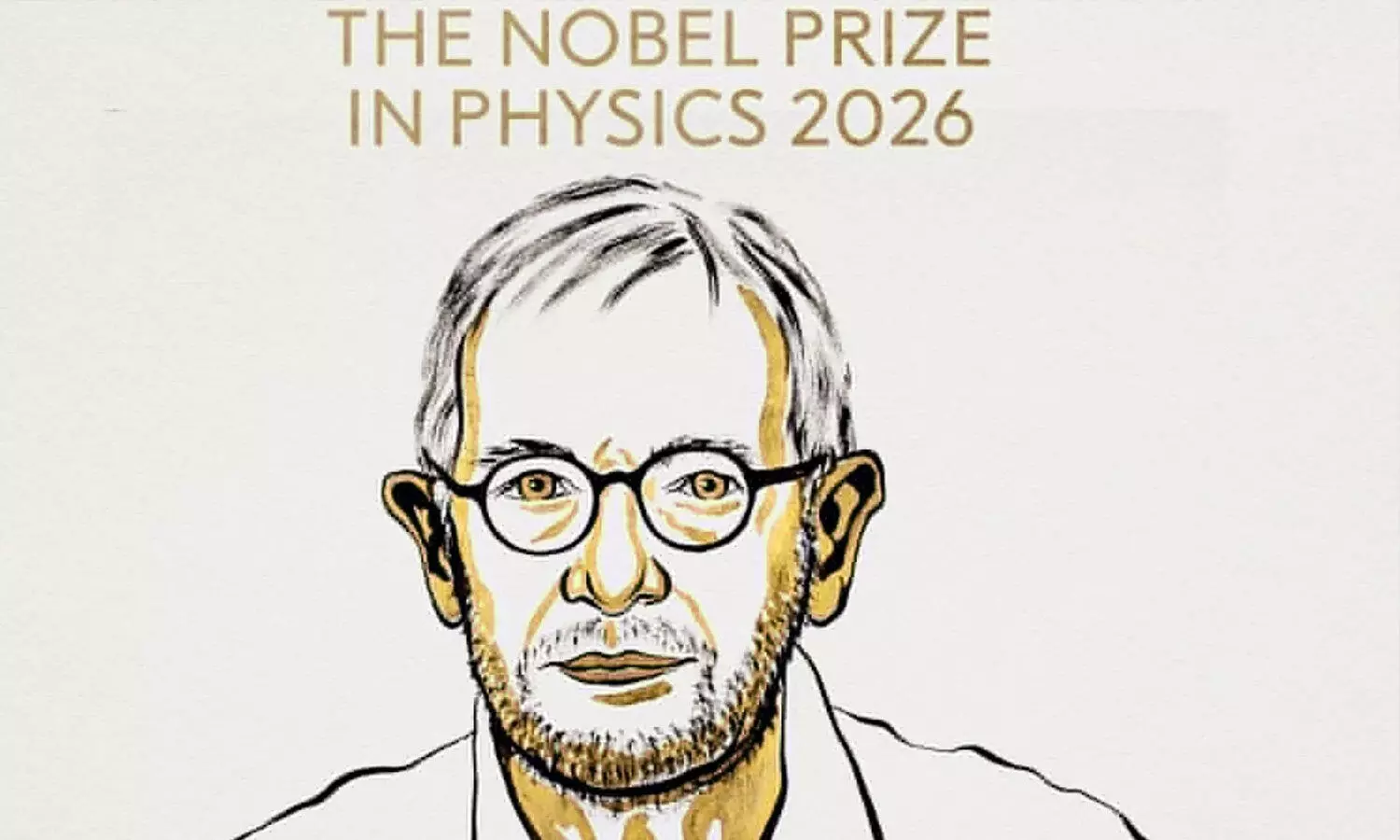
Physicist Francis wins Nobel Prize for IceCube neutrino discovery
Stockholm: Belgian-born scientist Francis Halzen won the Nobel Prize in physics Tuesday for his efforts to demystify a rare group of neutrinos, tiny cosmic particles that researchers believe offer clues to how the universe evolved. "It was a great surprise, and I obviously didn't expect it," Halzen said, speaking to the Nobel Physics Committee by phone from Italy, in a call broadcast at the news conference to announce the winner.
Halzen said it was predicted that he would win the prize, but the announcement still made him feel "strange." "I am working on a proposal, and I hope that this prize will help getting it approved," he said to chuckles from the audience.
Neutrinos are tiny cosmic particles with no electrical charge and extraordinarily small mass, making them difficult to detect. Yet they are everywhere: They spew from stars like the sun, and trillions zip through our bodies every second. Scientists cannot glimpse the mysterious ghost particles zooming around on their own, so they measure what happens when the particles collide with other bits of matter. Neutrinos bump into other particles only rarely, so scientists build large detectors to improve their odds of catching collisions. Halzen had the idea to turn the vast Antarctic ice into such a detector. The Nobel committee said his work was instrumental to the construction of the IceCube Neutrino Observatory in Antarctica, which glimpsed the first high-energy neutrinos from faraway galaxies.
"This experiment in the Antarctic is a revolutionary way of understanding the universe that we didn't have before," said Michael Moloney, chief executive officer for the American Institute of Physics. When a neutrino interacts with ice in the detector, it produces a flash of light that's picked up by sensors.
Indo-US talks at ‘plateau,’ not a precipice
India’s gender parity: What does global evidence say?
Gyanesh Kumar: Can a CEC under a cloud continue in office?
'Work underway to develop India's 1st AI city in Lucknow': CM Yogi Adityanath
Technology must become a tool for inclusive and sustainable development: PM Modi
Rahul Gandhi, Priyanka Detained After INDIA Bloc Sit-In Over Gyanesh Kumar Row


