




- Hanumakonda takes up Rs. 20.52 crore road and drainage works
- Ponnam vows to fight alleged voter purges
- Don’t ignore persistent joint pain & stiffness, warns rheumatologist
- The Deccan Hospital, creates awareness on prostate cancer and importance of early detection
- The hidden health cost of traffic: When daily commute becomes a health hazard
- Rahul accuses Modi, CEC of treason
- Governor Quota MLC Seat: Cong may nominate Konda Laxman Bapuji ’s daughter to checkmate BRS
- Workers should support united alliance candidates: Revuri Prakash Reddy
India’s gender parity: What does global evidence say?
In Short
India’s next stage of gender development must focus not only on schools and colleges but also on employment and the workplace. Equal access to jobs must be accompanied by equal pay, opportunities for promotion, safe working conditions and access to leadership positions. Women entrepreneurs also need better access to credit, technology, markets and business networks. Women account for only 16.1 per cent of parliamentary representation, while the ministerial-level parity score is only 5.9 per cent.

Share :
India’s gender parity: What does global evidence say?
India has made significant progress in closing the gender gap, but the latest global evidence shows that the country still faces a major challenge: turning women’s gains in education into equal opportunities in employment, income, leadership and decision-making.
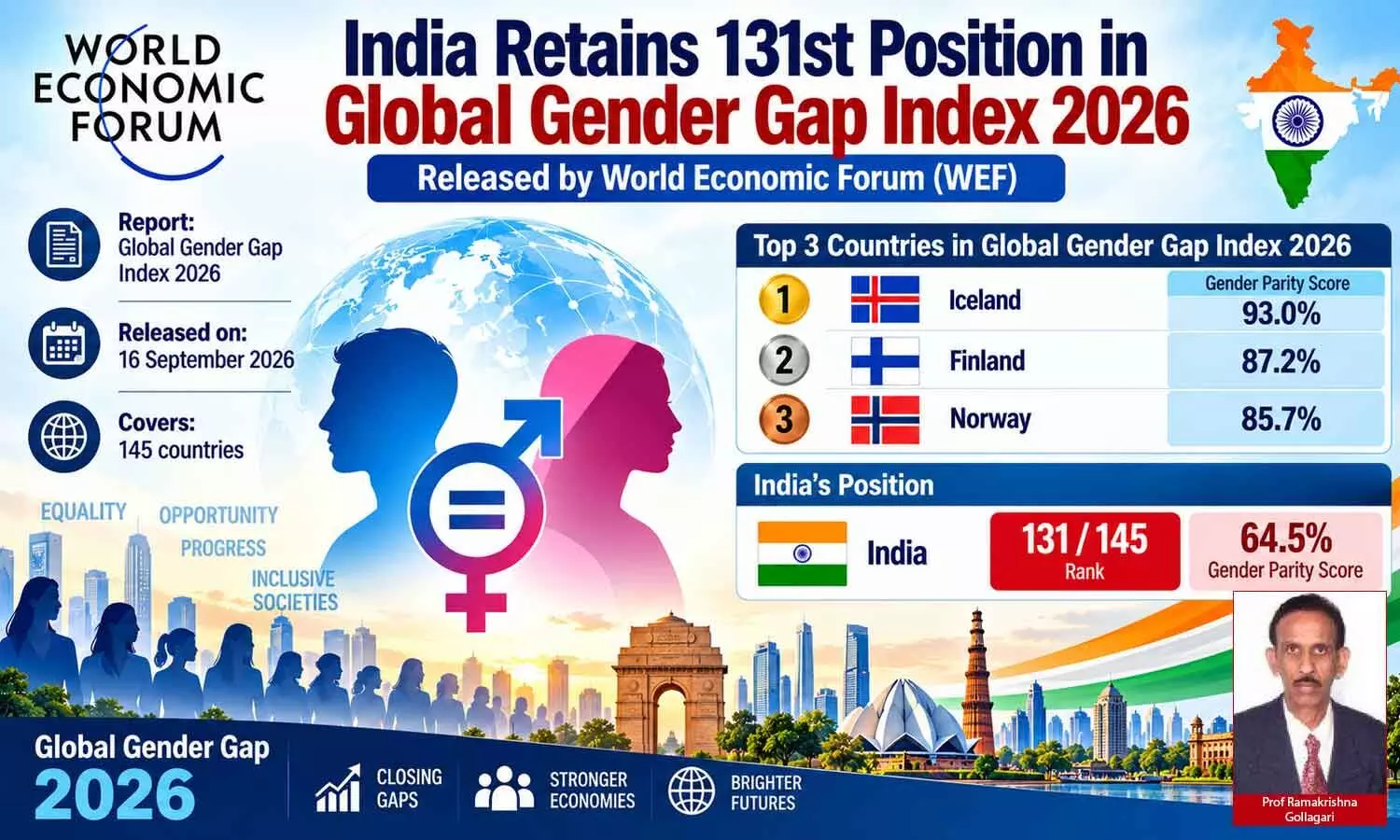
The Global Gender Gap Report (World Economic Forum, 2026), covering 145 countries, gives India a gender parity score of 64.5 per cent and ranking it 131st. Globally, 69.2 per cent of the gender gap has been closed, up 0.4 percentage points from the previous year, but full parity could still take about 120 years at this pace.
Among economies continuously assessed since 2006, the global score has risen from 64.2 per cent to 69.4 per cent. Iceland leads with 93 per cent, followed by Finland, Norway and Namibia. The evidence shows that gender equality depends not only on income, but also on effective institutions, public policies, education, employment opportunities, social conditions and women’s political representation.
Educational equality:
There is remarkable progress in education attainment. Globally, 96.9 per cent of the educational attainment gap has been closed, while health and survival stand at about 96.2 per cent. In contrast, economic participation and opportunity have reached only 61.7 per cent, and political empowerment just 22.1 per cent. In many countries, girls have entered schools and universities in large numbers and have achieved educational outcomes comparable to or better than boys. But education has not automatically produced equal job opportunities.
The estimated time required to close the remaining global gap could take around 129 years, while political parity could take about 194 years at the current pace. The challenge is therefore no longer only to educate women, but to ensure that education translates into jobs, earnings, entrepreneurship, management positions and political influence.
The Indian case:
India’s educational attainment score is 96.6 per cent, with full parity in secondary and tertiary enrolment and a 14.7-point improvement since 2006. Adult literacy parity has also risen to 82.5 per cent. However, this educational progress has not translated equally into economic opportunities. Economic participation and opportunity stand only at 41.2 per cent, ranking India 143rd among 145 economies, while labour-force participation parity is at 44.1 per cent.
Women’s representation among professional and technical workers has improved from 26.6 per cent in 2006 to 49.9 per cent in 2026, but remains only 13.1 per cent among legislators, senior officials and managers. Thus, India has made substantial progress in educating women, but the greater challenge is creating a stronger pathway from education to employment, economic independence and leadership.
Education:
A degree does not automatically guarantee a job. Women’s participation in the labour market is influenced by the availability of suitable employment, workplace safety, mobility, childcare responsibilities, social expectations and the flexibility of working arrangements. The problem is especially important because women who leave education with qualifications may still face difficulties entering or remaining in paid employment.
A woman may be well educated but unable to accept a job because of inadequate childcare, unsafe transport, family responsibilities or limited employment opportunities close to home. This is why India’s next stage of gender development must focus not only on schools and colleges but also on employment and the workplace. Equal access to jobs must be accompanied by equal pay, opportunities for promotion, safe working conditions and access to leadership positions. Women entrepreneurs also need better access to credit, technology, markets and business networks.
Political empowerment
India’s political empowerment score is 24.5 per cent, considerably higher than its economic participation score, and India ranks 67th globally on this dimension. But the level of representation remains limited. Women account for only 16.1 per cent of parliamentary representation, while the ministerial-level parity score is only 5.9 per cent. The global picture is also similar. Political empowerment remains the weakest, with only 22.1 per cent of the global gap closed.
Although progress has occurred over the past two decades, the political gains have also shown signs of reversal in recent years. Political representation matters because decisions about education, health, employment, childcare, taxation, social protection and economic development are ultimately made through political institutions. Women’s participation in these institutions is therefore an important component of gender equality.
Regional comparison
These differences suggest that countries need to look beyond income levels and examine the policies and institutions that enable women to participate fully in economic and political life. India’s overall score of 64.5 per cent is the same as South Asia, but both are below the global average of 69.2 per cent.
South Asia has closed only 40.9 per cent of its economic participation and opportunity gap. In contrast, Europe has closed 75.7 per cent, North America 75.2 per cent, Latin America and the Caribbean 74.5 per cent, East Asia and the Pacific 70.3 per cent, and Sub-Saharan Africa 68.8 per cent. These differences suggest that policies and institutions, not income alone, are crucial for women’s economic and political participation.
The real challenge:
India’s gender story is one of uneven transformation. While educational attainment has reached 96.6 per cent parity, with full parity in secondary and tertiary enrolment, economic participation remains much lower at 41.2 per cent.
The key challenge is therefore to convert educational gains into economic opportunities through market-relevant skills, formal employment, equal pay, leadership opportunities, affordable childcare, safe transport, credit access and flexible work. Changing social norms is equally important, particularly by reducing the disproportionate burden of unpaid household and care work on women.
Equality of opportunity:
The latest global report offers India both encouragement and a clear warning. The country has demonstrated that rapid progress in girls’ education is possible. The next challenge is to achieve comparable progress in employment, earnings, management, entrepreneurship and political representation. The crucial question for India’s gender development is not how many girls are entering colleges.
But what happens to these educated women after they leave college? If education is successfully converted into productive employment, higher incomes, entrepreneurship and leadership, the benefits will extend beyond women themselves. Families, businesses and the wider economy can gain from a larger and better-utilised pool of human talent.
Conclusion:
India’s gender challenge has therefore entered a new phase: from educating women to empowering them economically. The evidence shows that educational equality is underway. The real test now is whether India can ensure this educational equality is followed by equality in work, income, leadership and decision-making.
(The writer is a retired Professor of Economics, OU and visiting Professor, CESS, Hyderabad)
Indo-US talks at ‘plateau,’ not a precipice
India’s gender parity: What does global evidence say?
Gyanesh Kumar: Can a CEC under a cloud continue in office?
'Work underway to develop India's 1st AI city in Lucknow': CM Yogi Adityanath
Technology must become a tool for inclusive and sustainable development: PM Modi
Rahul Gandhi, Priyanka Detained After INDIA Bloc Sit-In Over Gyanesh Kumar Row


