




- Don’t ignore persistent joint pain & stiffness, warns rheumatologist
- The Deccan Hospital, creates awareness on prostate cancer and importance of early detection
- The hidden health cost of traffic: When daily commute becomes a health hazard
- Rahul accuses Modi, CEC of treason
- Governor Quota MLC Seat: Cong may nominate Konda Laxman Bapuji ’s daughter to checkmate BRS
- Workers should support united alliance candidates: Revuri Prakash Reddy
- Parents must support children with disabilities: Srinivasa Reddy
- Purani Haveli’s 1,000-ft wing gets heritage makeover
Gyanesh Kumar: Can a CEC under a cloud continue in office?
In Short
When the referee becomes the subject of serious questions, democracy cannot look the other way

Share :
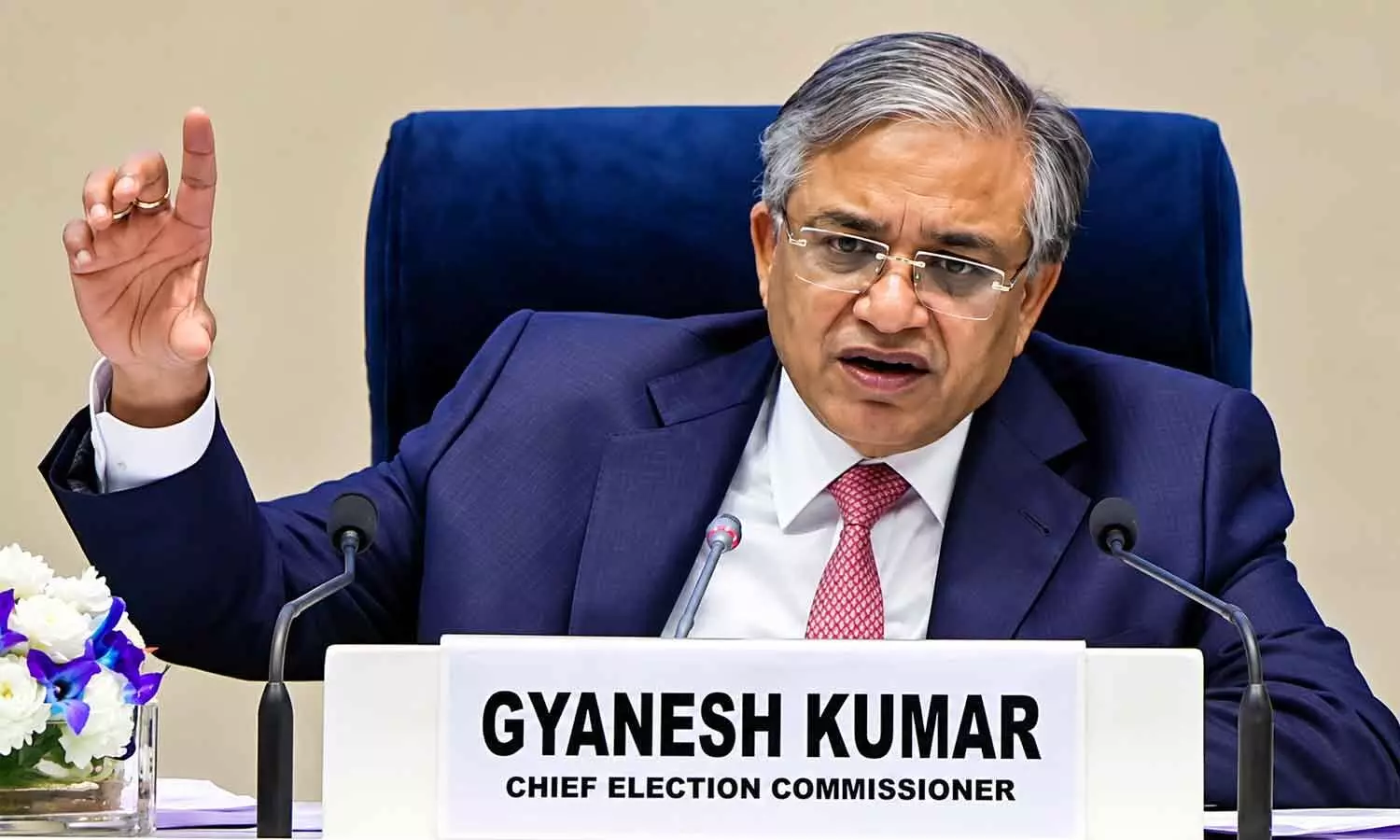
Gyanesh Kumar: Can a CEC under a cloud continue in office?
The Chief Election Commissioner (CEC) is not an ordinary constitutional functionary. He is the custodian of the ballot, the guardian of electoral rolls and the referee of India’s democratic contest. Above all, the CEC must command public confidence that every voter is treated equally.
That confidence is now under serious strain.
A media report claimed that Election Commissioners Sukhbir Singh Sandhu and Vivek Joshi recorded objections on 14 occasions in 10 months over decisions and processes concerning electoral rolls, voter registration, deletion and restoration of names, and access to the voter database. The Election Commission has acknowledged the existence of the notes, while maintaining that the decisions were ultimately unanimous. But that does not eliminate the questions raised by the objections.
14 objections cannot be routine stuff:
Disagreement within a constitutional body is not itself the problem. What demands scrutiny is the frequency, subject matter and substance of the objections.
According to the investigation, the concerns went to the heart of the electoral process: who can be added to the rolls, who can be removed, who controls the electoral database and how decisions affecting voters are recorded.
Form 6: Who has the power to change the rules?
The controversy over Form 6 is particularly significant. The two Election Commissioners reportedly objected to SIR-related changes introduced on the ECINet portal for new voters, calling the changes “illegal” and “unauthorised” and arguing that statutory forms could not be altered without following the prescribed legal process.
For a young citizen seeking to exercise the constitutional right to vote for the first time, the electoral system should provide clarity—not burden them with more hurdles. The fundamental question is simple: Can an administrative authority effectively rewrite a statutory form through software without following the procedure prescribed by law?
If the answer is no, accountability cannot end with correcting the software after the controversy erupts.
When software becomes more powerful than the officer:
An even deeper concern is the reported centralisation of electoral-roll control. Few days back 97 voters in Goa, who were found eligible by the Electoral Registration Officer could not immediately be restored because the central software did not permit the officer’s decision to be recorded.
This raises a fundamental democratic principle:
Technology may assist the law. It cannot replace the law. An algorithm cannot acquire authority that Parliament has not granted it. If a statutory officer has the power to determine a voter’s eligibility, a software platform controlled elsewhere cannot silently nullify that authority.
The Commission therefore owes citizens a transparent answer: who controlled the system, who authorised the architecture, who could override whom, and what audit trail existed?
The voter and the commission’s mistakes:
The larger concern is what happens when legitimate voters disappear from the rolls.
If the State removes a citizen from the electoral roll by mistake, the burden of correction should not simply be transferred to that citizen.
A citizen should not have to prove his right to vote all over again because the State failed to protect it in the first place. The vote is not a favour granted by the Election Commission. It is a legally protected democratic entitlement subject to the qualifications prescribed by law.
The credibility test:
The Supreme Court is now examining petitions challenging aspects of Gyanesh Kumar’s functioning and the nationwide Special Intensive Revision exercise. The petitions raise allegations concerning unilateral decision-making and the legal basis of the SIR process. These are allegations before the Court, not judicial findings of wrongdoing.
The distinction matters:
The CEC cannot answer a crisis of institutional confidence merely by saying that procedures were followed. The public is entitled to know what procedures were followed, by whom, under what authority and with what safeguards.
Independence must be visible:
The Election Commission does not merely have to be independent. Its independence must be visible and credible. That requires transparency in decision-making, respect for the statutory powers of Election Registration Officers, meaningful consultation among all three election commissioners and complete accountability for changes affecting the electoral roll.
The CEC must be above suspicion—not because criticism is prohibited, but because the office is too important to operate under a persistent cloud of doubt.
Question bigger than Gyanesh:
The real issue is not whether Gyanesh Kumar is politically popular or unpopular.
It is whether the institution he heads commands sufficient public confidence to conduct elections whose results will be accepted by citizens across political divisions.
The reported internal objections, the Form 6 controversy, questions over centralised electoral software and the judicial challenges to the SIR process have created a situation that demands independent scrutiny.
Gyanesh Kumar has not been judicially found guilty of wrongdoing. That must be clearly acknowledged. But constitutional accountability is not the same as criminal conviction. When the credibility of the institution itself is questioned, the first duty is to protect the institution—not the individual occupying the chair.
The credibility factor:
India does not need an Election Commission that merely conducts elections.
It needs an Election Commission that convinces every citizen that the election is fair.
The ballot belongs to the voter. The electoral roll belongs to the people. The Election Commission holds a constitutional responsibility to protect both.
Therefore, the controversies surrounding Gyanesh Kumar’s tenure warrant an independent, transparent and time-bound examination. Until the questions raised by fellow Election Commissioners, citizens and the courts are satisfactorily addressed, the debate over his continuation cannot simply be dismissed as partisan politics.
The issue is not whether the referee can defend himself. The issue is whether every player—and every voter—still trusts the referee.
When that trust is seriously shaken, accountability must come before authority.
Democracy is too important to depend on unquestioned faith in any one individual.
Indo-US talks at ‘plateau,’ not a precipice
India’s gender parity: What does global evidence say?
Gyanesh Kumar: Can a CEC under a cloud continue in office?
'Work underway to develop India's 1st AI city in Lucknow': CM Yogi Adityanath
Technology must become a tool for inclusive and sustainable development: PM Modi
Rahul Gandhi, Priyanka Detained After INDIA Bloc Sit-In Over Gyanesh Kumar Row


