




- Jamia Announces Student Union Elections After 20 Years, But Protesters Reject Move
- Gold and silver rates today 26 Oct surges in Bengaluru and Chennai, check gold prices of 18K, 22K, 24K
- Gold and silver rates surges today, 26 Oct in Delhi, Mumbai, check gold prices of 18K, 22K, 24K
- IMD issues red alert for Andhra as deep depression intensifies into cyclonic storm
- Shiv Sena(UBT)'s questions border security amid ITBP chief's remarks in 'Saamana'
- Man posing as Army Captain caught at IAF air show in Varanasi
- Unknown gunmen kill 58 in Nigeria's Taraba
- South Korea, US kick off combined air drills this week
Aravalli Biodiversity helps Delhi retain 3mn litres of rainwater

Share :
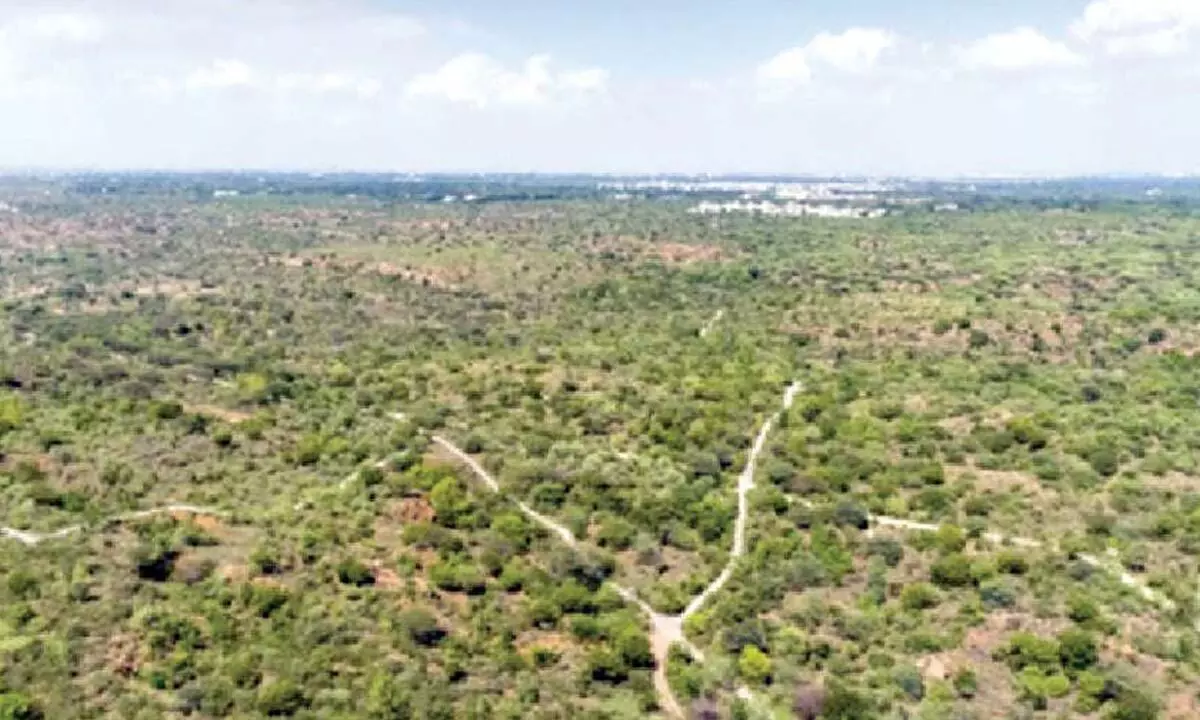
New Delhi: As Delhi braces for the upcoming monsoon, a recent study found that the Aravalli Biodiversity Park helps retain nearly three million litres of rainwater annually, reducing surface runoff that can contribute to waterlogging and urban flooding.
According to the study, the 692-acre restored forest is doing more than providing a patch of green amid the urban sprawl.
It said urban forests with roughly 2.02 lakh trees help prevent nearly three million litres of surface runoff annually, replenishing groundwater reserves and helping slow the movement of rainwater across the ground, allowing more water to infiltrate the soil instead of rapidly flowing over paved surfaces.
The researchers added that the Aravalli Biodiversity Park is located in an important groundwater aquifer recharge zone and plays a key role in replenishing underground water reserves.
The study, titled "Structure, ecosystem services and economic evaluation of native tree diversity: a case study of the restored Aravalli Biodiversity Park, Delhi, India", was conducted by researchers from the Centre for Environmental Management of Degraded Ecosystems (CEMDE), Biodiversity Parks Programme, Department of Finance and Business Economics and Satyawati College, all affiliated with the University of Delhi.
"Delhi has a dry-winter humid subtropical climate bordering on a hot semi-arid climate and receives an average annual rainfall of 774.4 mm, most of it during the monsoon months between July and September," the study said. Besides regulating water, the park also plays a significant role in improving air quality.
The study estimated that its trees remove around 126.89 tonnes of air pollutants every year, generating environmental benefits valued at nearly Rs 1.89 crore. Researchers said the trees help remove particulate matter and other harmful pollutants from the atmosphere.
The study noted that structurally diverse urban forests are particularly effective in trapping airborne pollutants and improving environmental quality.
The biodiversity park was also found to function as a growing carbon sink. Researchers estimated that its trees currently store around 8,360 tonnes of carbon, valued at nearly Rs 11.34 crore, while absorbing another 1,236 tonnes of carbon every year as they continue to grow.
Three more Kerala PSC exams under scanner as Governor seeks removal of chairman, members
Jamia Announces Student Union Elections After 20 Years, But Protesters Reject Move
Crude oil prices decline up to 2 pc as hopes of US-Iran de-escalation weigh
Luiz Inacio Lula da Silva wins Brazil Presidential re-election, secures 4th term
Congress govt anti-farmer, fails to release drought relief: Karnataka BJP
JMI seeks public apology from students for 'defamatory' remarks against university
AP power utilities on high alert as cyclone threat looms
Cyclone alert: Hyderabad IMD sounds red alert for heavy rain in Telangana
As Fine Paddy Prices Skyrocket… Procuring fine rice for PDS a big challenge for Telangana govt
Cyclone Arnab: AP on alert as IMD warns of severe cyclonic storm


