




- 'Want to strengthen BJP in Tamil Nadu': L. Murugan seeks to quit as Union Minister and Rajya Sabha member
- Draw up coordinated strategy to make Haryana drug-free, says CM Saini
- Union Territory of Ladakh integral and inalienable part of India: MEA rejects China's claims
- AP SEC briefs media on meeting political parties over local body elections
- Trinamool questions Bengal CEO’s campaign for enrolment of deleted eligible, new voters
- Education Ministry forms three-member panel to probe IIIT-Ranchi student's death
- K'taka sting Op row: Siddaramaiah moves court; BJP accuses Cong of betrayal
- BJP women MPs turn up heat on Cong MP caught in ‘sex for marks’ row, to meet President
PM Modi Calls for Global Framework to Combat Cybercrime at IMC 2026
In Short
PM Modi praised India's digital transformation, highlighting telecom growth, online education, gaming, and the need for global cooperation against cybercrime.

Share :
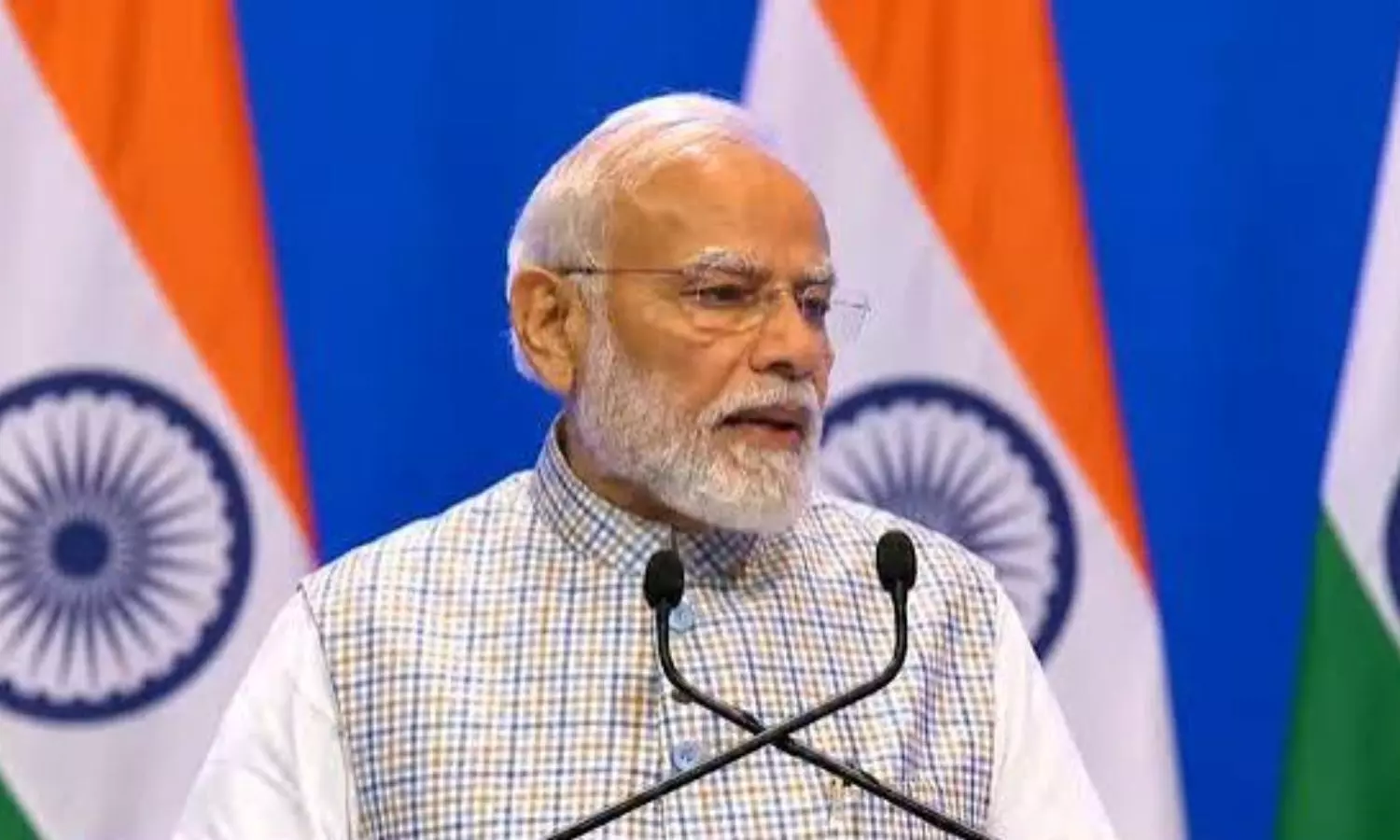
Prime Minister Narendra Modi
Prime Minister Narendra Modi praised India's expanding digital ecosystem at the 10th edition of the Indian Mobile Congress (IMC) 2026, highlighting how mobile technology has transformed governance, education, communication and content creation. He also called for a global framework to tackle cybercrime, warning that digital fraud and online scams have become challenges that require international cooperation.
Inaugurating the event on Thursday, Modi said India's digital ecosystem had demonstrated the ability to achieve “Scale Without Boundaries.” Referring to the summit's theme, he described the platform as one that had evolved into a showcase for “India’s progress and India’s dreams.”
Digital India transforms telecom access
Modi said India's telecom sector had grown beyond networks, spectrum, towers and internet speeds. Mobile phones, he explained, had become essential tools for public services and governance.
“Over the past 10–12 years, mobile phones have not only served as a medium of modern communication but have also emerged as an essential tool for good governance,” he said, linking the transformation to the government's Digital India vision.
The Prime Minister noted that the digital divide had been a significant challenge a decade ago, when access to modern technology was largely limited by financial resources. The Digital India mission aimed to change this by placing mobile connectivity at the centre of the country's digital transformation.
“Through the Digital India mission, we resolved to change this landscape, placing the mobile phone right at its center,” PM Modi added.
He highlighted telecom reforms, infrastructure expansion and the growth of domestic smartphone manufacturing as important steps towards making digital services more accessible. “Through every such endeavor, access to mobile phones and data became significantly easier for the average Indian citizen.”
Digital services supported education during COVID-19
Modi pointed to the COVID-19 pandemic as an example of how India's digital infrastructure helped maintain essential activities during a crisis.
“Yet, in India, offices continued to run. Work went on. Education never stopped. This was made possible by India’s digital ecosystem.”
He also highlighted the role of the DIKSHA platform in supporting online learning. According to the Prime Minister, the platform recorded “over 5 billion learning sessions and nearly 60 billion learning minutes” up to July 2022. Digital education initiatives aimed to connect nearly 250 million students.
“In other words, the telecom revolution has directly benefited every citizen of India,” he said.
Gaming and content creation gain momentum
The Prime Minister also discussed the growing gaming and creator economy, describing smartphones as tools for both entertainment and professional creativity.
“Take the gaming sector, for example. It is estimated that today, more than 500 million people in India are connected to the gaming ecosystem in some way,” he added.
He further said, “In other words, in India, the mobile phone today is not just a gaming console—it has also become a creation studio.”
Modi said mobile technology had made content creation more accessible, opening new opportunities for creators and contributing to economic growth.
“The mobile phone has also democratised content creation in India,” he said.
PM Modi urges global action against cybercrime
Alongside the benefits of digital expansion, Modi warned that cyber fraud and online crime were creating serious concerns for ordinary citizens.
“An ordinary citizen does not think in terms of protocols or architecture. For them, trust is extremely important,” he noted.
Calling for coordinated international action, he said, “Cyber fraud and cybercrime do not respect borders. They have already crossed those boundaries.”
He added, “Therefore, it is important that we work towards a global framework to address this. Governments, technology companies, telecom operators and financial institutions—all of them will have to be part of this framework.”
“India has learned a great deal from its own experience in this direction, and India is always ready to share its experiences with the world.”
His address highlighted the importance of expanding digital access while strengthening trust, security and international cooperation to protect users in an increasingly connected world.

Telangana Dy CM Bhatti Vikramarka announces measures for Singareni workers
SIR Hearing Deferred to Thursday; Rahul Must Refile Petition
Modi says India grows 'with the world, not at anyone's cost', cites strong economic fundamentals
CJP Challenges Jantar Mantar De-notification; Police Register Four FIRs Against Congress
Srisailam Project earns international recognitionl, included in World Book is Records
CJP Leaders Saurav Das, Ashutosh Ranka Detained After Jumping Gate To Enter Jantar Mantar


