Anantapur tops in farm pond construction

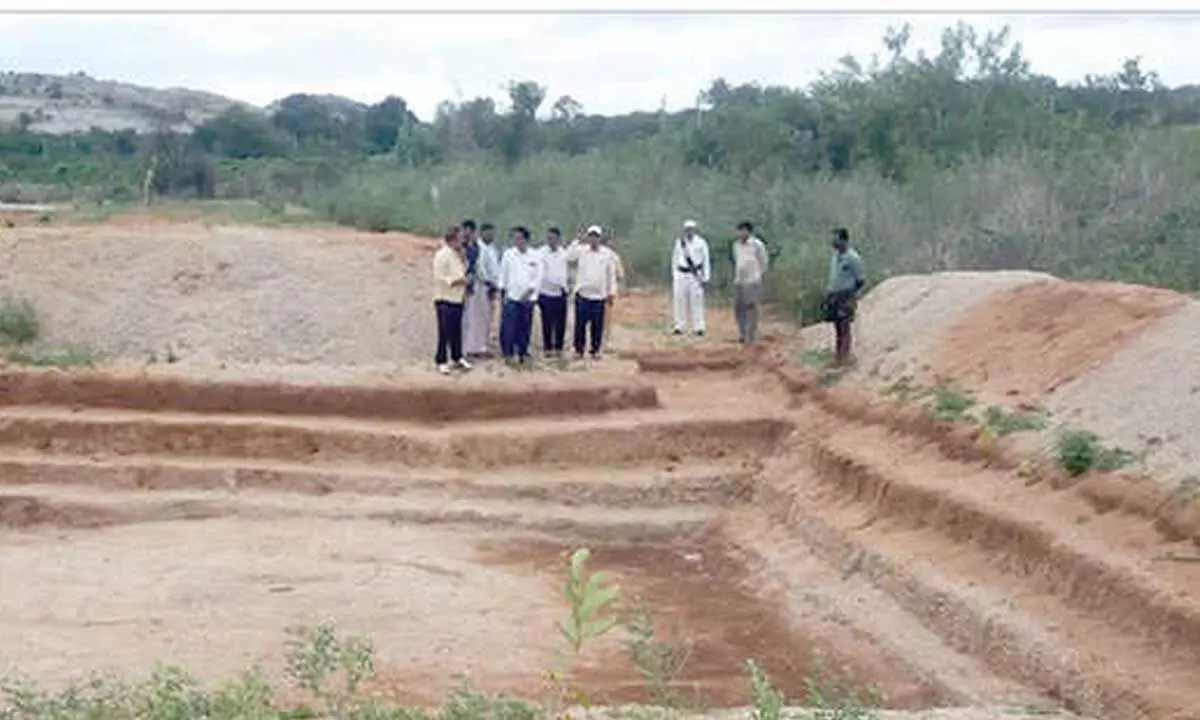
Anantapur: In a district notorious for drought and poor living conditions, water has long been regarded as ‘liquid gold.’
With no major rivers flowing through Anantapur, residents depend largely on erratic rainfall or borrowed water from the Tungabhadra and Handri-Neeva Sujala Sravanthi (HNSS) projects. Against this backdrop, the farm pond construction scheme under the District Water Users Association (DWAMA) has emerged as a lifeline.
DWAMA Project Director N Saleem Basha, under the guidance of District Collector Dr V Vinodh Kumar, is spearheading the ambitious project to construct 9,000 farm ponds across 31 mandals and 578 gram panchayats in the district during 2025-26. The initiative is expected to conserve an estimated 169.2 million cubic meters of water equivalent to 6 tmcft providing significant relief to the drought-hit region.
Despite its acute water scarcity, Anantapur has remarkably secured the top position in Andhra Pradesh’s horticulture sector. Officials attribute this success to the commitment of both the district administration and the DWAMA team, whose focus on water conservation is helping transform agriculture in the region.
Speaking to The Hans India, Saleem Basha revealed that progress has already surpassed expectations. “In the first quarter of 2025-26, we have completed 3,689 farm ponds. At this pace, the target of 9,000 will be achieved well ahead of schedule,” he said.
The benefits of farm ponds go beyond immediate irrigation. By capturing rainwater, these ponds help recharge groundwater levels, creating a sustainable water source for future use. Farmers stand to gain a “double bonanza” improved irrigation for their fields and enhanced groundwater reserves.
Basha’s relentless field inspections and continuous monitoring have been crucial to the project’s success. Jointly funded by the State and Central governments, the initiative is seen as a model for water conservation in drought-prone areas. Officials and farmers alike hope that the large-scale farm pond network will not only mitigate the district’s water woes but also set the foundation for a more resilient agricultural economy in Anantapur.