




- NSO releases draft guidelines for compiling GSDP via expenditure method
- JMI hosts delegation from the National Library and Archives of the UAE
- Bihar Congress plans phased agitation over voter rights until November, demands CEC Gyanesh Kumar’s resignation
- Govt kicks off e-auction process for 5-acre prime industrial plot in Delhi
- NDA will allot 34 pc tickets to Backward Classes in local body polls, says Andhra Pradesh CM
- AP Cabinet to meet tomorrow , to discuss on BC reservations
- Punjab Chief Secretary offers unconditional apology to High Court in DA case
- Bandi Sanjay Begins 11-Day Bhavani Deeksha in Karimnagar
How Brokerage Impacts Long-Term Trading Profitability
In Short
Discover how brokerage fees affect long-term trading profitability. Learn how commissions, spreads, and hidden charges can impact returns and how to choose cost-efficient trading platforms.

Share :
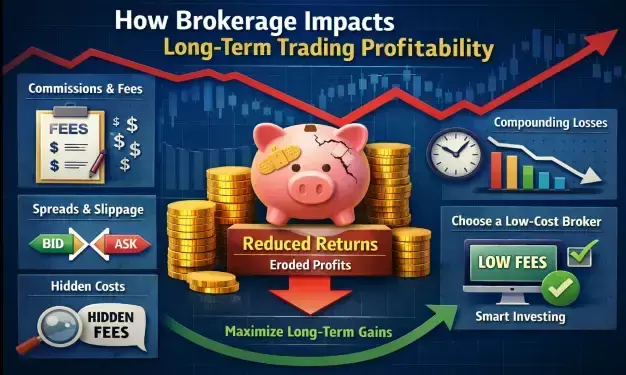
Brokerage fees represent the costs that investors must pay whenever they conduct stock transactions. The expenses associated with trading, which seem insignificant for a single transaction, will decrease your investment gains during the entire investment duration.
The Definition of Brokerage
Broking constitutes the fee brokers charge to process your trading order. The buyer pays brokerage fees when he purchases shares. The seller must pay brokerage fees when he sells his shares. Broking fees are accompanied by additional minor costs, which include exchange fees and taxes. Your total earnings decrease because all these expenses work together to decrease your profit.
The Impact on Compounding
Long-term investing operates by using compounding. Compounding enables your initial investment to generate increased returns throughout time. Brokerage expenses decrease your available capital, which results in a decrease in your future potential earnings.
You will earn 12 percent every year for a period of 15 years. Your trading expenses will decrease your yearly returns by 1 percent. Your financial growth decreases from 12 percent to 11 percent. The 1 percent difference in growth creates a substantial difference in total wealth after an extended period of time.
The key point is simple. Business expenses diminish both present earnings and future business development.
Trading Frequency and Cost Impact
Active traders are required to pay brokerage fees every day. The monthly trading schedule requires traders to pay their brokerage fees at the same frequency. Investors who maintain their assets for a long duration will incur brokerage fees only during their initial purchase and final sale.
Brokers handle trading as their main operating cost. This expense becomes a fundamental element of the trading system. Broking charges will quickly consume the profit margin that each trade generates. The total costs that investors face will decrease when they decide to trade less often.
Active trading remains valid as a trading method. The expense must be accounted for during the planning process.
Trade pricing establishes the break-even point for each trade. 'Break-even' means the price at which you neither make a profit nor a loss. Brokerage fees increase above this threshold.
The price of shares must rise beyond ₹300 before you can start earning profits after buying shares worth ₹50,000 with ₹300 as total costs. Brokerage expenses will transform your small profit into a complete financial loss when your anticipated price movement remains minimal.
Traders need to calculate their brokerage expenses, which is why they use a brokerage calculator. A brokerage calculator helps you check how much you will pay before placing a trade. The system displays anticipated expenses while showing the net profit you can achieve following all expenditures. You can employ precise numerical data to make your decisions.
Impact on Long-Term Strategy
High turnover rates for portfolios result in diminishing investment returns over time. Investors who execute trades without a valid justification will face increased brokerage expenses. The total return appears profitable, but the final return after deducting all expenses reaches a lower value.
Two investors may earn the same gross return. An investor who makes frequent transactions will lose his total wealth because he incurs more brokerage expenses than the other investor. This difference becomes clearer over long periods.
Cost awareness encourages better discipline. Traders need to consider their actions before executing their trades. The company provides tools that help users handle their risks.
Risk and Net Returns
The evaluation of performance requires net return as the sole essential metric because gross return holds no value. Net return denotes the remaining amount after all expenses have been deducted. Brokerage expenses decrease this value.
Reduced net returns impact performance evaluation metrics. Your total efficiency will decrease when you achieve lower returns by taking the same risks but facing higher expenses. Professionals who trade need to control their costs the same way organisations manage their operational costs.
Using a brokerage calculator regularly can help you compare different trade sizes and methods. You can visualise various scenarios before making financial commitments.
Conclusion
The small size of brokerage fees in individual transactions conceals their significant impact over time. The system decreases profits, while compounding benefits decrease and break-even requirements increase. Your trading frequency will determine how much focus you should dedicate to understanding your expense framework.
NSO releases draft guidelines for compiling GSDP via expenditure method
CDS General N.S. Raja Subramani opens residential block for sailors at Karwar Naval base
Fenesta Open: Nitin Sinha stuns Manish Sureshkumar to reach men’s final; Vaidehee in summit clash
Jaipur ED attaches properties worth Rs 34 crore in Nexa Evergreen investment fraud
India-Liberia led group aims to bring safety of seafarers to centre of global discourse: MEA
Prez to Meet Opposition Delegaton at 8 PM
Supreme Court gives nod for local body elections in AP
Delhi Turns into a Fortress Amid Hectic Political Activity Against CEC
Supreme Court dismisses AP’s Petition on 34 % BC reservations
Bypoll Results 2026: BJP Leads In Bengal And Assam, Vijay’s TVK Faces Test In Tamil Nadu


