




- Not all pains are failure of organs
- Surekha summoned to Delhi
- Assembly passes CURE Bill amid objections
- Section 22-A list shrinks by 47,440 acres, says Ponguleti
- Protection kits distributed to frontline staff at tiger reserve
- Three arrested for murder
- Centre decides to fast-track Adilabad Airport: Kishan Reddy
- Jarange Patil to begin indefinite hunger strike from Sept 19
How the art of repair is back in fashion in India
In Short
After seeing a pushback to fast fashion among Gen Z, retailers integrating sewing and repair as part of their workshops

Share :
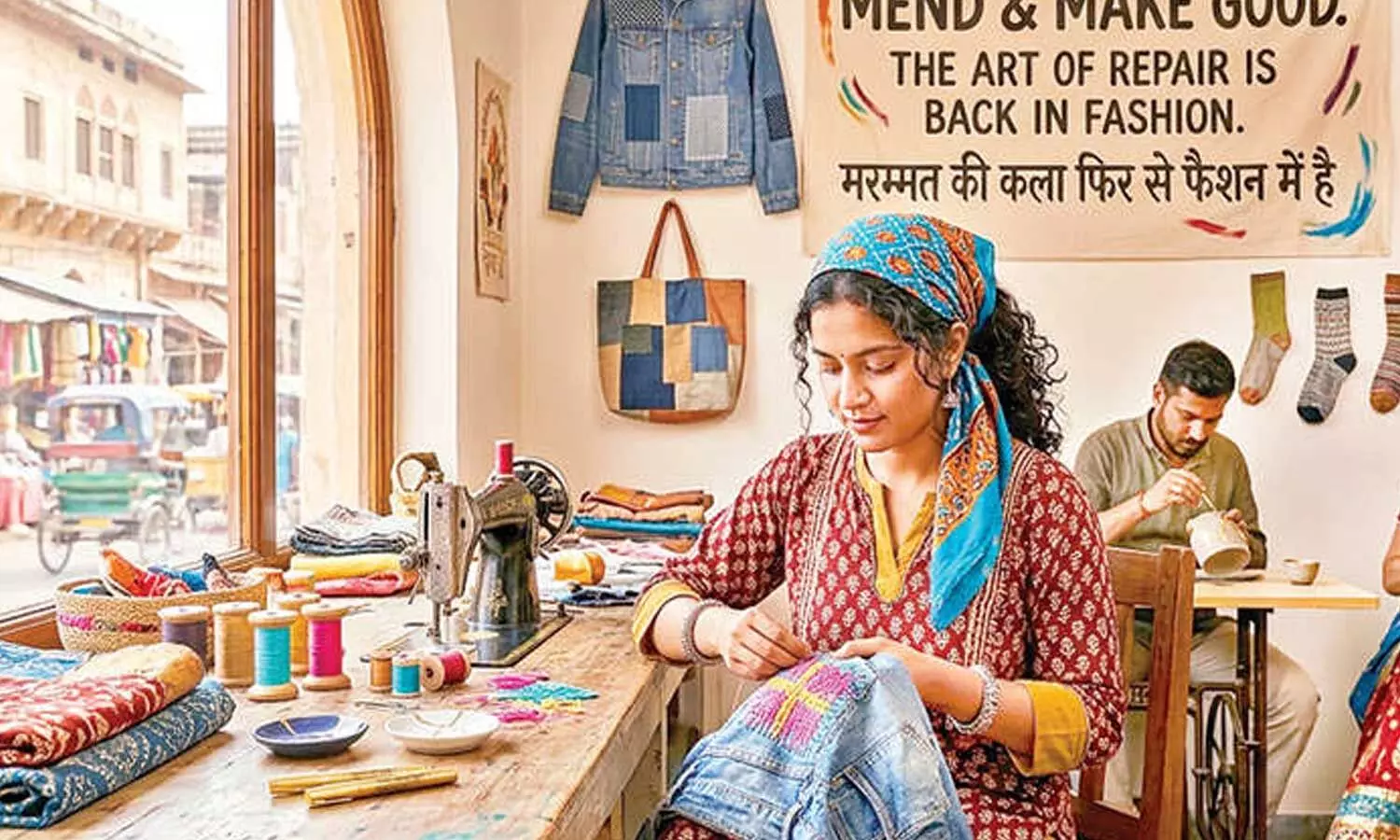
How the art of repair is back in fashion in India
Leadingpremium and luxury brands have always offered repair and alteration services as an extended, complimentary service. After the commercialised fast-fashion era, retail brands are slowly embracing repair services more often, as they see customers’ inclination towards slow fashion. Brands are including it as an integral part of their ethos. It is a calculated strategy to reposition and become more sustainable, while others may see it as a sales deterrent. However, customers are loving it.
The rising thrift economy is popular among Generation Z, and niche millennial participants of sustainable fashion are no exception. Choosing repurposed fashion has become a status symbol among them. The virality of this choice is a direct reflection of their awareness about the planet and a severe repercussion of infamous fashion practices. The previous decade, which aggressively built fast fashion, is fading away, and the younger generation wants to go back to
slow and mindful fashion. Fashion is more personal, ethical, and responsible. Brands are pushed to recognize their voice and address the appeal underneath it.
After seeing a pushback to fast fashion among Gen Z, retailers are integrating sewing and repair as part of their workshops. A garment is bound to go through the repair stage if it is used mindfully and sustainably. On seeing enthusiasm among the youth, denim retailer Levi Strauss & Co. and Japanese retail company Uniqlo are among many retailers that have introduced product repair across their stores internationally. Their approach is intentional and aimed at sustaining the interest of young consumers with traditional methods of mending and restoring clothes.
Textile waste is always considered one of the key components of climate catastrophe. Many documentaries, such as The True Cost, The Circular Garment Documentary, The Hidden Cost of Staying Trendy – Earth Focus, are among the most watched to spread awareness among the youth. The secondhand clothing industry is not only an aftermath of such causes of awareness.
While the thrift industry is developing at a gigantic scale, The Business Research Company cited that the global market for secondhand products reached $475.19 billion in 2025, and is projected to expand to $854.57 billion by 2030, with a compound annual growth rate (CAGR) of 12.4 per cent. However, the secondhand product industry lacks a robust infrastructure to operate seamlessly across the world, and sometimes the cost of selling them is higher.
Paris, a remarkable location on the global fashion map, is widely recognised for its labour legislation and rights. An interesting opportunity arises for social enterprises, as the country has
implemented national and local repair legislation to encourage sustainability, paired with unique
impetus programs to eliminate discard culture. Europe is another example of following a sustainable lead by enacting repair legislation on 31 July 2026. United Repair Centre (URC), popularly known for mending performancewear clothes from brands such as Patagonia, The North Face, and among other brands numbering almost 35 and above, has opened its second
facility in Paris. The Dutch social organisation’s expansion addresses the region’s growing recognition and lasting impact. The company employs almost 51 tailors and repairs approximately 55,000 pieces a year. The world watches closely and continues to draw inspiration to combat the climate upheaval caused by the textile industry.
As countries across the world encourage people to adopt a circular economy, brands are making an effort to embrace it well. The textile industry sits at the top of the pollution-contributing list, and clothing repair can iron out its primary challenge of overproduction. Repair is an elementary part of the circular economy, as we elaborate on its pillars, such as remake, resale, and reuse. However, clothing repair is an intricate segment, considering the uniqueness of pieces of the volume. Manual and trained labour costs the same as it takes to produce a new garment. It is very similar to the infrastructure scarcity of the garment resale industry. It is a value-driven industry, and momentum can sometimes appear effortful.
International retail brands like Marks & Spencer and Primark have collaborated with companies
like Sojo and Seam, respectively. These collaborations have given other retail brands the confidence to take a strategic plunge and evaluate their sustainable goals without worrying about sales metrics. Repair-centric companies leverage this growth area to scale, as scalability for this segment remains slow as volume doesn’t bring much impact. The rising cost of living and unemployment force nations like France to include repair legislation to manage product life cycles and provide the benefits of such scheme inclusions. France can be seen as a benchmark, as it has the most distinctive Extended Producer Responsibility (EPR) policy, such as an approved lower VAT rate of 5.5 per cent on repair services.
India is witnessing repair-centric companies as an extended arm of fashion, repair, and service.
These companies can be classified into service, repair, and tech enablement for fashion. Looking at international brand collaborations, these brands have unique advances in B2B opportunities that could benefit and bring a collective effort to drive business, sustainability, and thoughtfulness. Before mass and premium segments, luxury segments consisted of repair-oriented services in organised and unorganised sectors, considering the high price point and longer product lifecycle, such as Thread Lab and Restore Love, an initiative by Antar-Agni, a designer clothing brand. Ateliya, AlterHub, and Stitchat are the country’s startup companies focused on repair, along with other services.
Considering India’s unique positioning as a manufacturing country, clothing repair can be a positive growth area for businesses. With rising unemployment, cost of living, and uncertainty, an abundance of human labour can create employment opportunities with a unique proposition of environmental protection and a purpose to reduce carbon footprint. It will certainly help the nation come closer to its commitment to reach net-zero carbon emissions by 2070.
(The writer is an educator and writes on fashion & retail, lifestyle and culture)
Centre offers to back Quantum Bio Valley
Vijaya Dairy to hike milk prices by up to Rs 2/Litre from tomorrow
AP to digitise citizens’ health records from Jan 1
CM Revanth Reddy firms up steps for Ganesh festivities
Make health a priority, says Director of Public Health
Holy Darbha mat procession taken out in Tirumala


