Technical indicators suggest sustained bullish momentum

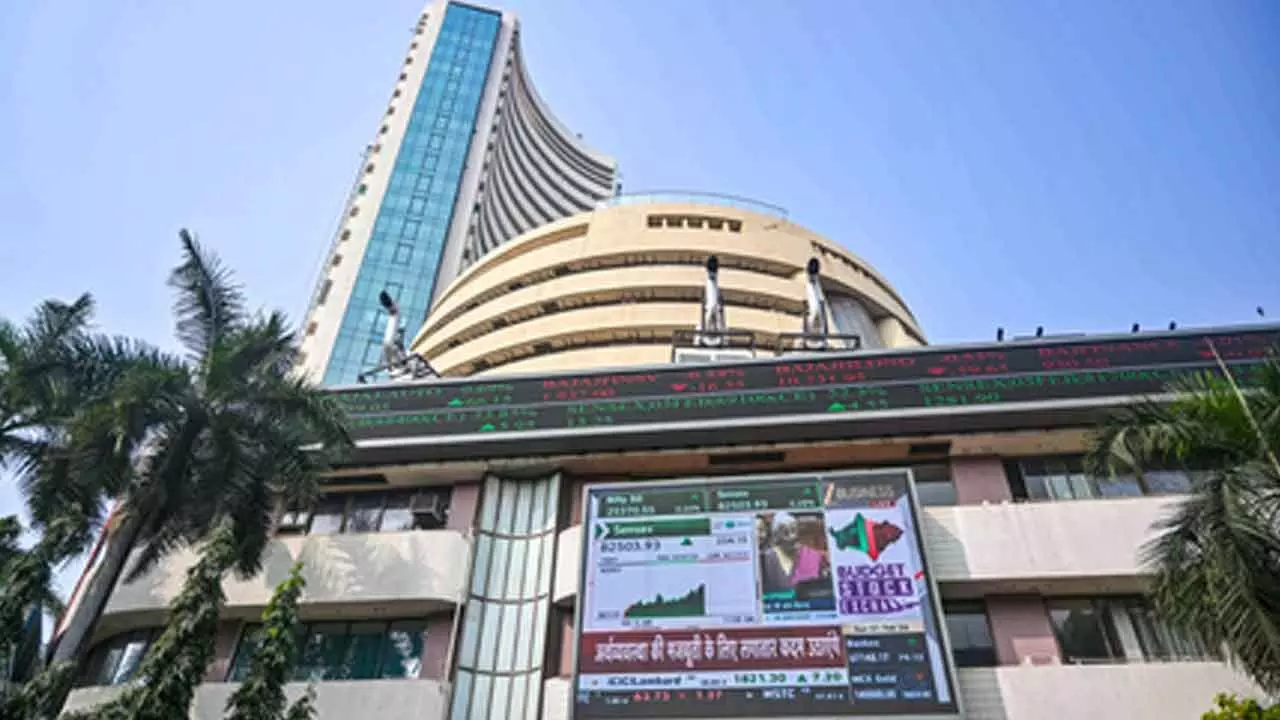
Navigatingthe “Anthropic” jolt to software services sector and buoyedby the landmark India-US trade agreement, which helped ease external uncertainty; marketsextended their gains for a third consecutive week during the week ended.
The BSE-Sensex rose 1,310.62 points, or 1.59 per cent, to close at 83,580.40, while the NSE-Nifty gained 373.05 points, or 1.47 per cent to settle at 25,693.70.FIIs turned net buyers this week, purchasing equities worth Rs2,645.53 crore, while DIIs continued to lend support to the market with net purchases of Rs2,892.14 crore.While the Union Budget did not materially shift market sentiment, the announcement of a higher Securities STT on F&O trades alongside an expanded government borrowing program triggered a brief knee-jerk reaction across indices. RBI kept the repo rate unchanged at 5.25 per cent, maintaining a neutral stance.
Consequently, the Standing Deposit Facility (SDF) rate remains at 5.00 per cent, while the Marginal Standing Facility (MSF) rate and bank rate stay at 5.50 per cent. The RBI’s decision signals a deliberate approach, allowing the economy to absorb previous rate cuts while supporting growth momentum and borrower confidence. Near-term inflation expectations have edged slightly higher, but rate stability is expected to sustain domestic demand.
Overall, the data put out by RBI suggests a steady recovery trajectory, underpinned by supportive monetary policy, expanding production, and sustained domestic demand.Anthropic’s release sparked a selloff in software services companies and it quickly fed into a continuing narrative about the potential for AI tools to disrupt established software businesses.Fears that software companies are facing an extinction event are exaggerated, but other dangers are real.Artificial intelligence won’t destroy the software business.
But the persistent belief that it can still do a lot of damage.AI won’t eliminate the need for specialized-software platforms. But survival alone isn’t enough to claw back recent losses.There’s this notion that the software industry is in decline and will be replaced by AI. It is the most illogical thing in the world, and time will prove itself.But time isn’t waiting in a volatile market that is eager to find signs of AI disruption.
Heard on the Street:The Dow Jones Industrial Average hit 50000 for the first time last week, the latest milestone in a years-long run in which the US economy has muscled past its rich peers and snapped up investment the world over. Since the blue-chip index plunged below 6600 during the depths of the 2007-09 recession, it has effectively moved in one direction on the flickering screens of Wall Street: up and to the right. Bouts of trading turmoil that periodically upended the Dow now seem like speed bumps in America’s rear-view mirror.
An era of ultralow interest rates helped spur the longest post-war expansion in U.S. history and pump Silicon Valley into a global juggernaut. Washington threw massive amounts of money into the financial system and economy to propel a rapid rebound from the pandemic. An artificial-intelligence boom has more recently juiced the stock market at a historic scale.
The Dow’s final push above 50000 arrived at an unlikely moment. As Wall Street has ramped up scrutiny of AI mania, and a slump in software stocks began spilling into other areas of the market in recent days, investors have funnelled money into real-economy stocks in a wager that America’s growth is once again accelerating.
In recent days, software stocks and other risky assets have been mowed down by artificial intelligence, but stodgier stocks are springing up to replace them among the market’s leaders. Many investors are hoping to sidestep the Grim Reaper of AI, reduce their exposure to the biggest technology stocks and still earn decent returns by beefing up their positions in these boring companies (Ex: ITC, HUL).
But make sure you understand the trade-offs before you join in. Over the short run, you’ll probably sleep better investing in boring companies, but the long run could end up lasting longer than you realize.The recent selloff has hit some of last year’s most exciting stocks the hardest. Boring stocks tend to do better when the overall market does worse.
After all, it takes a 100 per cent gain to recover fully from a 50 per cent loss, a 33 per cent gain to recover from a 25 per cent loss, and so on. Low volatility has less of a hole to dig itself out of to get back to that prior peak. That ability to weather selloffs can be very useful.In opposition to the efficient-market hypothesis, which holds that stock prices reflect all available information, it is argued that “the pathetically inefficient market doesn’t seem to have a clue as to what is going on.”
Quote of the week:“The individual investor should act consistently as an investor and not as a speculator” — Ben Graham
You’re an investor, not someone who can predict the future. Base your decisions on real facts and analysis rather than risky, speculative forecasts.
FUTURES & OPTIONS / SECTOR WATCH
The week ended wasmarked by sharp swings as markets first reacted nervously to the Union Budget announced on Sunday, followed by a strong positive response to the announcement of a trade agreement between India and the United States.
However, sentiment in the IT sector weakened after news related to U.S.-based AI developer Anthropic raised concerns about potential disruption to traditional software business models. Despite a modest correction from peak levels towards the end of the week, the Nifty concluded the week with gains of approximately 3.5 per cent. Bank Nifty also maintained its upward journey, closing the week with gains of around 3 per cent. In the options segment, the significant Call open interest for Nifty was observed at the 26,000 and 25,800 strikes level whereas notable Put open interest was concentrated at the 25,500 and 25,600 strikes.
For Bank Nifty, significant Call open interest was seen at the 60,000 strike with substantial Put open interest at the 60,000 strike. Implied volatility (IV) for Nifty’s Call options settled at 10.69 per cent while Put options concluded at 11.27 per cent. The India VIX, a key indicator of market volatility concluded the week at 12.17 per cent.
The Put-Call Ratio Open Interest (PCR OI) stood at 1.13 for the week. The Nifty oscillated in a wide intra-week range of 1661.80 points.Structurally, the broader trend of the market remains positive, though the index is currently navigating a consolidation phase after a strong up-move.Immediate resistance for the Nifty is placed around 26,000, followed by a stronger hurdle near 26,300.
On the downside, supports are seen at 25,400, with the next important support placed near 24,850, which also coincides with key moving average support.For near term, market players would do well to adopt a balanced and selective approach and to remain stock-specific rather than index-led. Aggressive long positions may be avoided until the indices show a clear breakout above resistances. Existing positions should be managed with disciplined trailing stops to protect gains.
Stocks looking good are Hero Motocorp, HUL, MFSL, Tata Consumer, SAIL and Unominda.Stocks looking weakareAsian Paints, BDL, HAL, TCS, IRFC, Syngene and Mazagon Docks.
(The author is a senior maket analyst and former vice-chairman, Andhra Pradesh State Planning Board)
Rajratan Global Wire Limited
Thefirm is engaged in the business of manufacturing and sale of tire bead wire and high carbon steel wire. The company’s tire bead wire product has applications in earth moving equipment tires, automobile tires, aircraft tires, two-wheeler tires, truck tires and bus tires. The main function of bead wire is to hold the tire on the rim and to resist the action of the inflated pressure, which constantly tries to force it off. It also offers high carbon steel wire, a versatile material used in various industries including construction, engineering and automobile. Its high carbon steel wire has applications in wire rope and cable, high performance spring, mechanical springs, bedding and seating, outer and inner automotive cable, cut wire shot for shot blasting and pinning, steel-fiber and aluminum clad steel. The company’s subsidiary is Rajratan Thai Wire Company Limited and is the only bead wire manufacturer in Thailand. The game changer in the company’s performance was the decisive turnaround performance in its new Chennai plant. The company’s customers include all leading Tyre companies like Apollo, Michelin, Bridgestone, MRF, JK Tyres and others. Buy on declines for medium term target of Rs750.