




- Govt medical colleges pip private institutions in MBBS 1st yr results
- West Bengal team studies rural development works in Krishna dist
- Jagan’s Letter To Sharmila: YSRCP accuses Chandrababu of exploiting family dispute
- Good response to hmtv’s Innovative Hackathon-2026
- The three qualities that shape our everyday life
- This Diwali, trade fireworks for a sky full of stars in Kenya
- Telugu talent Jidnyasa Chilka makes her mark on Mumbai’s theatre stage
- Uttam blames BRS regime for states’s El Nino woes
In between the lines: Divya Iyer’s journey from poetry to fiction
In Short
“I was interested in the little moments we often overlook but which can mean so much in a relationship. A delayed reply can leave you wondering, while a simple voice note can bring comfort,” she says.

Share :
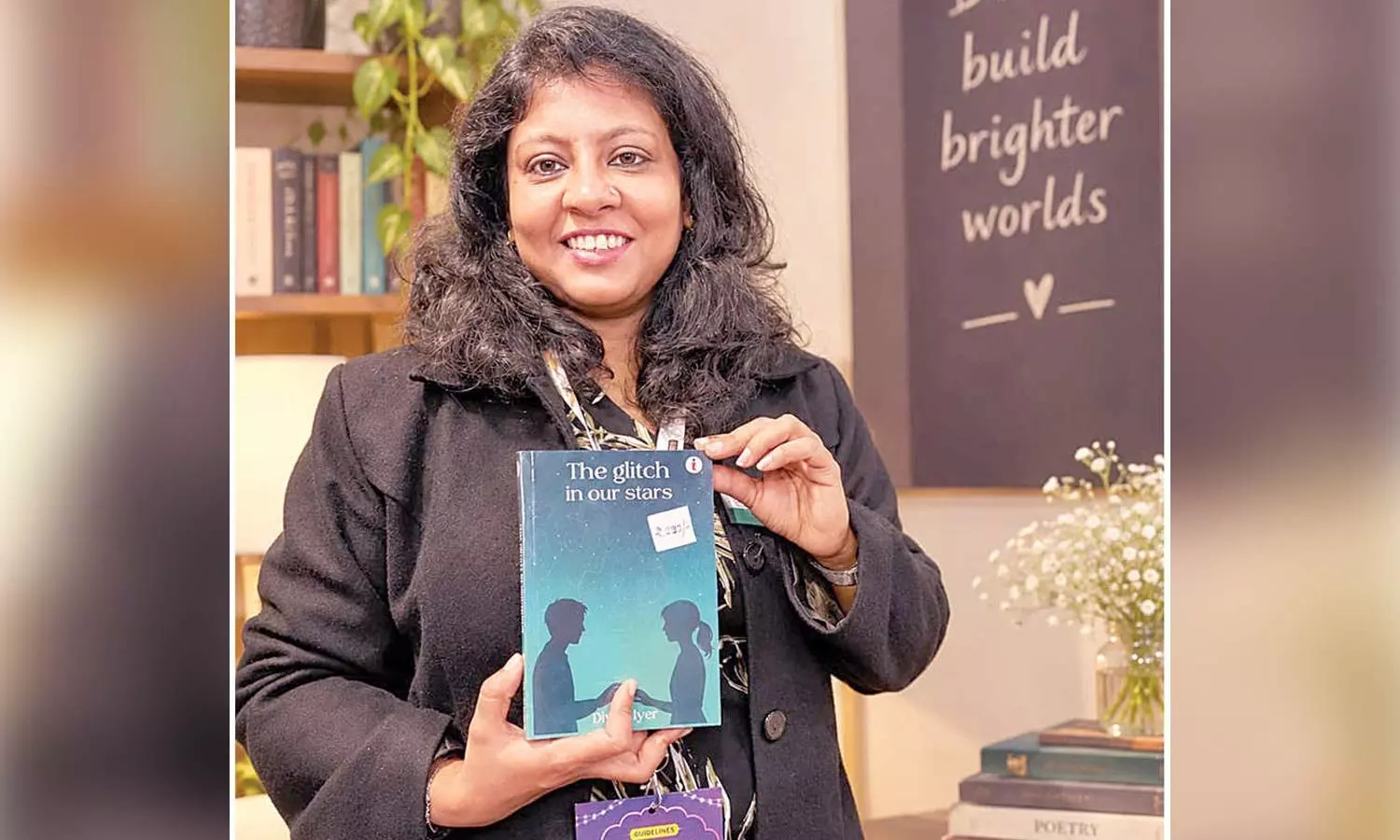
Divya Iyer
Divya Iyer expected a line to become a poem. It arrived on a quiet evening, unfinished yet familiar, and she instinctively wrote it down. But the line refused to settle into a stanza. It demanded characters, a story and a world of its own. That unexpected moment marked the beginning of her journey into fiction.
“Poetry has always been my sanctuary. But this particular line seemed to be asking for more. It needed characters and a story,” she says.
The result was ‘The Glitch in Our Stars’, her debut novella exploring love and intimacy in an age shaped by digital communication. Rather than grand romantic gestures, Iyer focuses on everyday moments that define contemporary relationships: a message left on read, the anticipation of typing bubbles and a video call that ends too soon.
“I was interested in the little moments we often overlook but which can mean so much in a relationship. A delayed reply can leave you wondering, while a simple voice note can bring comfort,” she says.
Through these familiar experiences, the novella examines how technology can bring people closer while leaving emotional distances unresolved. Even when communication is constant, understanding another person remains complicated.
The writing process unfolded in fragments, with Iyer developing scenes during long walks and sleepless nights. There were times when the pieces seemed unwilling to come together, leaving her uncertain about the narrative’s direction. Gradually, however, she began to recognise that the gaps and pauses carried meaning of their own.
“There were times when I wondered whether the story would come together. Eventually, I realised that the gaps and pauses were meaningful too. They reflected the uncertainties and silences that are part of our relationships,” she says.
Moving from poetry to fiction also demanded a different discipline. While poetry allows emotions to be captured in a few lines, a novella requires characters and their experiences to develop over time.
“Writing fiction taught me to stay with an emotion instead of trying to capture it quickly. I had to learn to trust the process and let the story lead me,” she says.
One of the most rewarding aspects of the book has been its reception. Readers have reached out to share how they recognise their own experiences in its characters. At the book launch, one reader told her, “I see myself in Dil.”
“That stayed with me. When you write something personal, you never really know how it will be received. To have someone recognise themselves in a character made me realise that the story had become something shared,” she says.
At its heart, ‘The Glitch in Our Stars’ explores how relationships are shaped as much by absence as by presence. An unanswered message, an interrupted conversation or a midnight voice note can carry emotions that words alone cannot explain.
“Sometimes, the silence between two people tells its own story,” she says.
Though Iyer continues to identify primarily as a poet, fiction has expanded her creative horizons. Her transition from verse to narrative is less a departure than an extension of her poetic sensibility, allowing emotions to unfold across chapters rather than lines.
“Sometimes, a feeling can be expressed in a poem, and sometimes it needs an entire story,” she says.
With ‘The Glitch in Our Stars’, Iyer reminds readers that meaningful connections often emerge in the spaces between words, where longing, vulnerability and affection quietly find their voice.


