




Ati Sarvatra Varjayet: Opposition must know where to draw the line
In Short
Vote Chori Protest: More 0ptics, less substance
Share :
Ati Sarvatra Varjayet: Opposition must know where to draw the line
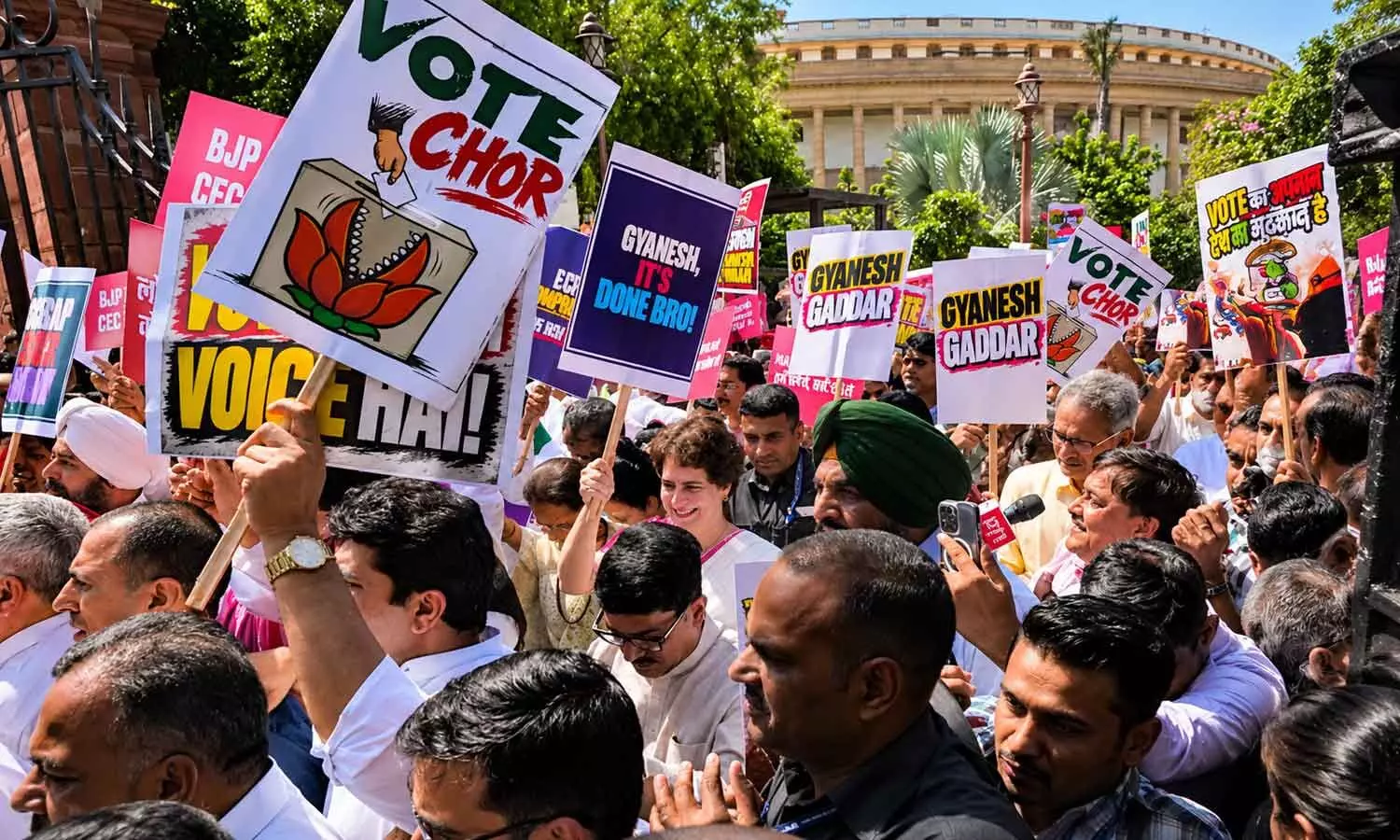
Prime Minister Narendra Modi should resign. Chief Election Commissioner Gyanesh Kumar must be impeached. Modi, Amit Shah and the CEC will not be spared and must face punishment. These are the charges we hear repeatedly from the Opposition, which appears to have more energy for street protests than for using Parliament effectively. Even when united on an issue, its parties often organise separate demonstrations and compete for political credit.
The Opposition seems to have forgotten the Sanskrit maxim (Ati Sarvatra Varjayet) — excess should be avoided in everything. The saying is particularly relevant to the protests over the Special Intensive Revision (SIR) of electoral rolls and the demand for the CEC’s resignation.
There are questions about the SIR process, whether genuine or amplified by the Opposition, that the Election Commission cannot afford to ignore. All three Election Commissioners should address these concerns at a press conference and explain the process in a transparent manner. Their silence only creates more doubts and gives the Opposition fresh ammunition.
At the same time, the Opposition is squandering an opportunity to turn the issue into a sustained political campaign. Although the INDIA bloc has rallied around a common cause, its parties remain divided over strategy and, increasingly, over who deserves the credit.
What began as a campaign demanding the CEC’s resignation is increasingly becoming a contest over credit chori. Daily protests and confrontations risk alienating ordinary citizens, particularly when they disrupt normal life without producing tangible results.
Since October 2, individual parties have staged dharnas and demonstrations, while the first joint protest by INDIA bloc MPs remained largely symbolic. The Congress attracted attention through the reported theatrics of Rahul Gandhi and Priyanka Vadra jumping out of a bus, entering Akashvani Bhavan and participating in a prolonged protest under a banyan tree. The episode raised questions about the purpose of the demonstration rather than advancing the substantive debate on electoral transparency.
Congress leaders, including Leader of the Opposition Rahul Gandhi, have argued that they need no permission to protest because it is their fundamental right. Peaceful protest is indeed a fundamental right, but it is not an unlimited licence to disregard the law. The exercise of this right is subject to reasonable restrictions, and protesters must comply with applicable laws and lawful directions. No political leader is above the law.
The Opposition, which questions the CEC’s independence, must also apply its standards consistently. Observations attributed to former Chief Election Commissioner T N Seshan concerning elections during Rajiv Gandhi’s tenure as Prime Minister deserve consideration in this context. Allegations of political interference in the Election Commission must be examined irrespective of which party is in power.
The Congress, which governs Telangana, attributes its electoral victory to the alleged misrule of the BRS. Did the BJP fail to make electoral gains because it could not indulge in the alleged vote chori? Was it not the same poll panel that conducted elections in Telangana? Does the Congress credit the BRS with preventing electoral malpractice? Rahul Gandhi and Chief Minister A Revanth Reddy need to explain their position.
Similar questions arise in Karnataka, Kerala and Himachal Pradesh, where the Congress came to power despite not being the incumbent government. If the BJP is accused of manipulating electoral rolls, how does the Opposition explain its limited electoral gains in Tamil Nadu and the BJP’s inability to improve its position in Kerala? Why have Congress-led governments in Telangana and Karnataka not explained publicly the safeguards they employ to ensure electoral-roll integrity?
If vote chori is real, violates the Constitution and amounts to “treason”, as Rahul Gandhi has alleged, the Opposition must substantiate its charges with evidence. It should also explain what its own governments are doing to prevent electoral malpractice. Why not share proposed safeguards with other non-BJP parties and develop a common framework for electoral transparency?
The Opposition has two meaningful options: await the Supreme Court’s judgment in the matter before it or take the fight to Parliament with facts and figures and compel the government to respond. Parliament is where the Opposition can question the government, demand explanations and place evidence before the country.
Even if it loses a motion or resolution, the Opposition should not confuse defeat in a parliamentary vote with defeat in the court of public opinion. A forceful, evidence-based debate can expose inconsistencies and compel ministers to answer questions. If it believes ordinary parliamentary methods are inadequate, it could consider extraordinary political steps, including mass resignation by its MPs. Such a move would carry serious consequences and should not be proposed lightly. But it would represent a definite political decision rather than an endless cycle of demonstrations.
What is the point of daily protests if the parties cannot agree on a common strategy or present convincing evidence? Political theatre may generate headlines, but it cannot substitute for a sustained constitutional challenge.
The Opposition is entitled to demand Modi’s resignation if it believes the government has compromised the Election Commission’s independence. But accountability cannot be selective. Allegations of electoral malpractice in states governed by Opposition parties deserve equally serious examination.
Consider Punjab. The Supreme Court reportedly ordered repolls in five wards after concerns were raised about electoral irregularities, including allegations that nomination papers had been torn. If electoral malpractice is a grave constitutional issue nationally, why should there not be equally forceful demands for accountability in Punjab?
Arvind Kejriwal and Rahul Gandhi should clarify their positions rather than remain silent when allegations involve a state where their parties have political interests. If the Congress believes electoral malpractice warrants the Prime Minister’s resignation, why should similar allegations not prompt demands for accountability from a Chief Minister?
The constitutional distinction between the Election Commission of India and State Election Commissions must, however, be recognised. Under Article 243K, State Election Commissioners oversee Panchayat elections, while Article 243ZA provides for their role in municipal elections. The Chief Election Commissioner is responsible for elections to Parliament, state legislatures and the offices of the President and Vice-President.
Therefore, responsibility for alleged irregularities in local-body elections must be examined in light of the relevant State Election Commission’s role, the state administration and the facts of the case. It would be inconsistent to hold the Prime Minister politically accountable for alleged interference at the national level while automatically absolving state governments when similar questions arise within their jurisdictions.
Meanwhile, the Congress is losing valuable time that could be spent preparing for the forthcoming Assembly elections in Uttar Pradesh and Punjab. The SP and BJP are already preparing for the UP contest. Unless the Congress strengthens its organisation, develops a state-specific strategy and negotiates from a position of strength, it may once again find itself playing second fiddle to the SP.
The Opposition must decide what it wants to achieve: establish electoral malpractice through evidence, secure institutional reforms, obtain judicial relief or simply keep the issue alive through protests. These are different objectives requiring different strategies.
Democracy is not strengthened by shouting the loudest, staging the most dramatic protest or claiming exclusive ownership of a political cause. It is strengthened by evidence, consistency, and the willingness to subject one’s own conduct to the same scrutiny demanded of others.
Ati Sarvatra Varjayet — excess should be avoided in everything.
(The author is former Chief Editor of The Hans India)
Kudos to GST Council for charting a new path
Ati Sarvatra Varjayet: Opposition must know where to draw the line
One El Niño and so many consequences
Rs 5,000-cr German aid to boost TG urban makeover
Rev up road projects in CURE: CM Revanth to officials
Pay for 10 days, travel for 30 days to ASR International Airport


