




- Awareness programme held at Medicover Nellore
- DGP calls for strong security plan for local body polls
- ‘Home Aayah’ scheme to skill SHG women
- Taxpayer-friendly recommendations hailed
- Pawan Kalyan to visit Polavaram tomorrow
- Serve devotees with dedication, staff told
- KIMS Bollineni performs first kidney transplant in city
- Odisha State govt has failed entirely: Naveen Patnaik
One El Niño and so many consequences
In Short
An analysis of how El Niño affects Telangana's agriculture, power grids, and water resources, emphasizing proactive crisis management and integrated governance.

Share :
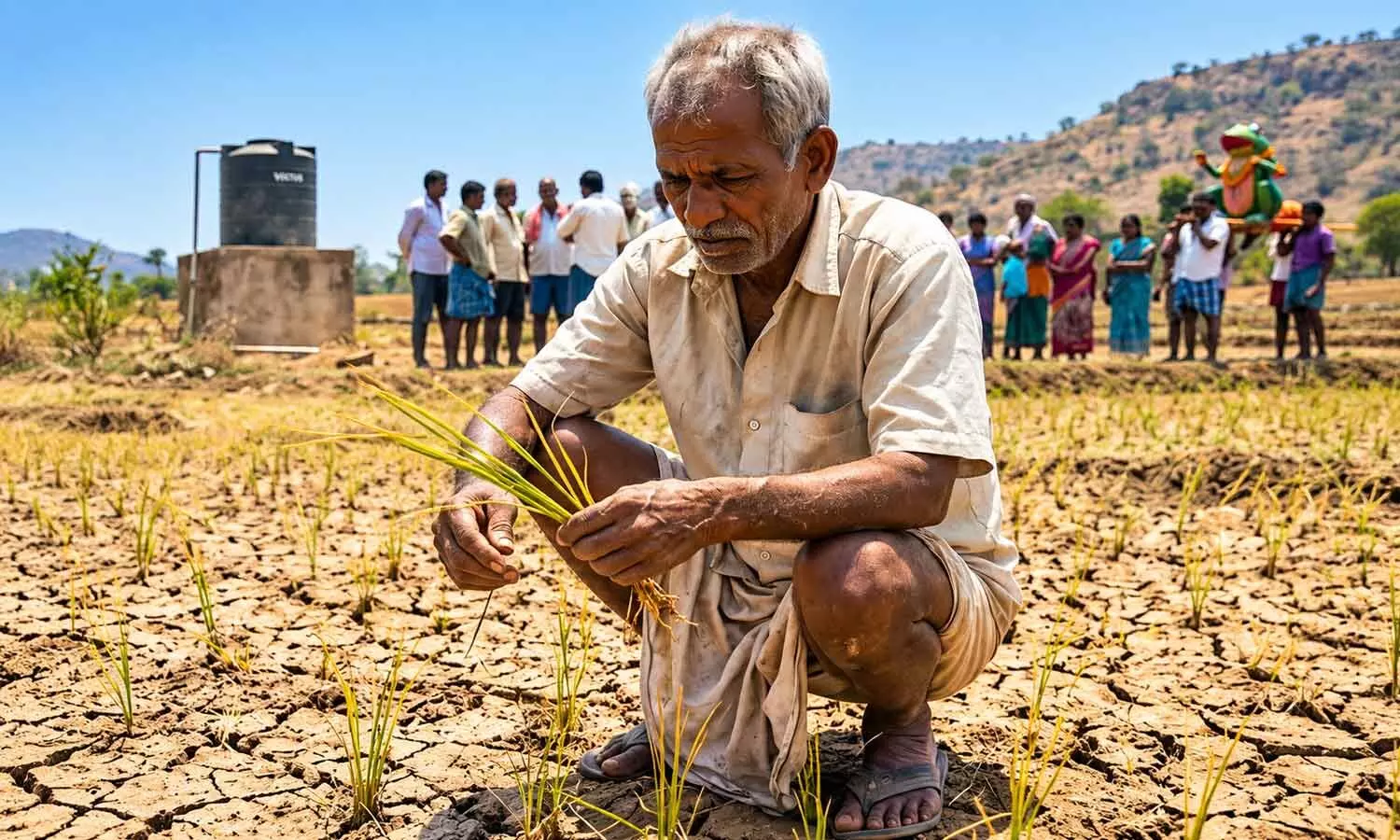
One El Niño and so many consequences
El Niño may begin in the Pacific, but its consequences do not remain just there. For Telangana, its effects can travel from the atmosphere to farms, power grids, village taps and household budgets. It is therefore a mistake to treat El Niño merely as a meteorological phenomenon. It is a stress test for governance.
Telangana’s dependence on the monsoon makes the warning serious. The State receives an average annual rainfall of about 907 mm, with nearly 79 per cent coming from the southwest monsoon. Agriculture therefore depends not merely on how much rain falls, but on when it falls and how evenly it is distributed. The State received 615.7 mm of cumulative rainfall between June 1 and October 5, against a normal 761.6 mm—a deficit of 19 per cent. The significance lies in what follows.
Rain that does not fall cannot enter tanks. Water that does not enter tanks cannot recharge groundwater. Falling groundwater levels mean deeper pumping, higher energy consumption and greater costs for farmers. Thus, what begins as a rainfall deficit can become a drinking-water, irrigation and income problem.
The agricultural numbers make the vulnerability clearer. Telangana has a gross cropped area of 56.9 lakh hectares, while its gross irrigated area is about 25.57 lakh hectares. A substantial part of cultivation therefore remains exposed to rainfall variability. If dry spells coincide with critical crop stages, farmers face lost investment in seed, fertiliser and labour, while the next season begins with greater financial uncertainty.
The question is whether the administration is converting warnings into decisions. If a dry spell is anticipated, should farmers continue investing in water-intensive crops? Should crop advisories not reach them before sowing? Should drought-tolerant crops, micro-irrigation and moisture conservation not be promoted more aggressively? Waiting for crop failure and then announcing relief is not drought management. It is crisis management.
The water problem also has another consequence: electricity demand. As groundwater recedes, pumps must work harder and longer. Prolonged heat simultaneously increases household demand for cooling. Telangana’s peak power demand crossed 16,600 MW in 2025; the projected peak is 18,138 MW for 2025-26 and 19,529 MW for 2026-27. If irrigation demand and domestic consumption rise together, the power system faces additional pressure.
Water and electricity, therefore, cannot be treated as separate policy questions. A village with falling groundwater can become an energy-stressed village as well. The State needs a common picture of rainfall deficits, groundwater levels, pumping intensity, irrigation requirements and electricity consumption. Separate departments maintaining separate numbers will not produce an integrated response.
Lower production of rice, pulses, vegetables and fodder can tighten supplies and push up prices. The water shortage that begins in a village can eventually raise the cost of living in a town. Drought preparedness must therefore be viewed as both agricultural and food-security policy.
There is also a public-health dimension. Heat stress does not affect everyone equally. Farmers, agricultural labourers, construction workers and others working outdoors face greater exposure. Dehydration, heat exhaustion and other heat-related illnesses can intensify during prolonged hot spells. If drinking-water sources deteriorate simultaneously, the health burden becomes heavier.
Telangana is not short of information. Weather parameters are increasingly monitored. The challenge is to move from information to intervention. Every district should know which mandals are entering water-stress zones, which villages may face drinking-water shortages, where groundwater extraction is rising and which crops are most exposed.
Such information should trigger action, not another report. Every mandal needs a drinking-water contingency plan, alternative sources and a clear reservoir-use strategy. Agriculture, irrigation, energy and health officials should review conditions together rather than in silos.
Tank desilting, feeder-channel restoration, rainwater harvesting and groundwater recharge cannot remain seasonal responses after reservoirs decline. They must become permanent investments in water security. Rural employment programmes can be linked to water conservation, creating both employment and resilience.
Farmers need weather-based crop advisories before sowing. Crop insurance claims must be assessed quickly when losses occur. Water-efficient crops and micro-irrigation need incentives strong enough to influence actual farm choices.
El Niño cannot be switched off by governments. But its consequences can be reduced. The question is not simply whether El Niño will bring less rain. The real question is whether Telangana will allow a climatic disturbance to become a social and economic crisis.
Rainfall is beyond administrative control. Water storage is not. Heat may be beyond control. Public-health preparedness is not. Climate variability cannot be abolished, but its damage can be reduced.
Nature may set the test. Governance determines the marks.
Kudos to GST Council for charting a new path
Ati Sarvatra Varjayet: Opposition must know where to draw the line
One El Niño and so many consequences
Rs 5,000-cr German aid to boost TG urban makeover
Rev up road projects in CURE: CM Revanth to officials
Pay for 10 days, travel for 30 days to ASR International Airport


