




- MMC launches digital drive for hassle-free Ganesh immersion
- Congress MLA urges govt to take back assigned lands from BRS netas
- Telangana High Court seeks CCTV footage of masked men at Saifabad PS
- 6 students drown during Ganesh idol immersion
- Rollback UPI tax
- Centre rules out UPI fee rollback
- Jagan to discuss drought with party leaders today
- Naidu to lay stone and inaugurate five projects in Vizag
An embodiment of determination- Modi the architect of the dream of a developed India
In Short
According to reports from the World Bank and the International Monetary Fund (IMF), severe poverty in India has fallen to single-digit levels during the period in which welfare programmes have been implemented under Prime Minister Modi’s leadership.
Share :
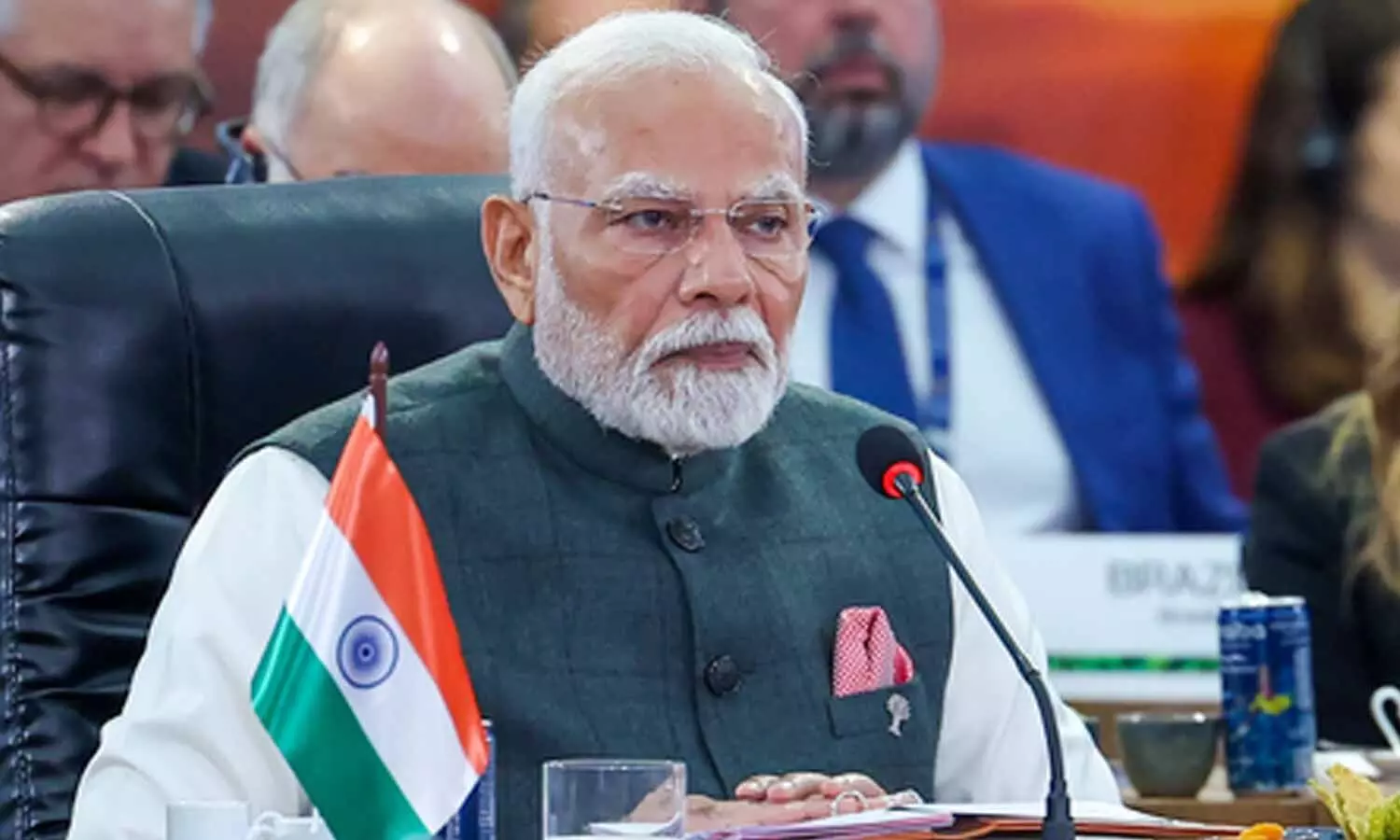
Prime Minister Narendra Modi
“Thedream we envision does not merely represent an individual, a community, or a particular region. My life’s mission is to give a living form to the aspirations and self-respect of 1.4 billion Indians.”
These are words that Prime Minister Narendra Modi often reminds people of the country. In the history of democracy, there have been many statesmen, but leaders who consider the nation their home and its 1.4 billion citizens their own family members, dedicating themselves tirelessly to their welfare, are rare.
September 17 is Prime Minister Modi’s birthday. On this occasion, it is our fundamental responsibility as Indian citizens to reflect upon the golden chapter of the New India that he has worked tirelessly to build and to assess the transformative progress achieved under his leadership. His journey, dedicated entirely to the service of the motherland, without keeping anything for himself and setting aside his personal life, stands as one of the greatest driving forces of contemporary India.
Modi is devoting all his time, like Nishkama Karma, to realising the Vishwaguru Bharat envisioned by Maharshi Vivekananda and Acharya Chanakya. His administrative journey of more than a decade is not merely centred around five-year electoral politics. It is a great national endeavour aimed at laying strong foundations for the future of India over the next hundred years. It is in this context that he has placed before the nation the ambitious vision of Viksit Bharat 2047. The core objective of this long-term vision is to make India, by the centenary of independence, one of the world’s most prosperous, self-reliant, comprehensively developed and leading nations.
Before 2014, India was often perceived on international platforms as having a weak economy. Political instability, policy paralysis and corruption scandals on an unprecedented scale had brought the wheels of national progress to a standstill. However, since assumed the country’s top office on the ‘Sabka Saath, Sabka Vikas’ mantra, the direction and trajectory of the economy have undergone a major transformation.
In the past 12 years, India has withstood adverse global economic headwinds and emerged from the 10th position to become the world’s fifth-largest economy. Having surpassed economic powers such as Germany and Japan, India is rapidly moving towards becoming the world’s third-largest economy. The GDP growth rate of 7.8 per cent recorded in the first quarter of FY2026-27 demonstrates the strength and resilience of the country’s economy. With a vision to expand the current economic size of approximately $3.7 trillion to $30 trillion by 2047, continuous reforms are being implemented.
The introduction of a unified taxation system such as GST has created the framework of a single national market. Through the Insolvency and Bankruptcy Code, non-performing assets have been brought into a more orderly resolution process, helping rebuild a stronger banking sector. Through Make in India and Production Linked Incentive (PLI) schemes, India is emerging as a new global manufacturing hub.
Modi has emphasised that technology should not remain confined to the privileged sections of society but should simplify the everyday lives of ordinary citizens. The Digital India programme, launched on July 1, 2015, has now completed a decade and is celebrating ten years of achievements.
The fact that nearly 49 per cent of all real-time digital transactions taking place globally occur in India is a striking example of the technological revolution ushered in under Modi’s leadership. The Unified Payments Interface (UPI) has emerged as one of the world’s largest digital payment systems, enabling highly secure digital transactions ranging from street vendors to large shopping malls. According to 2025–26 reports, billions of UPI transactions have been recorded. The expansion of Indian UPI services into nearly nine international countries, including Singapore, the UAE, France and Cambodia, evidence India’s emergence as a global technology leader.
Through the revolutionary combination of Jan Dhan, Aadhaar and Mobile, the role of intermediaries has been substantially reduced. Under the Jan Dhan Yojana, more than 570 million bank accounts have been opened for economically weaker sections at minimal cost. Through Direct Benefit Transfer (DBT), the government welfare funds are transferred directly into beneficiaries’ accounts, helping prevent the diversion and misuse of public funds.
Through DigiLocker, more than 720 million users are keeping their important documents in digital form. By bringing more than 2,500 types of government services onto a single platform through the UMANG app, governance has become more accessible and transparent. Through the BharatNet project, fibre-optic connectivity has been extended to more than 2,20,000-gram panchayats, laying the foundation for digital education, telemedicine and e-commerce businesses even in rural India.
Recognising the importance of modern infrastructure, he introduced major projects such as PM Gati Shakti, Bharatmala and Sagarmala for multimodal connectivity. From border security to the transportation of industrial goods, infrastructure development under the Modi government has been extensive.
The progress witnessed in India’s infrastructure sector over the past decade has qualitatively transformed the country’s physical connectivity. Before 2014, national highways were reportedly being constructed at an average pace of only about 12 kilometres per day; under the Modi government, the pace has increased to more than 35 kilometres per day. In the railway sector, modern semi-high-speed Vande Bharat trains have replaced the image of outdated coaches and unsafe railway infrastructure. More than 95 per cent of railway routes have also been electrified.
With the progress achieved through the UDAN scheme, the number of airports in the country has increased from 74 to more than 150, making air travel accessible to ordinary citizens as well. Meanwhile, modernisation of ports has reduced cargo turnaround time and significantly lowered freight transportation costs in line with international logistics standards.
The Chenab railway bridge, the world’s highest railway arch bridge, the strategically important Atal Tunnel, and thousands of kilometres of world-class expressways stand as examples of the infrastructure growth achieved under the Modi government. Through technology and faster construction methods, India has showcased its engineering capabilities prominently on the global stage.
Prime Minister Modi himself comes from a challenging background and therefore understands the hardships faced by the poor at a deeply personal level. He believes that true Swaraj can be achieved only when every poor person has access to all basic needs. In this spirit, welfare schemes formulated under Garib Kalyan have brought light into the lives of millions of families.
With the slogan of providing a permanent house for every poor person, nearly 40 million pucca houses have been constructed and provided to families in both urban and rural areas. A large proportion of these houses have been registered in the names of women, creating a pathway for greater women’s empowerment. Through Ayushman Bharat, described as the world’s largest government-supported health protection programme, poor families are provided health coverage of up to ₹5 lakh per year, enabling millions of people to receive treatment. Under Swachh Bharat Abhiyan, more than 110 million toilets have been constructed, protecting women’s dignity while bringing about a sanitation revolution. The initiative has also received appreciation internationally, including from the United Nations.
To protect poor women from the smoke of traditional wood-burning stoves, more than 100 million free LPG connections have been distributed. In rural areas that had suffered from inadequate access to drinking water for generations, more than 150 million households have so far been provided safe tap water. Through PM-KISAN, ₹6,000 is transferred directly into farmers’ accounts every year, providing support to more than 110 million farming families.
According to reports from the World Bank and the International Monetary Fund (IMF), severe poverty in India has fallen to single-digit levels during the period in which welfare programmes have been implemented under Prime Minister Modi’s leadership. During this time, India has moved away from a defensive approach in foreign policy that had persisted for decades and adopted a more proactive policy of strategic autonomy. He has declared on international platforms that there can be no compromise on national security as it is not an era of war, but that India will not allow itself to become weak.
By carrying out operations against terrorist infrastructure across the border, a new approach to responding to terrorism has been demonstrated. India has also sought to change its dependence on foreign countries for defence equipment by giving a major boost to Make in India in the defence sector.
From the LCA Tejas and the indigenous aircraft carrier INS Vikrant to domestic weapons manufacturing, India has expanded its indigenous defence capabilities and has reached a level where it exports defence products worth more than ₹21,000 crore to other countries. Through the G20 Summit held under Modi’s leadership in 2023, the African Union was admitted as a permanent member, and India positioned itself as a prominent voice for the Global South and developing nations. With the message of One Earth, One Family, One Future, India projected itself as a significant force on the global stage.
Prime Minister Modi has not limited his focus merely to physical development and economic gains. He has also placed strong emphasis on restoring India’s thousands-of-years-old civilizational heritage, traditions and sense of self-respect.
Construction of the new Shri Ram Janmabhoomi Temple in Ayodhya, bringing to a historic conclusion a centuries-old issue that had remained unresolved for generations in independent India, is a landmark development. Through the Kashi Vishwanath Corridor, Ujjain Mahakal Lok, and the redevelopment of the Kedarnath and Badrinath Dhams, a new dimension has been brought to spiritual tourism.
India’s ancient knowledge of Yoga has received global recognition, with June 21 being observed by countries around the world as International Yoga Day. At Ekta Nagar in Gujarat, the world’s tallest statue, the Statue of Unity, dedicated to Sardar Vallabhbhai Patel, was established, inspiring a renewed spirit of national unity.
Furthermore, the new Parliament building, constructed with modern methods at the site of the historic Parliament complex, has emerged as a symbol of India’s national self-respect. The installation of the traditional Tamil Sengol there has also been presented as a symbol of India’s tradition of righteous governance.
In today’s era of advanced technology, semiconductors and artificial intelligence have reached a stage where they are shaping the future of the world. Believing that global supply chains should not be dictated by a single country, Modi has advanced the India Semiconductor Mission, including initiatives involving approximately ₹1.27 lakh crore in allocations under the Semicon 2.0 programme.
Mobile phones manufactured in India are now being exported to countries around the world. While there were only two mobile manufacturing companies in India in 2014, the country has today emerged as the world’s second-largest mobile phone manufacturing nation.
From classical computing to quantum computing, green hydrogen projects, and achievements in space exploration such as Chandrayaan-3 and Aditya-L1, along with the Gaganyaan programme aimed at sending Indian astronauts into space, India has emerged as a major force in global science and technology.
In Modi’s vision, the four major sections of society that receive the highest priority are youth, women, farmers and the poor. Through the New Education Policy (NEP), Indian students are being prepared to compete at the global level. With nearly 140,000 recognized startups, India today has one of the world’s largest startup ecosystems and ranks among the leading startup hubs globally.
Through the Nari Shakti Vandan Adhiniyam, a historic decision was taken to provide 33 per cent reservation for women in legislative bodies. From women serving in the armed forces guarding the nation’s borders to women scientists conducting space missions, efforts have been made to expand opportunities for women across diverse fields.
The life of Prime Minister Narendra Modi and the initiatives undertaken by him stand as a testament to hard work, dedication and unwavering determination.
“I have no personal ambitions of my own. The happiness of the people of this country is my happiness. Every moment, every drop of blood flowing through my body will be used to enhance the prestige of this nation.”
Modi has demonstrated these ideals through his life and public service.
Rather than treating his birthday merely as a celebration, his call to observe it as Seva Saptah, through blood-donation camps, tree plantation drives and free medical assistance for the poor, reflects his commitment to public service.
As India inches towards the goal of Viksit Bharat 2047 envisioned by Prime Minister Modi, the greatest birthday gift we can give him is for every citizen to fulfil his or her share of responsibility towards the nation.
Under the guidance of such a leader who believes in firm determination and unwavering Karma Yoga, let us aspire for India to shine as a leading nation of the world.
Let us wish that Prime Minister Narendra Modi lives a long, healthy and happy life, and continues to lead the motherland with the same dedication for many more years to come.
(The writer is BJP National All Cells Joint Coordinator, Delhi)
Will make Tirumala, Tirupati world-class spiritual centres
Naidu to join Seva Sankalp Abhiyan in Varanasi today
AP clears Rs 5,912-crore urban projects to be funded by ULBs
Modi gave wings to the great Indian dream
People to engage in a month-long intense cleanliness campaign
Ex-mayor’s brother held for plotting crime


