Circular economy key to sustainability

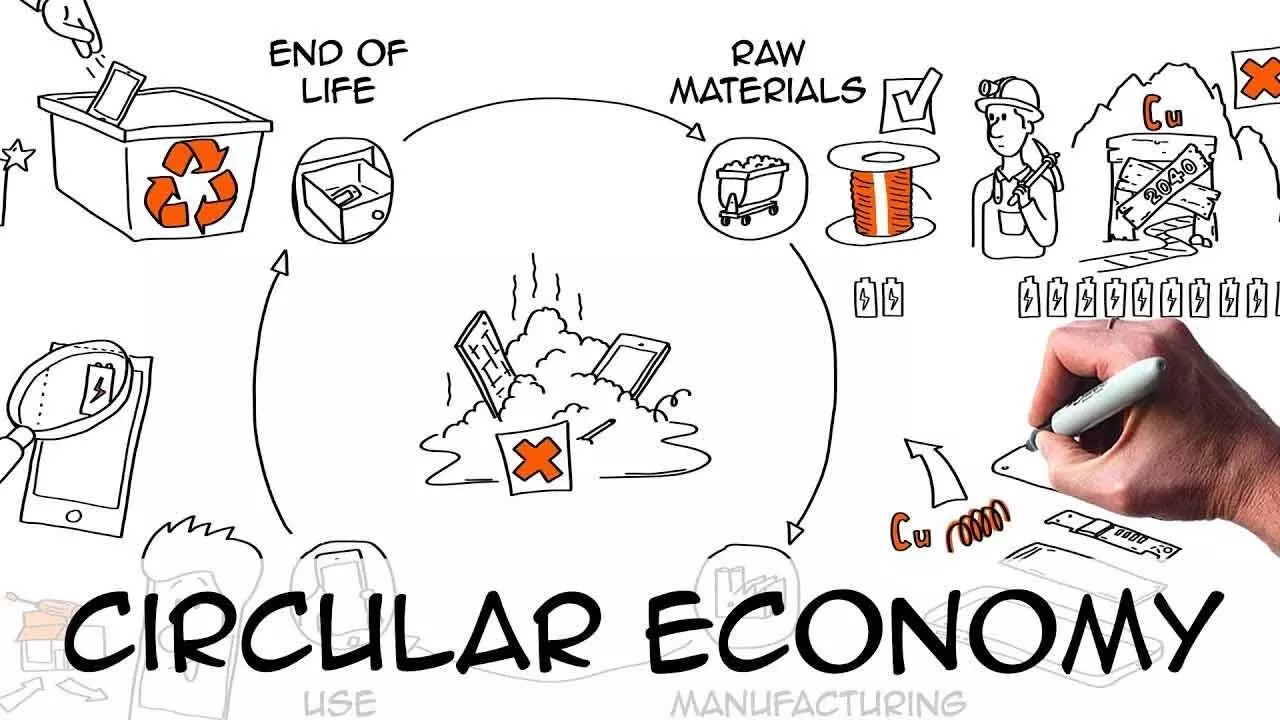
Industrial waste circularity can make a huge difference to the way we manage waste and reduce carbon emissions. By 2030, it can help reuse 750 million tonnes of industrial waste; conserve over 450 million tonnes of natural resources; and reduce 50-60 million tonne of carbon dioxide equivalent
New Delhi: Building and practising a circular economy is not just about managing waste efficiently – it has a potential to lead to substantial conservation of natural resources as well as reduction in carbon emissions, says a new report on industrial waste circularity by Centre for Science and Environment (CSE). A circular economy an economic system based on the reuse and regeneration of materials or products, especially as a means of continuing production in a sustainable or environmentally friendly way.
The report – Good Practices in Industrial Waste Circularity -- has estimated the potential of circularity of different industrial wastes in various applications by 2030 and the associated benefits in terms of natural resource conservation, reduction in carbon emissions and cost economics. According to it, there is a potential for utilising about 750 million tonne (MT) of various types of wastes in industries (steel slag, RDF, flyash, red mud, biomass, hazardous waste etc). Circularity can also help conserve more than 450 MT of natural resources like coal and gypsum, while the potential of reduction in carbon dioxide equivalent (CO2e) lies in the range of 50-90 MT.
Speaking at a National Dialogue based on the CSE report on the subject here today, CSE director general Sunita Narain said: “Industries contribute over 30 per cent of India’s GDP, and are significant consumers of natural resources and generators of waste. They are also major sources of pollution and carbon emissions. Circularity has emerged as a critical focus area globally and nationally, emphasising on the principle that waste is not merely waste, but a valuable resource. This model promotes the sharing, leasing, reusing, repairing, refurbishing, and recycling of existing materials and products to extend their lifecycle.”
Narain went on to say: “A new approach is needed in management of industrial waste. We must avoid simply transferring toxins from one place to another. Instead, waste from one industry should become a resource for another. Industrial activity should not contribute to pollution but instead follow a path of responsible circularity. CSE’s work in this field highlights that it can be a game-changer, making a significant impact on resource use in the country.”
The Dialogue has been organised to explore how circularity can serve as a tool not only for effective waste management but also for achieving co-benefits such as decarbonisation, cleaner air, resource conservation, and cost optimisation. Presenting the findings of the CSE study, Shobhit Srivastava, programme manager, industrial pollution, CSE said: “Many Indian industries are already taking steps to improve circularity – they have a number of good practices that need to be scaled up. States like Gujarat, Goa and Karnataka have taken initiatives towards circularity, but more states need to follow their example.” Highlighting the circularity potential of industrial wastes, the CSE report says that out of 52.5 MT of steel slag estimated to be generated by 2030, about 35.3-41 MT can be used in cement making. Similarly, out of 437 MT of fly ash expected to be generated by 2030, roughly 208-231 MT can be used in the cement sector. Using refuse-derived fuel (RDF) in cement industries and co-firing biomass in thermal power plants can help reduce CO2 emissions in the range of 46.6 to 85.6 MT of CO2e by 2030, says the report.
Biomass co-firing in thermal power plants has the potential to be one of the key pathways for decarbonisation. Both RDF and biomass circularity in industries is expected to be improved with the recently introduced notification for Solid Waste Management Rules, 2024.
Pointing to the challenges, K Murugesan from Odisha said: “One of the biggest roadblocks towards scaling up industrial circularity practices is the absence of attractive taxation policies for industries utilising waste.” According to Satish Upadhyay, “we need a strong economic case to drive funding and make circularity viable. A ‘push’ strategy is ineffective for circularity – we need a ‘pull’ strategy. Demand must drive the market, ensuring maximum utilisation of resources to achieve full circularity.”
A national circular economy action plan is the need of the hour, and it should include sectoral action plans for industries. Incentivisation for industries is another pathway to enhance and encourage the practice of circularity of waste -- government should come up with circularity-driven policies or industrial waste for different industries.