Hindi & Politics Of Regionalism

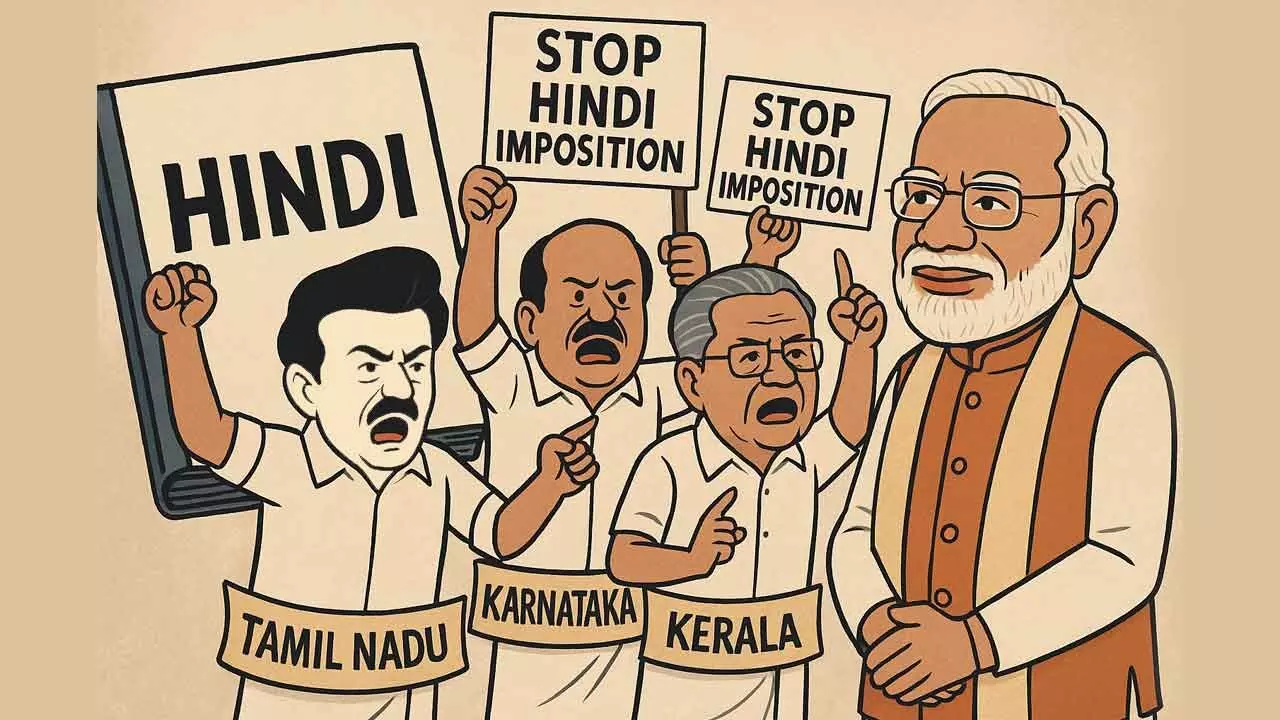
Over the years, regional parties have mastered the art of staying electorally relevant by building niche vote banks rooted in identity - language, region, caste, and in some cases, even dietary habits. They protect these vote banks as aggressively as a monopolist guards a dying product, not because it’s valuable, but because it’s all they have left
Every now and then, as predictably as pre-election freebies, certain state-level political leaders raise the bogey of ‘Hindi imposition.’ It’s as if they have a trigger switch tied to their political survival that goes off whenever a central government initiative mentions Hindi in any capacity. The recent noise from Tamil Nadu, Karnataka, Maharashtra and Kerala is a perfect example.
These states have yet again accused the Modi government of trying to impose Hindi on them, even though no such law, bill, or directive has ever been passed. What’s truly baffling is that even when the Centre merely promotes multilingual education or recommends Hindi as one of the national working languages for optional learning, it is somehow painted as a threat to their regional identity. Let me say this upfront, this is not about language. It never was. This is about politics. Regionalism is not a cultural assertion anymore, it is a political lifeline.
The political design of division
Over the years, regional parties have mastered the art of staying electorally relevant by building niche vote banks rooted in identity - language, region, caste, and in some cases, even dietary habits. They protect these vote banks as aggressively as a monopolist guards a dying product, not because it’s valuable, but because it’s all they have left.
Whether it’s the DMK in Tamil Nadu, the Congress and JD(S) in Karnataka, or the Left parties in Kerala, Udhav Sena, MNS in Maharashtra the pattern is clear. They feed the fear of cultural annihilation. They amplify a false sense of ‘otherness’ when it comes to the idea of India that the BJP or any national party proposes. And they particularly thrive on positioning Hindi as a weapon of domination.
Let’s be honest, these parties don’t fear Hindi because of what it is. They fear it because of what it symbolically represents today, the growing acceptability and spread of the BJP and Prime Minister Narendra Modi’s idea of a unified India, one that embraces all languages without dividing people through them.
Linguistic diversity is not the enemy
India is not a monolith. It is a civilisational mosaic of cultures, scripts, sounds, and dialects. The Constitution of India recognizes 22 official languages under the Eighth Schedule. Hindi is just one of them. And so is Tamil, Telugu, Kannada, Malayalam or Marathi.
To pit one against the other is a perversion of the very idea of Bharat. Knowing Hindi does not diminish Tamil identity. Speaking Hindi in Kerala does not erode Malayali pride. Using Hindi does not lower Marathi abhiman. Language is not a zero-sum game. It is not about subtraction. It is about addition.
I believe language is a bridge, not a boundary. A multilingual Indian is a more empowered Indian. And regional politicians need to understand that unity does not come at the cost of diversity. It comes through it.
The hypocrisy of English love and Hindi hatred
Here’s what exposes the real agenda of these regional parties, their unapologetic promotion and dependence on English. From state government websites to high court judgments, from elite schooling to bureaucratic communication, English is the default in almost all southern states.
Yet, not once have these parties accused the Union Government or anyone else of ‘English imposition.’ Not once have they stood up to question why primary education in urban areas of their own states has moved away from regional languages toward English medium.
If English is acceptable for courts, commerce, contracts, and education, why is Hindi such a problem? Why is English celebrated as modern, but indigenous Hindi ridiculed as hegemonic? That is not cultural logic. That is political expediency.
Let me put it bluntly, they’re not against Hindi. They’re against the political threat that comes with the spread of Hindi-speaking leadership.
Is Hindi being imposed? Let’s check the facts
Let’s strip the rhetoric and look at the facts.
♦ There is no constitutional amendment imposing Hindi on non-Hindi speaking states.
♦ The Modi government has not issued any directive mandating Hindi in official state communication.
♦ NEP 2020’s three-language formula gives complete autonomy to states in choosing which three languages to include in their curriculum.
♦ Most central government exams, including UPSC, are now being offered in multiple regional languages.
♦ The push has been for inclusion, not imposition. Promoting Hindi alongside Tamil, Telugu, and Kannada is not the same as replacing them.
Yet, even the mention of Hindi in a national context becomes a cause for statewide protests. It’s performative outrage, driven by electoral anxiety.
Employment and national integration
Let’s talk about who really matters - the Indian youth. In today’s economic landscape, mobility is key. People no longer work where they’re born. A student from Telangana may get posted in Himachal. A nurse from Kerala might land a job in Gujarat. An engineer from Tamil Nadu could be working in Delhi.
In this context, knowing Hindi is a competitive advantage, not a cultural burden. It helps non-Hindi speakers navigate inter-state opportunities more smoothly. It opens doors in the government sector, armed forces, hospitality, transport, and retail industries. It increases efficiency, eases communication, and builds bonds. Is that such a terrible outcome?
What the Modi government is actually doing
The accusation of Hindi imposition rings hollow when you consider what the Modi government is really doing with languages.
♦ The National Education Policy encourages foundational education in the mother tongue, not Hindi.
♦ The government is investing in translation of technical, engineering, and medical textbooks into Tamil, Kannada, Telugu, and more.
♦ E-Governance platforms and services are now available in multiple Indian languages, not just Hindi and English.
♦ Initiatives like ‘Ek Bharat Shreshtha Bharat’ actively promote cultural and linguistic exchanges between states.
This is not imposition. This is preservation, promotion, and partnership. The Modi government is enabling the growth of regional languages, not undermining them.
Who’s really failing regional languages?
If anyone is responsible for the weakening of regional languages, it is these very parties who cry wolf over Hindi. Their state school curricula are poorly funded. Their public universities are often linguistically disconnected. Their budget allocation for language research and promotion is negligible.
These parties use their language only as a slogan, not as a policy priority. They turn up the volume on identity politics when needed and mute their concern when in power. There’s no cultural war here. Just electoral theatre.
The false dichotomy: Hindi vs. regional identity
I find it dangerous how a false dichotomy has been manufactured. The idea that you can either be Tamil or learn Hindi. That you must choose between being a Kannadiga and being a multilingual Indian. This binary thinking is regressive. It undermines our very ethos as a civilization that absorbed and evolved through dialogue, linguistic, philosophical, and cultural. Language is not the enemy. Political weaponization of language is.
We need political maturity, not linguistic paranoia
India is at a crucial point in its journey, politically, economically, and culturally. We cannot afford to squander this moment over invented fears. The political maturity required now is to rise above identity-based manipulation and look at language through the lens of national progress.
Let’s be clear, no one is forcing Hindi down anyone’s throat. But we should also not allow a handful of insecure regional leaders to block opportunities for millions of Indian youth.
Let’s not make it harder for a Tamil boy to dream of a job in Madhya Pradesh. Let’s not limit the aspirations of a Kannada girl wanting to work in Chandigarh. Knowing Hindi helps them, not harms them. And let us not forget, a multilingual India is not a divided India. It is a stronger, more connected, more confident India.
Unity through language
Over the years, I’ve had the privilege of working and speaking across many Indian states. I’ve seen firsthand how knowing a few key Indian languages changes the way you connect, influence, and lead.
In my own political and public life, the ability to speak Hindi and English, while thinking in Telugu, has been a powerful advantage. It has not diminished my identity. It has enhanced my effectiveness and connect across the nation.
The same principle holds for our youth. Don’t be held hostage by those who want to limit your growth under the guise of protecting your culture.
Bharat is a symphony
The idea of Bharat is not built on linguistic uniformity. It’s built on cultural harmony. One can speak Kannada and be a proud Indian. One can write in Malayalam and serve in the Indian Army. One can think in Tamil and lead in Delhi. We need to end this manufactured war on Hindi. We must call out the politics of regionalism for what it is, a desperate attempt to remain electorally relevant in the face of a rising, unified national narrative.
Let our children learn any language they intend to - Telugu, Tamil, Kannada, Malayalam, Hindi, and English. Let them dream in many languages, think across borders, and work across states. Because in the end, the language of unity is understanding, not uniformity.
(Author is the Chief Spokesperson of BJP, Chairman for Nation Building Foundation & a Harvard Business School certified Strategist.)