
Nuclear power: India’s missing link for 1 lakh MW of assured 24×7 energy

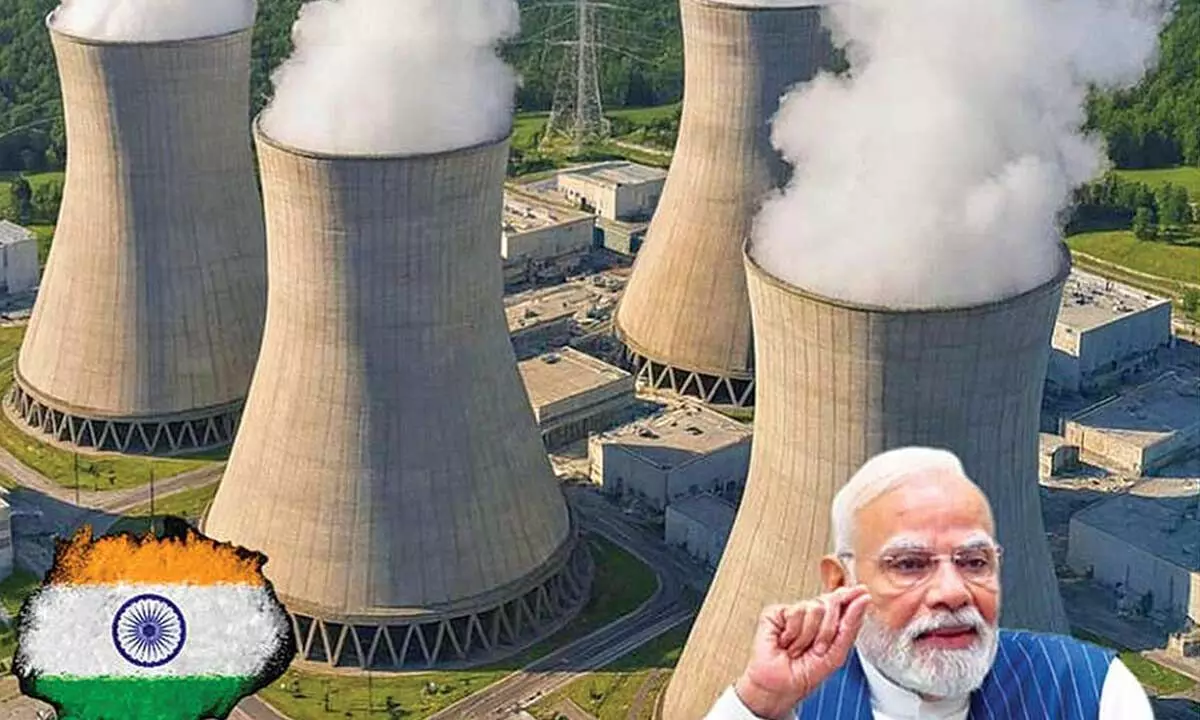
India’senergy transition debate is increasingly dominated by renewables, battery storage and pumped storage projects (PSPs). While each has a role, a critical reality is often underplayed: India urgently needs large-scale, uninterrupted, round-the-clock power to sustain data centres, financial infrastructure and advanced manufacturing—especially in urban-industrial hubs like Mumbai.
Intermittent energy sources alone cannot meet this requirement efficiently or economically. Thus, to meet the growing demand in 2047 India must have one lakh secure megawatts (100 GW) of firm, reliable power for which the Union Government is planning to launch aggressive mission largely through private participation.
A changing demand landscape:
India’s electricity demand profile is undergoing a structural shift. Growth is now driven less by conventional consumption and more by data centres, cloud computing, AI-driven services, semiconductor fabrication, electric mobility manufacturing and green hydrogen. These sectors require continuous, high-quality power, where even brief disruptions can cause serious operational and financial losses.
The emerging digital hub Mumbai cannot afford power systems designed primarily around variability. Solar and wind power, despite impressive capacity additions, remain inherently intermittent. Batteries and PSPs are often presented as substitutes for firm power, but they carry limitations—high capital costs, dependence on imported minerals, land and water constraints, long gestation periods and finite lifecycles.
Over-reliance on storage-heavy solutions risks increasing system costs without delivering assured reliability.
Nuclear power as the energy backbone:
Nuclear energy offers a proven and scalable solution. It delivers 24×7 electricity with plant load factors of 85–90per cent; requires minimal land per megawatt and does not produce carbon emissions during operation. Unlike storage technologies, nuclear power generates energy continuously rather than merely shifting supply across time.
With a planned and phased expansion, nuclear power can realistically provide 100 GW of uninterrupted electricity and support the country’s industrial, digital and urban growth while complementing renewable energy. For data centres and continuous-process industries, nuclear power offers what no other source can: predictable, stable supply over several decades.
Moving beyond battery and PSP hype:
Batteries are effective for short-duration grid balancing but are ill-suited for long-duration or continuous supply. Their economics tend to deteriorate sharply when scaled for baseload use. PSPs, while valuable for flexibility, face geographical, environmental and cost constraints and cannot be deployed universally. Treating batteries and PSPs as universal solutions risks creating a complex and expensive grid. Nuclear power, by contrast, simplifies system planning by anchoring the grid with firm capacity and reducing the need for excessive balancing and backup infrastructure.
Dedicated power for data centres and industry:
Nuclear power is uniquely suited for dedicated long-term supply arrangements. Large consumers such as data centres seek tariff certainty, supply reliability and long-term visibility—requirements that short-term electricity markets struggle to meet.
Allocating nuclear generation through long-term power purchase agreements or dedicated supply frameworks can attract high-value investment into cities like Mumbai while easing pressure on the general grid. It also allows better system planning and protects critical infrastructure from market volatility.
Rethinking tariff fixation:
A key reform that is needed pertains to tariff determination outside the conventional electricity regulatory framework. Nuclear power, with high upfront capital costs and very low operating costs, does not align well with short-term tariff cycles.
Tariffs should be fixed for 30–35 years, based on lifecycle costing, and determined by a specialised agency. Long-term tariffs will lower financing costs, reduce regulatory risk, encourage industrial participation and insulate nuclear tariffs from cross-subsidy distortions. This approach would also reduce the electricity sector’s dependence on frequent regulatory interventions.
Rational depreciation for affordable early tariffs:
Nuclear plants operate for60–80 years, yet tariffs are often high in initial years due to front-loaded depreciation. A more rational approach would allow lower depreciation in the early years, spreading capital recovery over a longer horizon.
This would keep early tariffs affordable, support industrial uptake and align financial recovery with the actual life of the asset—without compromising long-term viability.
In conclusion:
India’s future growth—digital, industrial and urban—depends on access to reliable, affordable, uninterrupted electricity. To achieve this, the country must move beyond storage-driven narratives and recognise nuclear power as a strategic necessity.
With one lakh MW of nuclear capacity, long-term tariff fixation, rational depreciation and dedicated industrial supply, India can build an energy backbone that supports growth while lowering system-wide costs.
The real risk is not investing in nuclear power—but delaying it.
(The writer is a former Chairman of Tripura Electricity Regulatory Commission)








