




- Bolsonaro beats Lula in first round of Brazil presidential election, heads to Oct 25 run-off
- Swiss President set to arrive in India today for state visit, to hold talks with PM Modi
- Karnataka ranks next to TN in south for groundwater-recharge water bodies
- AAP Delhi chief Saurabh Bharadwaj calls emergency meeting, says ‘something big’ being planned by Centre
- Congress-NDA row over video clip of interruption to FM Sitharaman's speech in Andhra Pradesh
- Government orders postings of Divisional Development Officers
- Dasara special puja tickets to be issued from Oct 5
- Show-cause notices issued to 26 APCC members
Karnataka ranks next to TN in south for groundwater-recharge water bodies
In Short
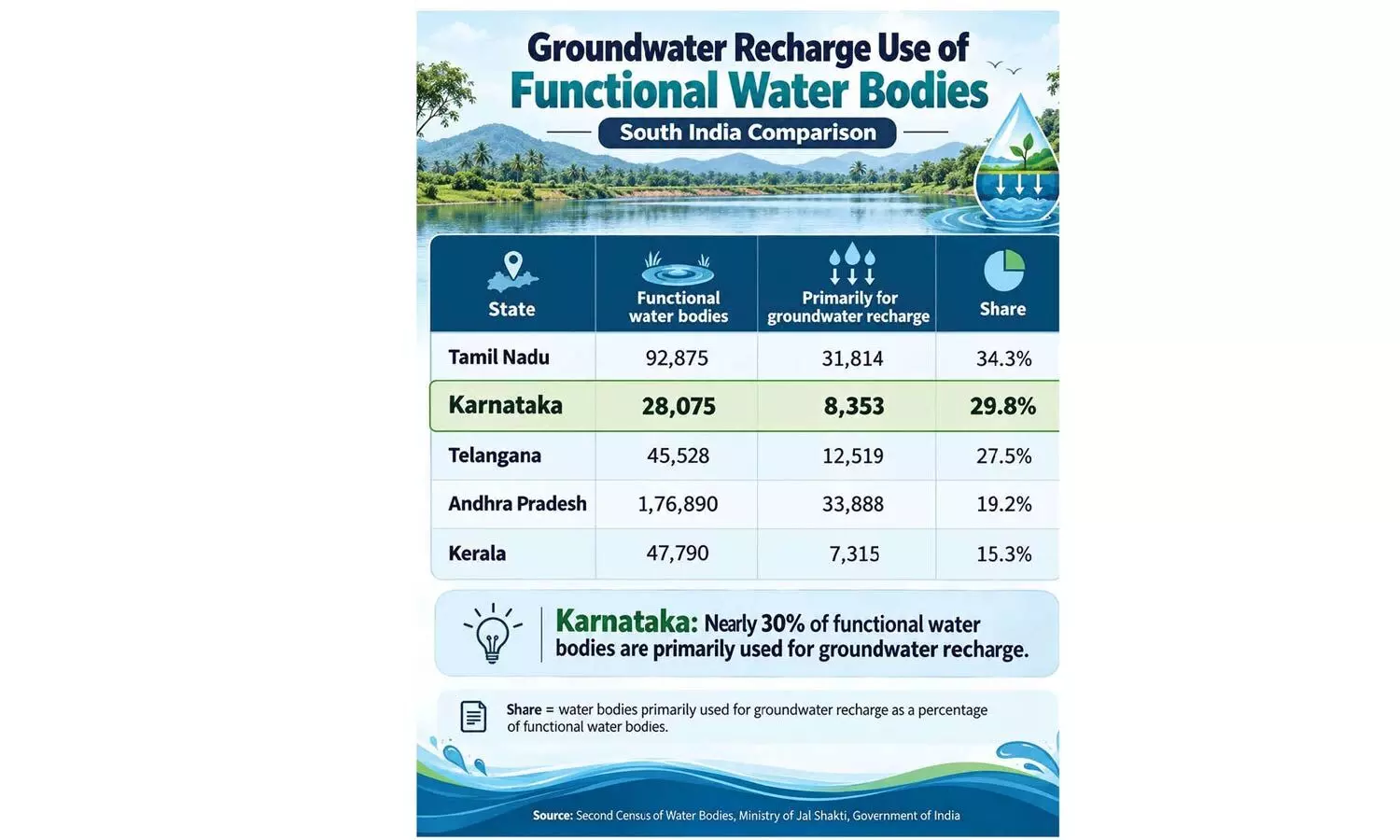
According to the Second Census of Water Bodies conducted by the Union Ministry of Jal Shakti, Karnataka has 28,075 water bodies in use. Of these, 8,353, or 29.8 per cent, are primarily used for groundwater recharge.

Share :
Karnataka ranks next to TN in south for groundwater-recharge water bodies
Bengaluru: Nearly 30 per cent of Karnataka’s water bodies currently in use primarily serve the purpose of groundwater recharge, highlighting the role of lakes, tanks and other traditional water structures in strengthening the state’s water security, Minor Irrigation and Science and Technology Minister Dr Ajay Dharma Singh said.
According to the Second Census of Water Bodies conducted by the Union Ministry of Jal Shakti, Karnataka has 28,075 water bodies in use. Of these, 8,353, or 29.8 per cent, are primarily used for groundwater recharge.
Karnataka’s share is higher than that of Telangana, Andhra Pradesh and Kerala, while Tamil Nadu has a higher proportion at 34.3 per cent. The corresponding figures are 27.5 per cent for Telangana, 19.2 per cent for Andhra Pradesh and 15.3 per cent for Kerala.
Dr. Ajay Dharma Singh said the figures should be viewed in the context of Karnataka’s recurring rainfall variability and drought conditions, which make groundwater recharge an important component of long-term water management.
“Lakes, tanks and other water bodies are not just storage structures; they are systems that help secure our groundwater for the future,” he said. Around 96 per cent of Karnataka’s water bodies are located in rural areas. Their conservation and recharge potential therefore have a direct bearing on agriculture, drinking water availability, livestock and rural livelihoods, the minister said.
Of the 8,353 water bodies primarily serving groundwater recharge, 5,302 are classified as water bodies, while 1,548 are lakes and 1,267 are ponds. The figures underline the continuing role of traditional water systems in maintaining groundwater levels.
The minister said the focus should now be on protecting catchment areas and improving the recharge capacity of existing water bodies.
“The next step must be to integrate watershed protection, desilting, restoration of lakes and rainwater harvesting with groundwater management. Strengthening the recharge capacity of rural water bodies will be a key priority,” he said.
The government intends to use the data from the water bodies census to strengthen conservation and recharge measures, particularly in rural areas where the majority of the state’s water resources are located.
CBI begins probe into Kaleshwaram project?
Kishan urges ryots to lead 'White Revolution 2.0'
Cops register case over Janhvi Kapoor AI video
Decriminalising GST regime augurs well
Justice must not only be done but also remain beyond doubt
A tale of two cities: Unmasking the reality of Hyderabad’s urban boom


