




- MMC launches digital drive for hassle-free Ganesh immersion
- Congress MLA urges govt to take back assigned lands from BRS netas
- Telangana High Court seeks CCTV footage of masked men at Saifabad PS
- 6 students drown during Ganesh idol immersion
- Rollback UPI tax
- Centre rules out UPI fee rollback
- Revanth outlines steps to resolve 22-A land issues
- Jagan to discuss drought with party leaders today
Hyderabad Liberation: Someone’s movement or everyone’s movement?
In Short
In all, 46 soldiers were martyred in Operation Polo.

Share :
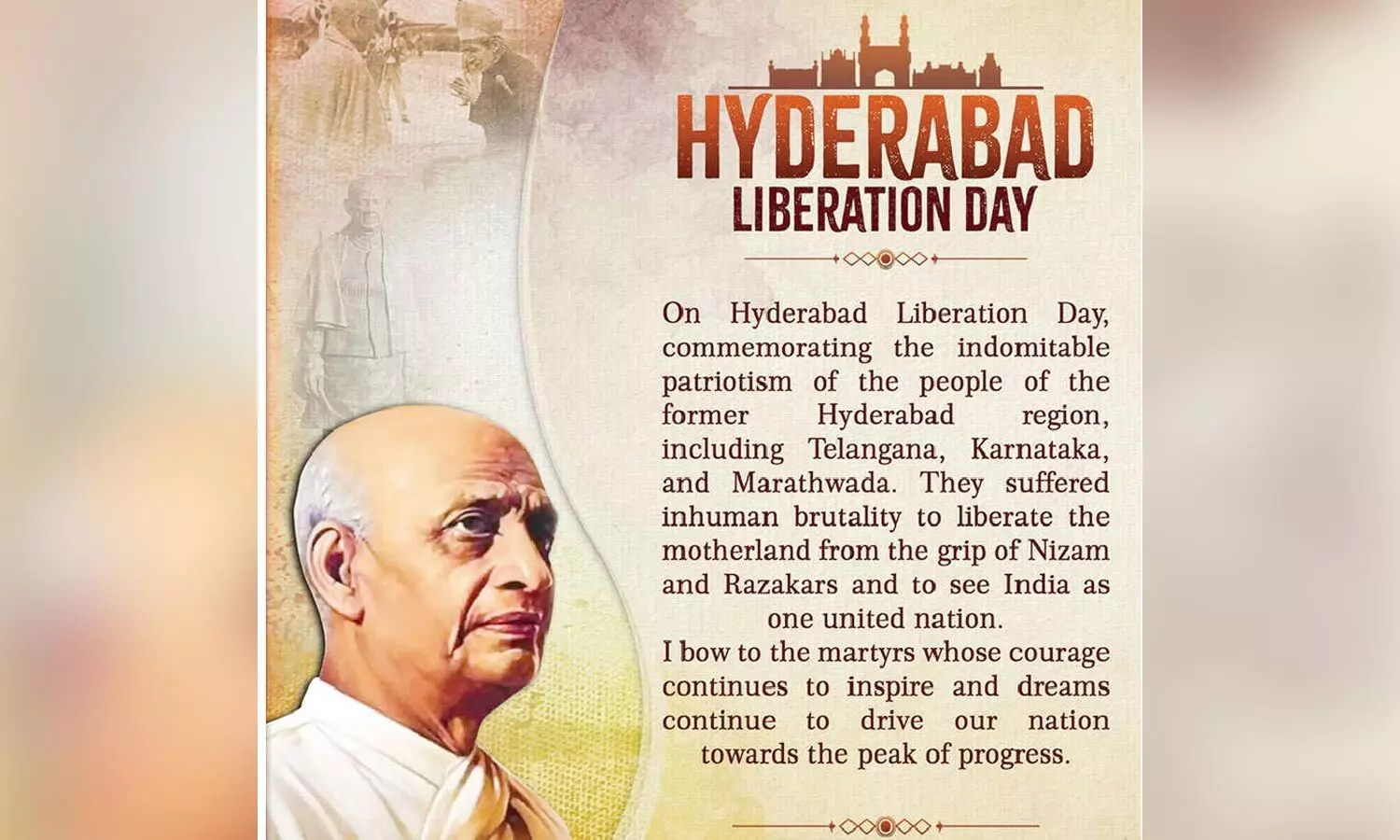
Hyderabad Liberation: Someone’s movement or everyone’s movement?
When negotiations failed, India launched Operation Polo on September 13, 1948. Sardar Vallabhbhai Patel supplied the political determination. Major General J N Chaudhuri commanded the operation. After his army surrendered, the Nizam announced a ceasefire on September 17. In all, 46 soldiers were martyred in Operation Polo. Refusing to commemorate 17 September explicitly as Hyderabad Liberation Day because of vote-bank appeasement is an injustice to history and a shame upon Telangana. The commemoration is not directed against any religion. It is an occasion to pray for the souls of the martyrs
Hyderabad Liberation was not the achievement of any one party, organisation or ideology. It was not merely a Congress movement, Communist revolution, Arya Samaj agitation, Hindu resistance or military victory. It was a century-long confluence of tribal rebellion, social reform, student protest, peasant uprising, cultural awakening, village self-defence and national military action. It was unquestionably everyone’s movement.
Autocracy and feudal exploitation
When India became independent on August 15, 1947, Hyderabad remained outside the Indian Union. The princely state included present-day Telangana, Marathwada and Kalyana Karnataka. The Nizam, Mir Osman Ali Khan, wanted Hyderabad to remain independent despite its location in the heart of India and the democratic aspirations of its people. There was no representative government. Political organisations were banned. Freedom of expression was restricted. Telugu-, Marathi- and Kannada-speaking people struggled for linguistic and educational rights. But the worst oppression was experienced in the villages. Vast areas were controlled by jagirdars, deshmukhs, samsthan rulers and doras. Peasants cultivated the land without security. Illegal taxes, arbitrary evictions, debt bondage and compulsory grain collections were widespread.
Under vetti chakiri, weaker communities were forced to provide unpaid labour to landlords and officials. Farmers surrendered their produce. Labourers surrendered their freedom. Women suffered exploitation and humiliation.
Razakar terror
After 1947, violence increased with the expansion of the Razakars, the armed wing of the Majlis-e Ittehadul Muslimeen under Qasim Razvi. In the name of defending Nizam’s independence, Razakar groups attacked villages, looted properties and terrorised people who supported democracy or accession to India. Bairanpally, Parkal, Gundrampally, Renikunta and Vallala became symbols of bloodshed. Villagers were killed for resisting attacks or hoisting the tricolour. In fact, it was a fight against the autocratic rule of the Nizam, the violent activities of the Razakars and, more importantly, oppression by landlords.
The first flames of forest resistance
The resistance began long before 1947. During 1857–60, Ramji Gond mobilised Gonds, Rohillas and forest communities around Nirmal. He and numerous followers were captured and executed. In Hyderabad city, Turrebaz Khan and Maulvi Allauddin attacked the British Residency. They proved that Hyderabad had participated in the First War of Independence. Later, Komaram Bheem mobilised the Gonds of Adilabad against forest restrictions and land alienation. His struggle represented Jal, Jangal and Zameen—water, forest and land. He and his companions were killed at Jodeghat in 1940.
Nationalist and civil-resistance forces
The Arya Samaj combined social reform with education, civil rights, Shuddhi and resistance. Its leading figures included Justice Keshavrao Koratkar, Dharmaveer Vaman Naik, Pandit Narendraji, Pandit Vinayak Rao Vidyalankar and Pandit Shyamlal.
Vande Mataram Ramachandra Rao endured brutal flogging but continued shouting, “Vande Mataram.” Narayan Rao Pawar, along with Jagdish Arya and Gandaiah, attempted to attack the Nizam’s motorcade with bombs. The Hindu Mahasabha organised the Bhaganagar Unarmed Resistance under Veer Savarkar, Senapati Bapat and L B Bhopatkar. RSS swayamsevaks, including L V Paranjape, Balshastri Hardas, Waman Hedgewar and Moreshwar Hedgewar, along with thousands of others, joined the satyagraha and suffered imprisonment.
Hyderabad State Congress
The Hyderabad State Congress was not a state branch of the Indian National Congress. Rather, it was a local organisation established by leaders who led the constitutional and nationalist political struggle. Though banned in 1938, it organised satyagrahas, underground networks and border camps. Swami Ramanand Tirtha became its central leader. Burgula Ramakrishna Rao, Konda Laxman Bapuji, Govindbhai Shroff, Digambarrao Bindu, Jamalapuram Keshava Rao, P. V. Narasimha Rao, Marri Chenna Reddy and T. Hayagrivachari carried the movement into different regions. Its volunteers transported flags and literature, helped refugees, collected information and demanded responsible government and integration with India.
Andhra Mahasabha
The Andhra Mahasabha began as a movement for Telugu language, education and cultural dignity. Madapati Hanumantha Rao, Suravaram Pratap Reddy, Konda Venkata Ranga Reddy, Kaloji Narayana Rao and Vattikota Alwar Swamy turned libraries and public meetings into platforms for political awakening. It later raised questions of vetti, taxation, tenant rights and landlord oppression. It carried political consciousness from towns into villages.
Communist-Led Peasant Struggle
The Communist Party, radical Andhra Mahasabha groups, the Comrades Association, village sanghams and armed dalams transformed rural suffering into organised resistance. Ravi Narayana Reddy, Baddam Yella Reddy, Puchalapalli Sundarayya, Makhdoom Mohiuddin, Raj Bahadur Gaur, Arutla Ramachandra Reddy, Arutla Kamala Devi, Bhimreddy Narasimha Reddy, Bommagani Dharma Biksham Goud and Mallu Swarajyam mobilised peasants, labourers and women. Chakali Ilamma resisted the seizure of her cultivated land. Sheikh Bandagi was murdered for challenging feudal domination. The killing of Doddi Komuraiah at Kadavendi in 1946 ignited the armed uprising. Nalla Narasimulu and thousands of unnamed fighters built village resistance. Their demands were clear: abolish vetti, end landlord oppression, protect cultivators and restore human dignity.
Village, cultural and regional fighters
Ordinary villagers also became warriors. Bathini Mogilaiah Goud died defending the national flag at Warangal. Renikunta Ramireddy organised village self-defence. Anabheri Prabhakar Rao and Singireddy Bhoopathi Reddy led rural resistance. Poets and journalists fought with words. Dasarathi Krishnamacharya wrote from prison. Suddala Hanumanthu and Bandi Yadagiri mobilised peasants through song. Shoebullah Khan, editor of Imroze, opposed Razakar extremism and supported accession to India. He was assassinated in August 1948. Mandumula Narasing Rao challenged autocracy through Rayyat.
Operation polo and military valour
When negotiations failed, India launched Operation Polo on September 13, 1948. Sardar Vallabhbhai Patel supplied the political determination. Major General J N Chaudhuri commanded the operation. After his army surrendered, the Nizam announced a ceasefire on September 17. In all, 46 soldiers were martyred in Operation Polo. Among them, three decorated soldiers deserve special remembrance. Havildar Bachittar Singh and Naik Nar Bahadur Thapa were awarded the Ashoka Chakra, while Captain Joginder Singh Gharaya was awarded the Kirti Chakra for gallantry.
Everyone’s liberation-Telangana’s duty to remember:
Refusing to commemorate 17 September explicitly as Hyderabad Liberation Day because of vote-bank appeasement is an injustice to history and a shame upon Telangana. The commemoration is not directed against any religion. It is an occasion to pray for the souls of the martyrs and honour known and unknown fighters, tribal warriors, peasants, women, students, journalists, Sardar Patel and the Indian Armed Forces. Maharashtra officially observes Marathwada Mukti Sangram Din. Karnataka officially celebrates Kalyana-Karnataka Liberation Day.
These observances continue irrespective of the party in power. They should be an eye-opener to Telangana’s rulers. Remembering liberation is not communalism. Forgetting sacrifice for political convenience is historical ingratitude.
Telangana must celebrate Hyderabad Liberation Day officially, with truth, inclusiveness, dignity and patriotic gratitude.
(The writer is a former MP, Vice-President BJP Telangana and Chairman of Telangana Liberation Celebration Committee)
Will make Tirumala, Tirupati world-class spiritual centres
Naidu to join Seva Sankalp Abhiyan in Varanasi today
AP clears Rs 5,912-crore urban projects to be funded by ULBs
Modi gave wings to the great Indian dream
People to engage in a month-long intense cleanliness campaign
Ex-mayor’s brother held for plotting crime


