




- South Coast Railway GM reviews crowd management arrangements
- Newly-constructed divisional sub-treasury office inaugurated
- With 82 % indigenous content, ‘Surya’ to replenish combat ships, submarines
- Six Ayushman Arogya Mandirs inaugurated
- Call to promote Paderu honey
- CM Naidu, Pawan begin seat-sharing exercise
- CM’s daughter Nymisha Reddy’s property row: HC directs police to issue notice to BRS social media convenor
- Insulting institutions won't strengthen democracy: Rijiju
Delhi boosts ASHA pay, rolls out newborn screening
In Short
The government also expanded Mission ANMOL, short for Advanced Newborn Monitoring and Optimal Life Care, to strengthen early detection and treatment of serious health conditions among newborns

Share :
Delhi boosts ASHA pay, rolls out newborn screening
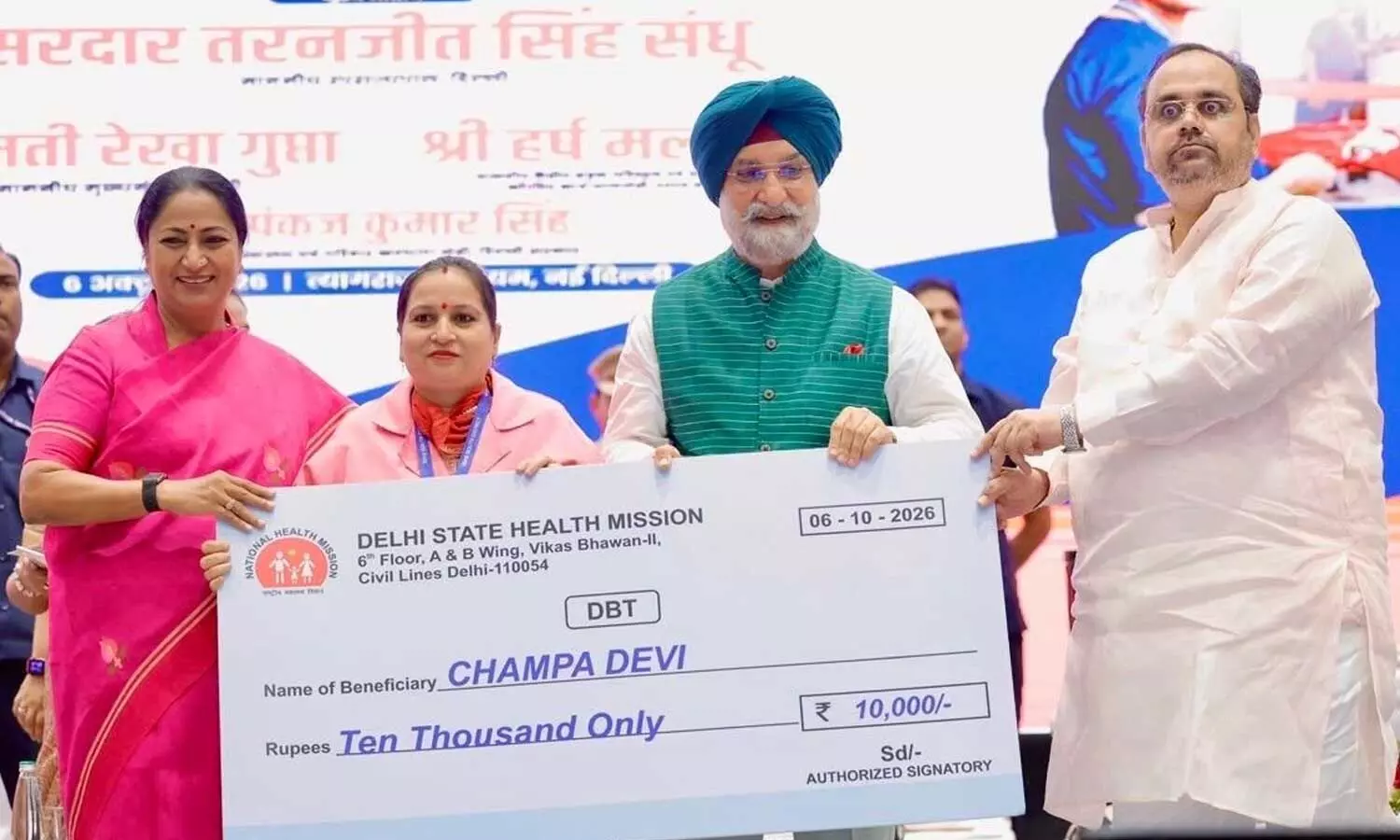
New Delhi: Delhi stepped up its healthcare push with a series of new initiatives focused on frontline workers, newborn care, organ transplantation and digital governance, with the government doubling the monthly honorarium of 6,690 ASHA workers from Rs 3,000 to Rs 6,000. The announcements were made at the state-level “ASHA Sammelan-2026 and ASHA Samman Samaroh” at Tyagaraj Stadium, organised under the Seva Sankalp Abhiyan, where Lieutenant Governor Taranjit Singh Sandhu and Chief Minister Rekha Gupta jointly launched the initiatives.
The increase in ASHA workers’ monthly incentive was one of the key highlights of the programme and addresses a demand that had remained pending for years. Gupta also felicitated ASHA workers who had delivered outstanding services and announced a special Dandiya programme for them during the upcoming Navratri celebrations. She said women who work every day to safeguard the health of families deserve dignity, recognition and care, adding that ensuring their welfare was a moral responsibility of the government. The government also expanded Mission ANMOL, short for Advanced Newborn Monitoring and Optimal Life Care, to strengthen early detection and treatment of serious health conditions among newborns. Under the programme, babies will be screened free of cost between 24 and 72 hours after birth for 63 serious genetic, metabolic and congenital disorders. Delhi plans to raise annual screening coverage from 1.5 lakh newborns to 2.5 lakh. According to the government, more than 75,000 children have already undergone screening and over 700 have received timely treatment after health conditions were detected. A major digital reform was also introduced with the launch of the Nursing Home Management System portal. The platform is intended to simplify and digitise the administrative functioning of private nursing homes, with registration and renewal processes being shifted online. The government said the system would reduce repeated visits to government offices, improve transparency and make regulatory monitoring and administrative work faster and more efficient.

Identify missing 45 acres in Erravalli: CM to officials
TG govt declares 320 mandals drought-hit
Good news for tipplers: No El Nino impact on beer production in TG
India among 7 bidders to host 2036 Olympics
Indo-US talks at ‘plateau,’ not a precipice
India’s gender parity: What does global evidence say?


