




- Food arrangements near the polling station raise questions over possible voter inducement
- Symbol Mix-Up in Vijayawada's 55th Division Brings Polling to a Halt
- Nandigama Records Highest Polling at 17.99% in NTR District
- Rajasthan IAS-IPS Couple Under ACB Scanner Over 36 Villas Worth Rs 5.5 Crore
- Comprehensive security grid built for today’s municipal polls
- Deepavali Asthanam at Tirumala Srivari temple scheduled for Nov 8
- TTD staff to receive AI training for smarter devotee services
- Strict action against misinformation, intimidation during civic polls: SP
Rahul’s Rally Reopens 1984 Wounds; Riot Victims’ Families Ask, What About Justice?
In Short
Rahul Gandhi's INDIA bloc rally in Delhi draws criticism from BJP leaders and families of 1984 anti-Sikh riot victims, who question the timing of the November 1 protest and renew demands for justice.

Share :
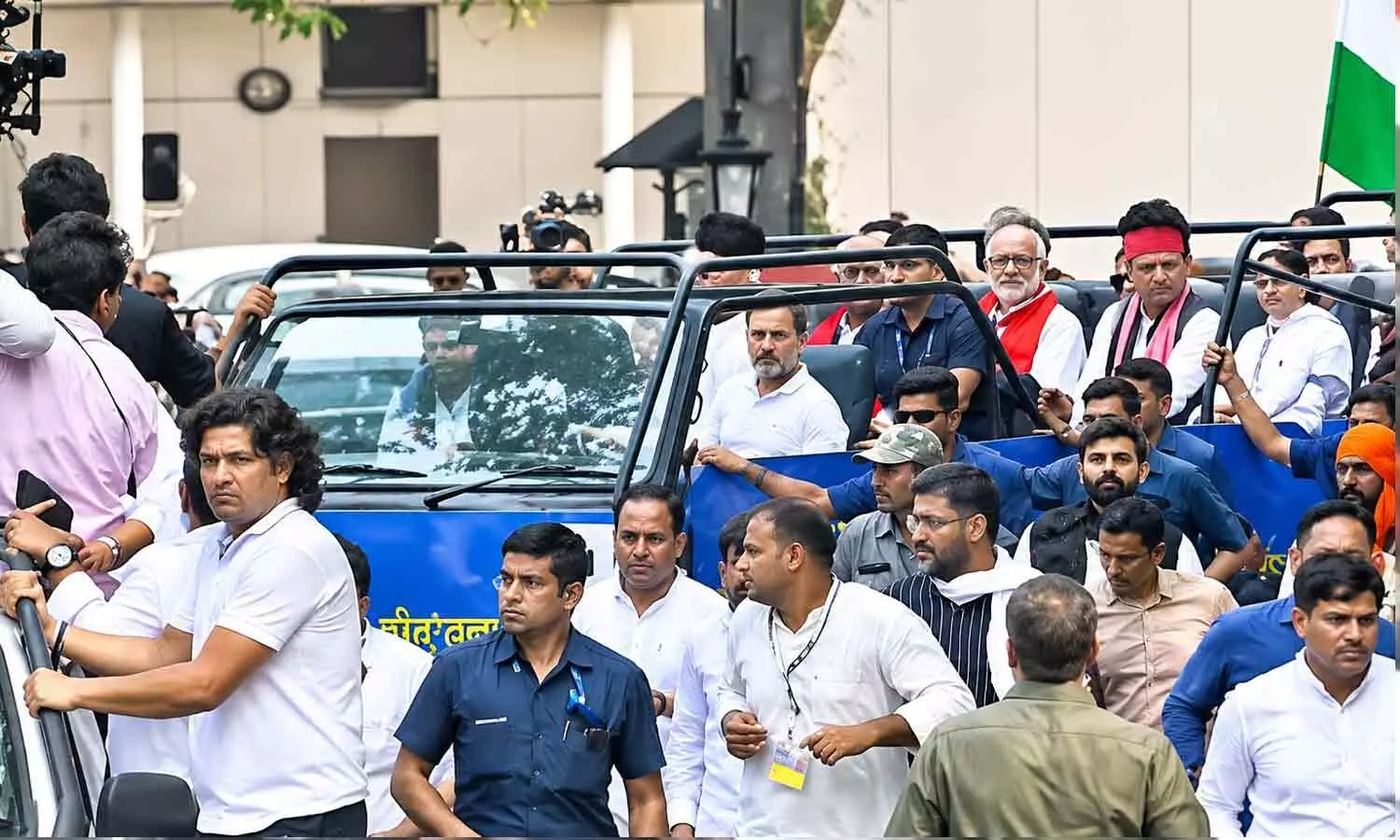
Rahul’s Rally Reopens 1984 Wounds; Riot Victims’ Families Ask, What About Justice?
Leader of the Opposition in the Lok Sabha, Rahul Gandhi on Sunday urged people to join the INDIA bloc's 'Chalo Dilli' march in the national capital, calling for public participation in the protest against alleged electoral irregularities and demanding the resignation of Chief Election Commissioner (CEC) Gyanesh Kumar.
"Delhi, get ready! Save the Vote, Save the Nation. Come to Connaught Place, let's march together. Or meet directly at Ramlila Maidan — but you must come. Today | 12 PM," he posted on X.
The BJP, however, dismissed the rally as a "designed drama", alleging that its objective was to spread misinformation, rumours and anarchy, damage the country's economy and destabilise an elected government at the behest of foreign powers.
Union Minister J P Nadda on Sunday launched a sharp attack on the Congress and Rahul Gandhi, describing the gathering at Ramlila Maidan as a calculated attempt to create chaos under the guise of defending democracy.
"What is unfolding today at Ramlila Maidan is not an act of respect for democracy; rather, it is a calculated conspiracy to sow chaos and plunge the nation into anarchy under the guise of democratic principles. It is nothing more than a foolish, well-orchestrated political drama staged by those who have been defeated and repeatedly rejected by the people. The public understands this perfectly well," Nadda said.
He alleged that Rahul Gandhi's rally had four objectives: to rub salt into the wounds of the Sikh community, orchestrate riots and chaos in Delhi to destabilise an elected government, deprive traders and shopkeepers of their festive-season earnings, and bring disrepute to the country.
Issuing a warning to Rahul Gandhi, the Union Minister said: "This is India, not some 'banana republic' where you can incite arson, trigger riots, or push an agenda for 'regime change' whenever you please."
Meanwhile, families of victims of the 1984 anti-Sikh riots in Delhi strongly criticised Rahul Gandhi for holding the rally on November 1, the day on which members of the Sikh community were brutally targeted following the assassination of former Prime Minister Indira Gandhi by her Sikh bodyguards.
Forty-two years after the massacre, the families said they had not expected the Congress leader to organise a political rally on a day that brought back painful memories of the killings and destruction suffered by the community.
They alleged that the violence was not confined to the killing of Sikhs, but also involved the burning of gurdwaras and copies of the holy Guru Granth Sahib by mobs allegedly linked to the Congress. The families said the scars of the violence remained fresh and that the loss of their loved ones could never be forgotten.
"Today, we are remembering those killed in 1984 at Gurudwara Shaheed Ganj, Tilak Nagar. There is an entire museum here displaying photographs of Sikhs who were massacred during the Congress government's tenure under Rajiv Gandhi. Even though photographs or evidence of many others could not be found, we have made every effort to preserve whatever we could and built this museum," a family member of a riot victim said.
Expressing anger against the Gandhi family, another victim said: "We strongly oppose the rally being organised by the Congress today. We had not expected Rahul Gandhi to do this, but his mindset, along with that of his mother and sister, is against the Sikhs."
He added that the affected families of Tilak Vihar had organised an 'Akhand Paath' to remember those who lost their lives in the violence.
He also recalled that the massive destruction in the national capital followed the controversial statement made by then Prime Minister Rajiv Gandhi that "when a big tree falls, the earth shakes".
A widow of a riot victim, who lost nearly six members of her family in the violence on November 1, 1984, described the day as deeply painful. She regretted that those responsible for the killings had still not been adequately punished and demanded justice for the victims and their families.
Bolsonaro backs off Brazil poll challenge after Trump says 'I’m not running Brazil'
HM Amit Shah presents President's Colour to Chandigarh Police at 60th Raising Day, hails six decades of 'dedicated service'
BJP organises nationwide 'Loktantra Bachao, Arajakta Hatao' marches to counter INDIA bloc's rally
Sarda Energy's Q2 profit slips over 2 pc to Rs 320 crore, revenue declines
AP Municipal Elections live updates: Polling begins in 92 urban local bodies
INDIA Blox Chalo Delhi rally live updates: Activists flock to Ramlila Maidan
Rahul Gandhi Leads INDIA Bloc March to Ramlila Maidan, Mamata and Akhilesh Join Protest
AP Formation Day: President extends greetings to people
Municipal polls continue in Vizag hassle-free
Polling begins in 92 urban local bodies in AP


