




- Indira Shakti Bhavans will boost women’s empowerment: CM Revanth Reddy
- TG Congress MPs join Rahul Gandhi protest, arrested
- Narayana students bag 3 golds at IOAA 2026
- Jagga Reddy, Nirmala start sit-in protest in Sangareddy in support of Rahul’s fight
- Telangana farmers a call away from agri experts
- Malreddy miffed over BRS’ ‘misleading’ bus travel video
- Fake NOCs used to register Waqf properties, Board warns
- Harish questions Bhatti’s silence on true-up burden on consumers
Chemistry Nobel goes to pair who solved mystery of 'mirror image' molecules
In Short
Soai, 76, is Japanese, and Kagan, 95, is French, and their work built on a discovery by the 19th-century French chemist Louis Pasteur.

Share :
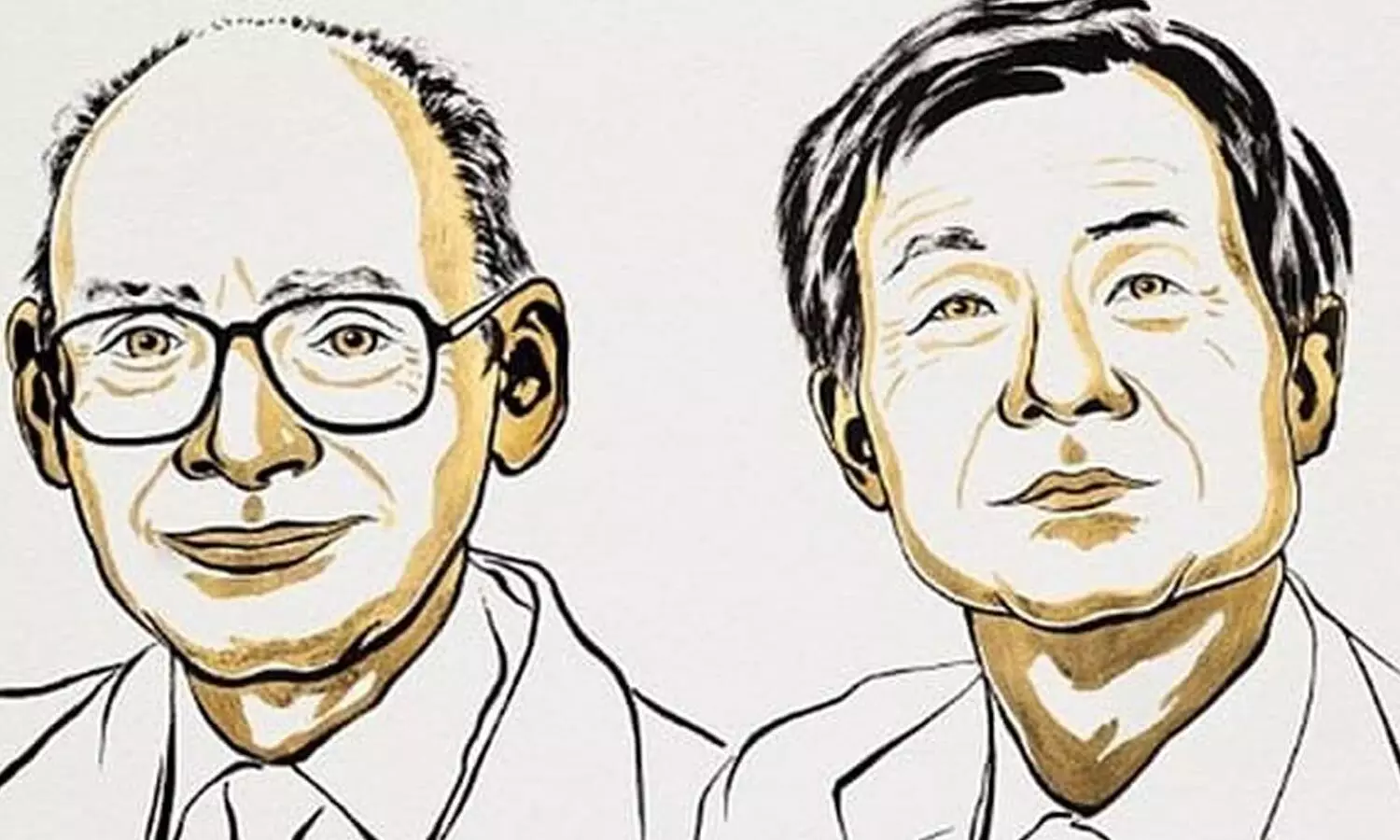
Henri B Kagan & Kenso Soai
Stockholm: Scientists Henri Kagan and Kenso Soai won the 2026 Nobel Prize in Chemistry for solving a long-standing riddle of asymmetric "mirror image" molecules, a discovery hugely important for pharmaceutical manufacturing, the award-giving body said on Wednesday.
Soai, 76, is Japanese, and Kagan, 95, is French, and their work built on a discovery by the 19th-century French chemist Louis Pasteur.
"This is the most exciting day in my life, I am very glad to share this prize with Professor Henri Kagan," Soai said, speaking by phone to the Nobel Prize press conference, adding he had been out shopping when receiving the news.
The Nobel committee was still trying to contact Kagan, the third-oldest person to be awarded a Nobel Prize, to inform him. French President Emmanuel Macron congratulated the laureates on X, calling it an immense honour for the country. "
A recognition suited to a lifetime of research," he said.
In fact, Kagan's work has long been seen as influential on the field and the then-French research minister complained to the Nobel Foundation in 2001 when Kagan was left out that year. The prize instead went to two American and one Japanese scientists for work in the same field.
The Chemistry Nobel, always the third prize to be awarded during Nobel week, followed those for medicine and physics announced on Monday and Tuesday.
Many of the molecules essential to life exist in two forms that are mirror images of each other, like left and right hands. Yet living organisms almost exclusively use only one version, a phenomenon known as "homochirality" – from the Greek word for hand – that has puzzled chemists for more than a century.
This year's prize was awarded for discoveries that showed how chemical reactions can be driven to favour a single molecular mirror image, work that has been key for chemists who design reactions for the manufacture of pharmaceuticals.
"The left-handed version of the drug can have one effect, and the right-handed version can have another effect, and then we need methods for selectively preparing them," Peter Somfai, a member of the Nobel Committee for Chemistry, said.
"In developing such methods the findings of this year's laureates are important. They provided powerful tools for that," he said.
The first link in the chain in solving the problem was work by Pasteur, who died a few years before the Nobel Prizes were first awarded in 1901. He was looking at tartaric acid, important in the production of wine, and noticed that bacteria only ferment one of the two forms of tartaric acid – that which is naturally found in grapes. With the other there is no fermentation.
That proved that some substances occur in two forms and that they have different properties, sometimes very damaging to health. How to create the right form of a chiral substance was a problem not solved until Kagan and Soai were able to produce asymmetric reactions, creating an excess of one form.
The importance of the work is illustrated by the case of the thalidomide scandal in the early 1960s, when thousands of children were affected by birth defects caused by a sedative, thalidomide. When researchers analysed what had happened, they realised that it was the active substance's mirror image that caused the harm.


