Shankaracharya sees spiritual renaissance among India’s youth

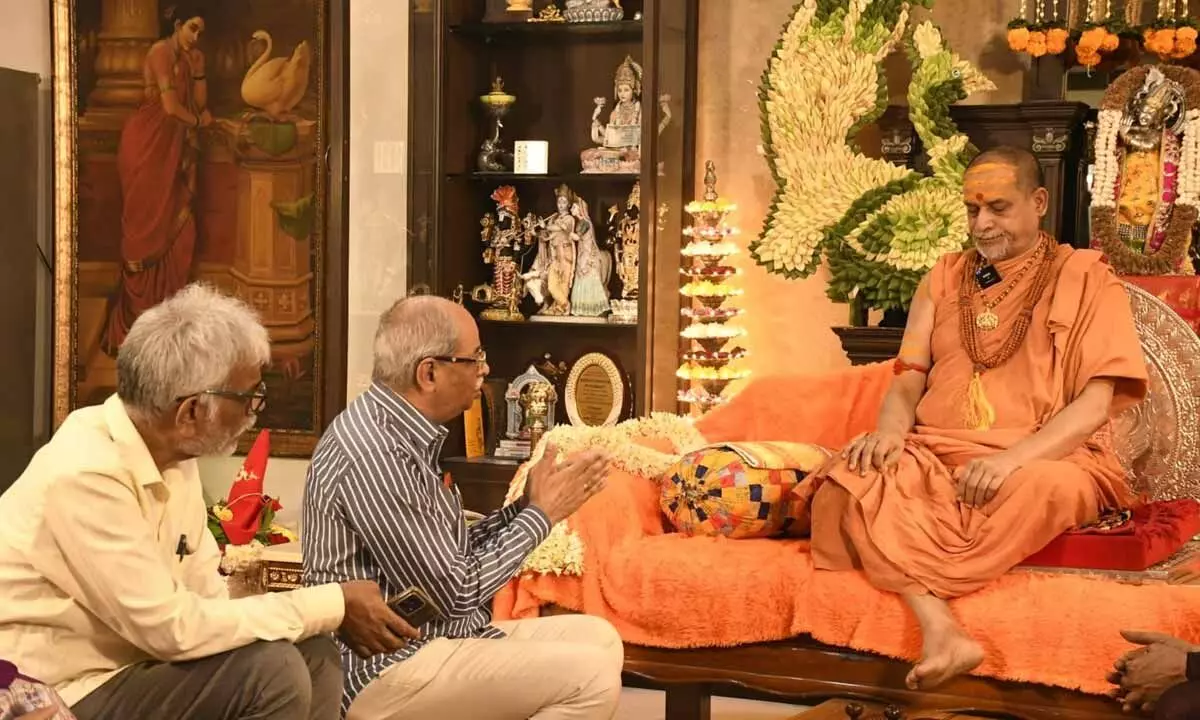
Shankaracharya Swami Shri Sadanand Saraswati, in an exclusive discussion with Hans India Editor-in-Chief V Ramu Sarma, touched upon various topics, including misconceptions about Sanatana Dharma, political rhetoric, and the need for a Sanatana Board
His Holiness Anantshree Vibhushit, Dwaraka Sharada Peethadheeshwar Sri Sri Jagadguru Shankaracharya Swami Shri Sadanand Saraswati, has observed a growing spiritual awareness among the people, particularly those in the age group of 20 to 45 years. In an exclusive discussion with V Ramu Sarma, Editor-in-Chief, The Hans India, Swamiji touched upon various topics, including misconceptions about Sanatana Dharma, political rhetoric, and the need for a Sanatana Board.
Misconceptions about Sanatana Dharma
Swamiji noted that certain political parties and leaders, who call for the elimination of Sanatana Dharma, do so without understanding its true meaning. He explained that "Sanatana" means that which cannot be destroyed. "It is unchanging and incorruptible. Sanatana Dharma has existed since the beginning of time. Just as the Quran is sacred to the Muslims and the Bible to Christians, the Vedas hold the same significance for the followers of Sanatana Dharma." He elaborated that the Vedas, along with their six branches, 18 Puranas, Upa-Puranas, Smritis, and Agamas, serve as credible scriptures for the practitioners of Sanatana Dharma. He emphasized that a true understanding of the distinction between Prachina Dharma (ancient traditions) and Sanatana Dharma can only be attained through knowledge of these sacred texts.
Political rhetoric & Call for a Sanatana Board
Swamiji criticised political rhetoric that seeks to manipulate religious sentiments for vote-bank consolidation. "Such individuals neither follow Dharma nor have the intention to uphold it," he stated. He expressed concern that the Hindus have been too generous in allowing temples to be administered by the government, unlike other religious communities that retain control over their places of worship.
He asserted that those in governance have failed to recognise their responsibility in preserving religious traditions, making the establishment of a Sanatana Board a necessity.
The lost Jyotirlinga of Dwaraka & Idol Worship
When asked about the discovery of the levitating lost Jyotirlinga of Dwaraka in Gujarat and the efforts of Gurudev Sri Sri Ravi Shankar to restore it to the Somnath temple, Swamiji welcomed the initiative. "It is a good step," he remarked. Addressing misconceptions about idol worship, he explained that some mistakenly believe that the Hindus worship mere idols.
"There is a 'Tatva' (philosophical essence) behind the 'Murthy' (idol) that is eternal and indestructible." He recounted how Mahmud of Ghazni attacked and shattered a rock but failed to destroy the Shivling itself, highlighting that the essence of divinity transcends physical destruction.
"If it were merely a rock, how could Sardar Vallabhbhai Patel have reconstructed and revived it?" he questioned. Swamiji stressed that accessing divinity in an idol requires 'Nishta' (discipline) and 'Sadhana' (perseverance).
A Spiritual Renaissance in India
Swamiji observed the revival of Sanatana Dharma, particularly among the younger generation. "A ruler's actions influence the people. When a Prime Minister, President, or Minister takes a sacred dip in the River Ganga, it sparks curiosity among the masses about its significance. This was evident during the Maha Kumbh." He noted that nearly 70% of those who participated in the sacred baths at the Maha Kumbh were between the ages of 10 and 40, including thousands of newlywed couples who took a holy dip at the Triveni Sangam. "This sends a powerful message and is beneficial for the country."
Swamiji asserted that politics should be guided by Dharma. However, post-independence, 'Dosha' (flaws) and 'Vikruti' (distortions) infiltrated the system. "Regardless of who holds power, every political party has a responsibility to uphold the country’s culture and traditions. They have no authority to alter the Sanatana Parampara (eternal traditions)," he concluded.