Tiger dancers on the prowl on Berhampur streets

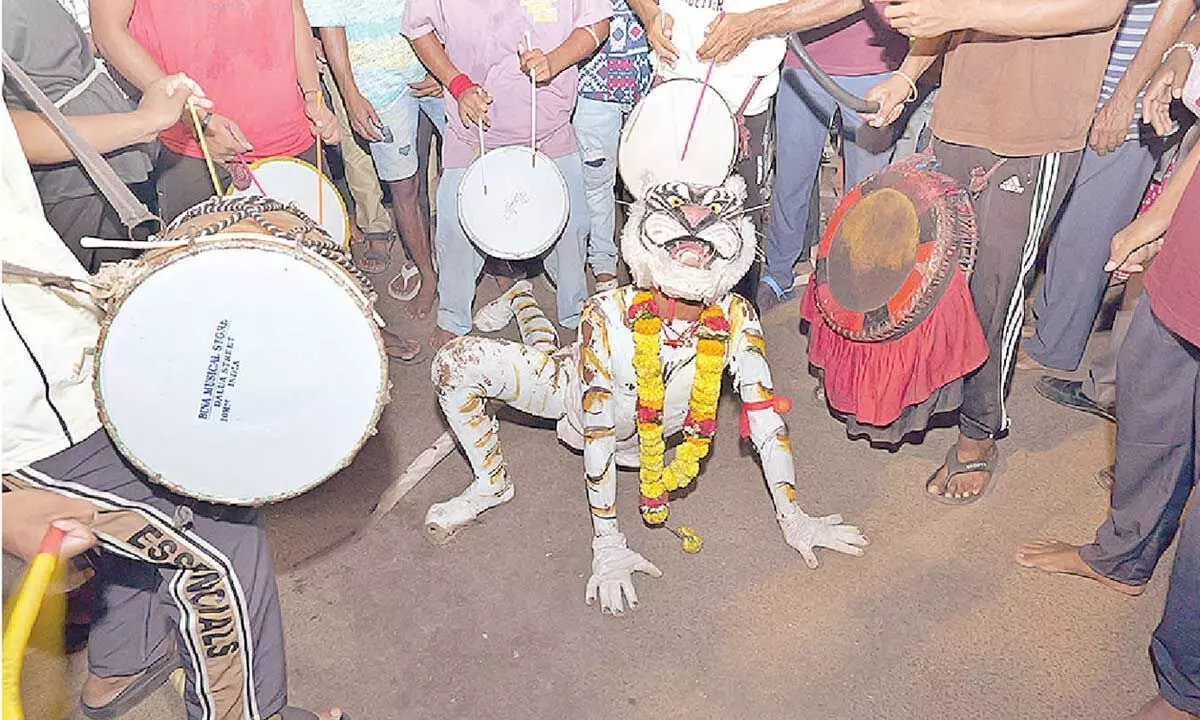
Tiger dancers are on the prowl on the streets of Berhampur. The dancers get their bodies painted as tigers and wear tiger masks to pay homage to Goddess Budhi Thakurani.
Berhampur: Tiger dancers are on the prowl on the streets of Berhampur. The dancers get their bodies painted as tigers and wear tiger masks to pay homage to Goddess Budhi Thakurani.
According to legend, Budhi Thakurani rides the tiger and by dressing up as the striped animal, a devotee secures divine blessings. Incidentally, the devotee, who dons the role of this carnivore, follows a strict vegetarian diet for at least a fortnight before his act and fasts on the day of the performance.
The tradition of Bagha Nacha or tiger dance started 125 years ago by a devotee and great artiste ‘Bagha Arjun’ of Old Berhampur, said Badri Narayan Nayak, a guru in Bagha Nacha and who has been in the field since 1983. However, he never charges anything for training tiger dancers.
The cost of Bagha Besha (attire), hiring drummers and other things comes to nearly Rs 25,000. Painting the body costs Rs 9,000, hiring three drummers and one dholki player costs Rs 12,000 and other charges are Rs 6,000, said Badri. “Most youths dress up as tigers to appease the goddess and get their wishes fulfilled,” he said.
The performer undergoes regular dance practice sessions for a minimum of two to four weeks under the guidance of a guru. The rituals are carried out by his family members. On the day of the performance, he visits the temple of the goddess.
“The donation received from the houses during the city tour is spent on offerings to the goddess and ‘Bhoga’ is distributed among friends and relatives,” added Badri.
Usually, it takes around three and a half hours to paint tiger stripes on a performer, said Raj Kumar, a resident of Chandramanipeta Street in Gate Bazar, who has been in this business for the last 22 years. He has sculpted Atal Bihari Vajpayee statue installed at Ramlingam Tank Water Park Arena. Hadia Behera, father of Raj, helps him in painting the tiger dance performers. During one season, they paint 400 men as tigers.
“My father and I have formed a group of 12 persons who are in charge of painting performers in Bagha Besha during Thakurani Yatra. The dancer’s entire body is shaved and we start painting early in the morning. In the afternoon, the dancer’s headgear, tail, lemon and ‘Kaudi’ are taken to the Yatra Mandap for puja. As dusk sets in, he gets into his act, dancing on the city streets followed by the drummers,” Raj Kumar said.
Each Bagha Nacha performer is usually accompanied by a minimum of 4 to 6 Dhampa drum beaters. The Dhampas are to be warmed up in short intervals. For this purpose, a cycle rickshaw stored with hay follows the drum beaters throughout the procession. The drum beaters light up the hay on the roadside to warm up their Dhampas.
Anybody can perform ‘Bagha Nacha’. However, traditionally, devotees promise a wish and seek goddess’s blessing to overcome a troublesome phase of life. Bagha Nacha during the Yatra is considered as thanksgiving to the goddess. Though Bagha Nacha performers need not be a professional dancer and the performers belong to different walks of life, they need regular practice sessions under the guidance of a guru.
In 2023, Badri trained a 29-year-old German who painted his body as a tiger and performed Bagha Nacha on Berhampur streets. He fell seriously ill during Covid and vowed to perform Bagha Nacha. “I taught him all the rituals of Bagha Nacha and Gayatri Mantra for five days and he later performed Bagha Nacha from 5 pm to 8 pm,” said Badri. Another youth from Visakhapatnam will perform Bagha Nacha on April 24, he said.