




- Delhi Police Detain Anti-SIR Protesters as March Towards Election Commission Headquarters Is Halted
- Telangana to host Khelo India Games in December: Minister Vakiti Srihari
- Jagan seeks appointment of amicus curiae to supervise local body polls in Andhra
- MP Congress questions Rs 575 Cr aircraft purchase by Mohan Yadav govt amid debt burden; seeks cost details
- YS Jagan addresses on local body elections, alleges YSRCP being obstructed
- India has recovered over 650 stolen ancient statues in 12 years: PM Modi
- Tirupati MP seeks removal of DIG, two SPs from Civic Poll duty
- Prabhas Birthday Special: Fauzi Poster Unveils His Mysterious Military Look
Pawan Kalyan Meets Naidu Again Over MPTC, ZPTC Seat-Sharing
In Short
Both the leaders met at Naidu’s residence and discussed various issues for over 30 minutes. It is learnt that they discussed the need to finalise the seat sharing in MPTC and ZPTC between the alliance partners at the earliest.

Share :
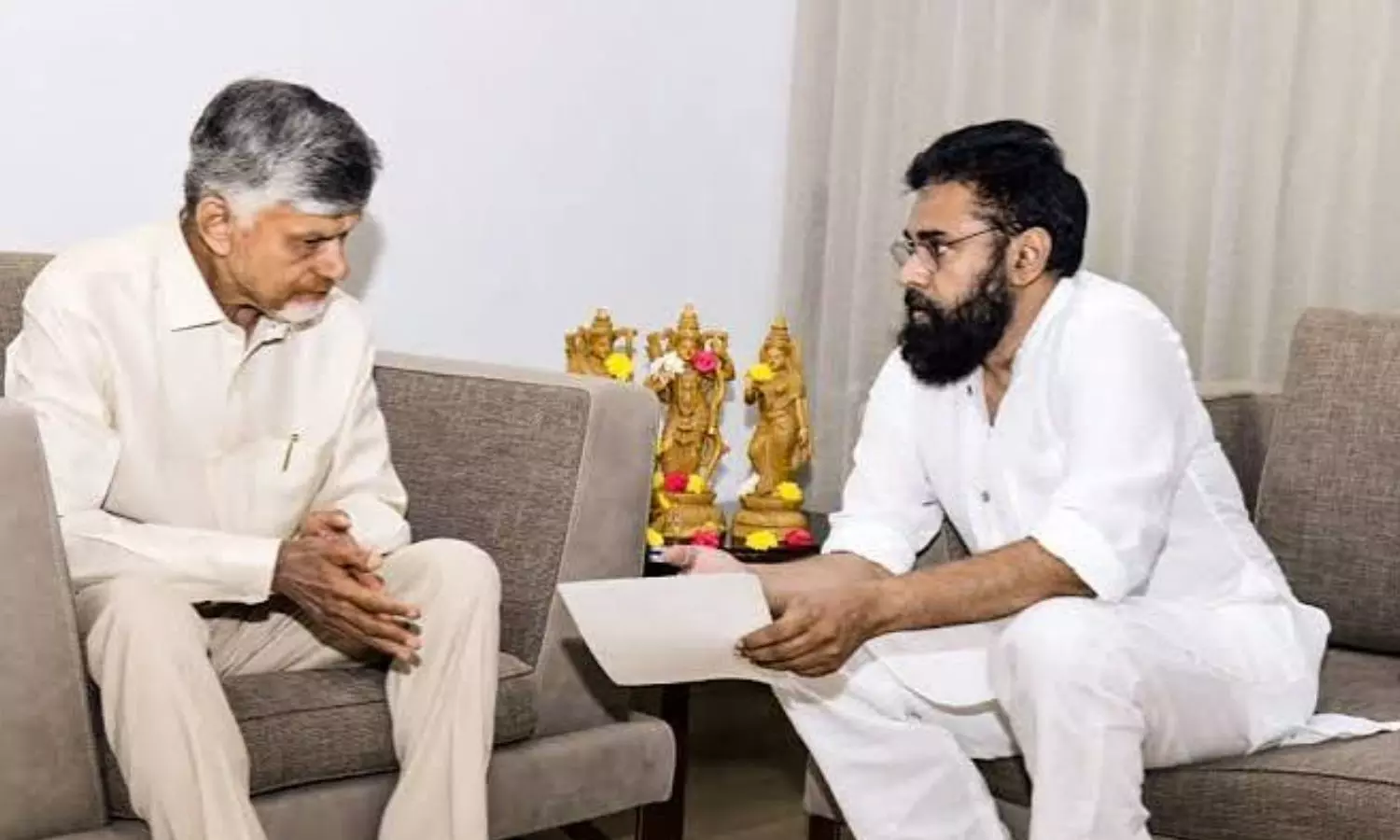
Chief Minister N Chandrababu Naidu and Deputy Chief Minister Pawan Kalyan
Chief Minister N Chandrababu Naidu and Deputy Chief Minister Pawan Kalyan had another round of one-on-one meetings on Friday to discuss the seat-sharing formula for MPTC and ZPTC elections in the state.
Both the leaders met at Naidu’s residence and discussed various issues for over 30 minutes. It is learnt that they discussed the need to finalise the seat sharing in MPTC and ZPTC between the alliance partners at the earliest.
In the absence of a clear formula for seat sharing, the aspirants of all three parties have been filing nominations. Both the leaders are believed to have discussed how to arrive at a consensus.
It may be recalled that Pawan had met Naidu on Thursday also to discuss the latest developments in view of the SC directive to State Election Commissioner to extend the nomination process for urban local body elections wherever YSRCP candidates could not file nominations due to clashes. The NDA partners had already reached a seat-sharing agreement for elections in 100 urban local bodies. The deadline for filing nominations ended on Friday evening.
Out of the total 663 ZPTCs, polling will be held for 659 ZPTCs. Similarly, polling will be held for 9,829 MPTCs out of 9,858 MPTCs in the state.
Filing of nominations began on October 21. Scrutiny of nominations will be taken up on October 24.
About 2.81 crore voters are eligible to cast their votes in elections to MPTC and ZPTC elections scheduled to be held on November 3.
According to the SEC, October 27 will be the last day for withdrawal of candidatures. The same day, a final list of candidates will be published.
Polling, wherever necessary, will be conducted on November 3. Repolling, if any, will be held on November 4. Counting of votes will be taken up on November 5.
Congress infighting behind sting operation, alleges Kumaraswamy (LD)
YS Jagan: SEC Undermining Supreme Court Directives
MP LoP Singhar questions SIR; accuses BJP of dismissing protesters as 'mob'
If Congress had not existed, India would not have been able to get a democratic system: Karnataka CM
DK Shivakumar Alleges Sting Operation Attempt Using Meta Glasses, Says Kerala CM Was Also Targeted
Congress legislator Khaira suspended for remainder of Punjab Assembly session


