EDM vs CNC Machining: Which One is Better?

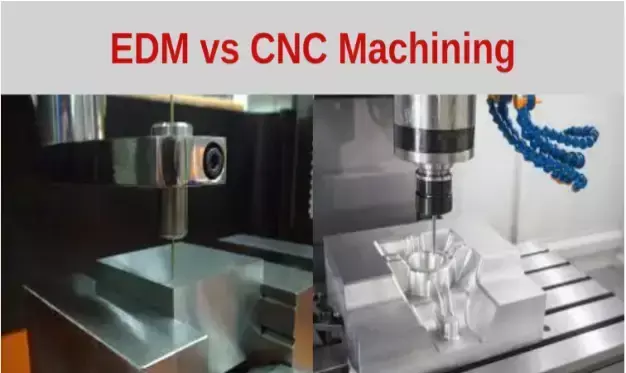
Explore the key differences between EDM and CNC machining, including precision, materials, cost, and applications, to determine which method is better for your manufacturing needs.
EDM (Electrical Discharge Machining) is a non-traditional machining process used for operations that are not achievable with conventional CNC machining. It removes material using controlled electrical sparks. This unique approach makes it possible to achieve results that are difficult with conventional methods.
Yet, many engineers are still using the CNC manufacturing process, overlooking situations where EDM machining services could deliver better results, higher quality, or even cost savings.
This guide breaks down what EDM is and scenarios where it outperforms conventional machining. For the best choice for your project, here is a comparison of EDM vs CNC machining.
What is EDM?
Electric Discharge Machining, also known as ‘spark machining,’ is a nonconventional machining process that uses thermal forces to remove materials. Both EDM and CNC machining are used to shape metal parts into the required size and shape. But EDM is an advancement that uses sparks to cut metal parts instead of cutting tools.
EDM works by using a soft electrode to generate a spark between the electrode and the workpiece. This spark causes intense heat that instantly melts and vaporizes particles of the metal.
A small voltage difference creates a spark, which instantly melts and vaporizes a tiny portion of the metal. Each spark generates intense heat in a pinpoint spot, melting or vaporizing tiny bits of metal.
This working principle applies to all three other types of EDM. The two main types of EDM in manufacturing are wire EDM and sinker EDM. In wire EDM, the wire electrodes act like a wire cheese cutter and cut hard metal parts with fine details. And in sinker EDM, the electrode is preformed into a specific geometry.
Most of the industries, like aerospace and automotive, that demand part accuracy and reduction of distortion, mostly prefer the EDM manufacturing process. But most of the time, it becomes slower for plastic, composite, and some other non-conductive materials, and here, the CNC manufacturing process outperforms.
When Does EDM Outperform Conventional Machining?
EDM produces better results in many situations. Here are 9 key aspects when EDM stands out compared to conventional CNC machining:
When Machining Ultra-Hard Materials
Material hardness is no longer a limitation, as EDM removes material with controlled electrical sparks rather than physical force. Some hard metals like titanium, tungsten carbide, and hardened steel are difficult to penetrate with cutting tools; EDM machining is ideal for these materials.
For Deep and Narrow Cavities
Conventional CNC machining often struggles when components demand extra-deep cavities. Long tools with a diameter-length ratio of 1:15 CNC can create chattering. It results in reduced accuracy and low surface quality. EDM added the advantage of not creating any burrs or chattering.
When Precise Internal Corners Are Required
The rotating tools of CNC machining leave behind small radii, even 0.05 inches. One type of EMD, specifically wire EDM, is good at cutting sharp corners when carefully choosing the right wire type.
It doesn’t matter that with rounded tools, it is difficult to achieve hard corners. The EDM process is also round, but its roundness is so fine that it easily creates round corners of a very small radius of 0.005 inches.
When Parts Need a Polished Finish
Conventional CNC machining often requires secondary finishing operations like polishing. EDM produces parts with mirror finishes. However, with the right setting and handling some parameters, it can produce polished finishes and thus eliminates the need for secondary polishing treatment.
For making molds
One of the advantages of EDM machining over CNC machining is mold-making because of its ability to cut hardened steel, create fine details, and cut deep ribs. But sometimes, industries use a CNC mill for molding before the Wire EDM for deeper cuts.
In cases where tool wear is a concern
The EDM process relies on electrical sparks, which means there is no physical cutting edge with the workpiece. Therefore, tool wear is minimal, or there is even zero chance of mechanical stresses. So, tough materials like titanium, tungsten, and even hardened steel are consistently produced with minimal or no deformation.
In case of Tight Tolerances
EDM machining tolerances often reach micron-level accuracy, as tight as +/- 0.0002”. While the cutting speed needs to be reduced for a high level of precision.
For Lights-out manufacturing
EDM offers excellent possibilities for lights-out manufacturing, as there is a low chance of error interruptions. Since it has minimal tool wear and high process stability, even a manufacturer, not an engineer, can operate around the clock with little supervision.
When Complex Geometries Are Needed
EDM is ideal for creating more complex geometries, but difficult for CNC machining.
CNC machining can hardly create complex parts due to some tool limitations, material hardness, and sometimes accessibility issues. But EDM removes these barriers by its capability to produce complex geometries.
EDM Vs CNC Machining: A Quick Overview
Although EDM machining outperforms in many situations, both technologies have their place in manufacturing and are suited to different applications.
Here is a quick side-by-side comparison of EDM vs CNC machining:
Factors | EDM | CNC Machining |
Process | No direct physical cutting, uses controlled electric sparks | Use rotatory tools for cutting and removing materials |
Part Complexity | complex shapes, deep cavities, and sharp internal corners | Geometry constraints cause limited accessibility |
Material | Only applicable for electrically conductive materials. | Applicable for a wide range of materials, from soft to medium-hard metals |
Speed | The metal removal process is slower compared to CNC machining. | Faster than EDM even for bulk material removal |
Surface Finish | Excellent mirror-like surface and eliminates secondary polishing | Tool marks require further process of polishing. Good, but not as EDM |
Production Volume | Low Production Volume | High Production Volume |
Cost | Higher per-part cost | Lower upfront cost |
Too Wear | Low or zero tool wear due to no physical contact | Tool wear is common due to friction and chattering |
Automation | Unattended manufacturing | Need operator supervision |
Conclusion:
In many cases, manufacturers don’t view them as rivals; they utilize both together. CNC for general shaping and EDM for precision detailing, all depend on your project’s material, design complexity, and performance requirements.
CNC Machining Services are often faster and more cost-effective for simpler parts and bulk production, and EDM machining stands out in complex geometries, fine surface finishes, and ultra-tight tolerances. Both machining have their place in modern manufacturing.
FAQs:
Is EDM more expensive than CNC?
Yes, EDM usually costs more per part due to slower machining speeds.
How accurate is EDM machining?
EDM achieves up to +/- 0.00004” (0.001mm) level of accuracy.
What are the types of EDM?
Wire EDM and Sinker EDM are the two main types of EDM.
What makes EDM different?
Its feature of electrically controlled sparks makes it different. It can work well on hard materials like steel, tungsten, and carbides.
Is CNC cutting expensive?
NO, generally, CNC machining is more cost-effective for simpler parts and bulk production compared to EDM.